Name: Elasmotherium, Codename: Siberian Unicorn

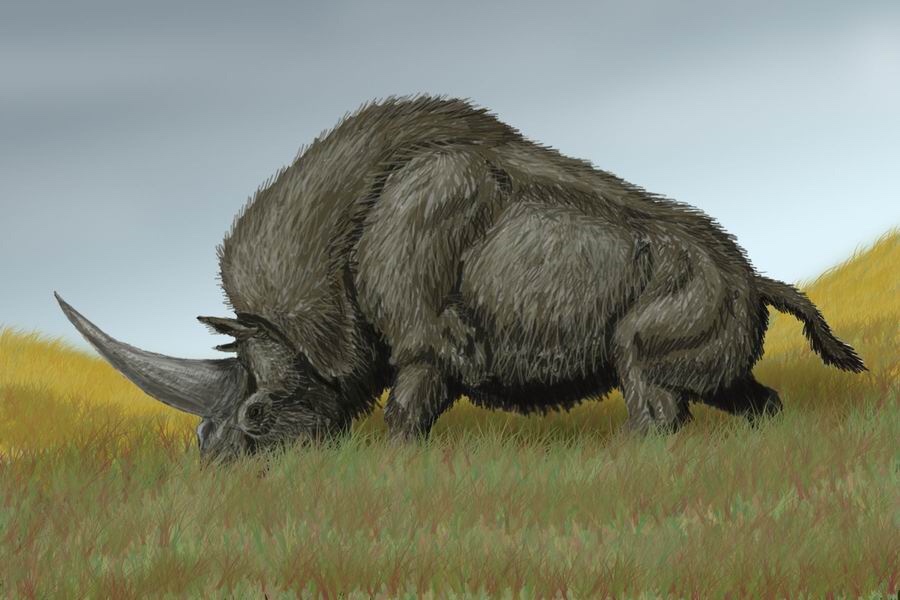
An artists impression of the Siberian Unicorn
Image Credit: DiBgd, https://fr.m.wikipedia.org/wiki/Fichier:Elasm062.jpg

One evening a man and his wife are looking on the internet for a present for their daughter’s birthday. Their daughters has repeatedly (and loudly) stated that the only thing in the world she wants this year is a real unicorn. The doting father looks for the perfect unicorn toy and after hours of searching he finds one advertised as a “one of a kind Siberian Unicorn!” It is very expensive, however the parents assume that it’s a top of the range item, after all nothing is too much for “their princess!” The day arrives, a large lorry pulls into the driveway. “Here’s your Unicorn” the deliveryman states. The ramp moves down, revealing a strange and unexpected sight; a very large, very furry rhino, possessing one very long horn. The parents look on in shock and confusion; this was definitely not the toy they ordered! Their daughter on the other hand has quite the opposite reaction. “I love him!!” She shouts joyfully as she cuddles the creatures’ thick woolly neck. None of her friends have anything like this.

The “unicorn” in this story is named Elasmotherium (meaning “plated beast”). First described in 1808 by Johann von Waldheim, this animal was a big herbivore measuring 5 metres long, 2 metres tall and weighing up to 4 and a half tonnes in the largest species (Elasmotherium caucasicum). Elasmotherium was related to modern day rhinos and a close cousin to the more famous woolly rhino (Coelodonta antiquitatis) that it coexisted with. Like its cousin, Elasmotherium possessed a thick coat of fur to keep warm in the cold of the ice age. This fur traps a layer of heat around the body, giving a layer of effective insulation. In addition Elasmotherium had a thick layer of subcutaneous fat, similar to modern day polar animals. This fat, stored partly in the animals shoulder hump (like bison) would not only keep Elasmotherium warm but would also act as a store of energy for when food was less plentiful. The most striking feature of Elasmotherium of course is its large nasal horn, which could measure longer than a human is tall. It’s thought to have had multiple uses; clearing away snow in order for Elasmotherium to reach its main food source of grass; display against rivals; and defence against predators such as the cave lion. Despite its stocky appearance it is thought that Elasmotherium could run surprisingly fast, useful for charging anything it perceived as a threat.
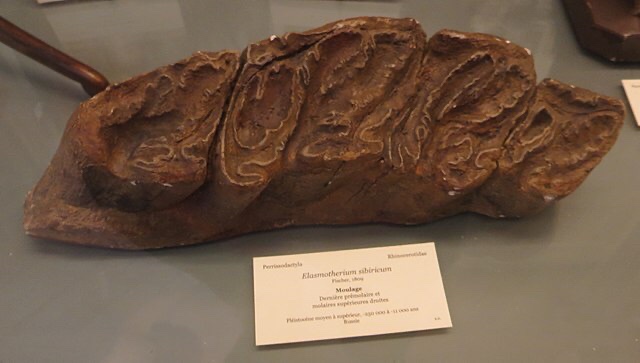
A preserved molar tooth of Elasmotherium, which it used to grind up tough grasses found on the Ice Age steppe.
Image Credit: Ghedo, https://commons.m.wikimedia.org/wiki/File:Elasmotherium_sibiricum_denti_superiori_destri.jpg

Elasmotherium was a widely successful species. Living for around 2 million years its range stretched across Eurasia, from the Ukraine in the west to Siberia in the east. Originally Elasmotherium was thought to have gone extinct around 100,000 years ago. However a study published in 2018, using radiocarbon dating, showed that this animal lived more recently than previously thought, with the new extinction date now being only 39,000 years ago. Around this time modern humans had just reached Europe and Siberia so it is thought that humans could well have come into contact with Elasmotherium. Furthermore it is speculated that this magnificent animal is the original inspiration for the legend of the unicorn. Russian folk tales tell of a great one horned beast, with the body of a bull and head of a horse, known as the Indrik. It is plausible that these stories would’ve spread west into Europe from travellers through word of mouth, evolving over the generations into the story of a one horned horse. There is even a very slight possibility that the Siberian Unicorn could be brought back, or at least a rhino/Elasmotherium hybrid. This is because DNA has been extracted from younger Elasmotherium fossils. Unfortunately, as the DNA is too fragmented to be used for cloning, this is still in the realm of science fiction for now. However this DNA can still give us details on its evolutionary history, showing that Elasmotherium was the last survivor of a lineage that spilt from modern rhinos 43 million years ago.

An Elasmotherium skeleton on display at Azov History, Archaeology & Palaeontology Museum. Note the lack of a horn. This is due to horns not fossilizing. However we can estimate its length from measurements of the attachment point and comparison with other rhinos.
Image Credit: Altes, https://commons.m.wikimedia.org/wiki/File:Elasmotherium_skeleton,Azov_Museum(1).jpg

So Elasmotherium was a spectacular example of the large megafauna that existed at the end of the last ice age. It also proves, if you believe the speculations, that there really were unicorns. They just were bigger, bulkier and more bad tempered than you might think!

UPDATE! (20/11/2021)

New research conducted by Titov, Baigusheva & Uchytel 2021 has shown that the head of Elasmotherium looked very different to what was once thought! From examination of more complete Elasmotherium skulls they have found that section of the skull beneath where the “horn” was was hollow, and would have supported an extended nasal cavity. This delicate structure was protected by a bony structure with a backwards facing top part. This structure was covered in keratin and gave it a horn that looked (at least to me) a bit like an iron. The extended cavity within would’ve given Elasmotherium an enhanced sense of smell, and it’s suggested that it might have enabled it to increase the volume and range of the sounds it made (calls, grunts etc.). Furthermore, this horn was sexually dimorphic (being larger in males than in females, and therefore probably having display and signalling functions) and still could’ve been used to clear away snowfall to reach succulent grasses that were located using smell!

In short, Elasmotherium didn’t have an almost 2 metre long spear on its head. But an iron shaped, all in one grass detector, snow plough, megaphone and advertising board!

References/Further Reading

Kosintsev et. al. 2019 paper on the evolutionary history and extinction of Elasmotherium

Kosintsev, P., Mitchell, K.J., Devièse, T. et al. Evolution and extinction of the giant rhinoceros Elasmotherium sibiricum sheds light on late Quaternary megafaunal extinctions. Nat Ecol Evol 3, 31–38 (2019). https://doi.org/10.1038/s41559-018-0722-0

A Natural History Museum article, written by Josh Davis, on new dating of Elasmotherium, that showed that it may have lived alongside Modern Humans

Davis, Josh, “The Siberian unicorn lived at the same time as modern humans”, Natural History Museum, Nov. 26, 2018, nhm.ac.uk/discover/news/2018/november/the-siberian-unicorn-lived-at-the-same-time-as-modern-humans.html

A ThoughtCo article, written by Bob Strauss, giving information on Elasmotherium’s lifestyle, evolutionary history and links to the mythical unicorn.

Strauss, Bob. “Elasmotherium.” ThoughtCo, Feb. 11, 2020, thoughtco.com/elasmotherium-plated-beast-1093199.
Smilodon: The Sabre-Tooth (not a) Tiger

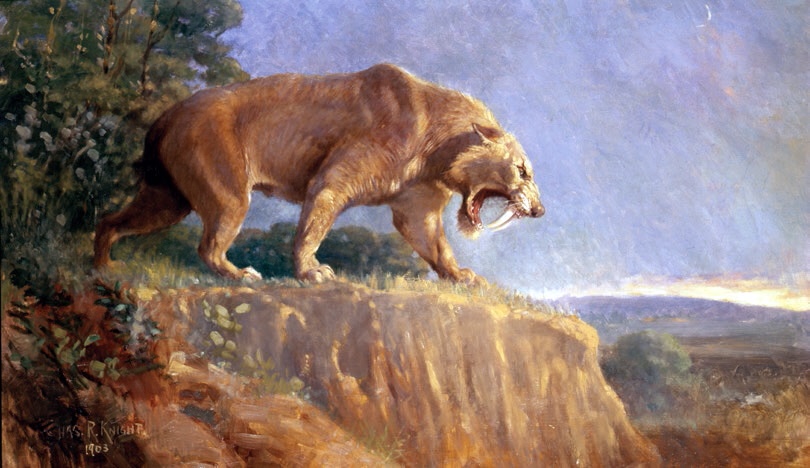
Smilodon looking over his kingdom
Image Credit: Charles R Knight, http://www.charlesrknight.com/dinosaur-artist-charles-r-knight/Knight%20article.pdf

Right, I’m going to start off by clearing up a common misconception. Despite often being called it in popular media Smilodon was NOT a Sabre-Toothed Tiger, or related to tigers at all! It was a Sabre-Tooth Cat (or Machairodontinae if you want to get technical). Also, the term “Sabre-Tooth Cat” refers to the family that Smilodon is a part of rather than just Smilodon itself. Other examples of Sabre-Tooth Cats include; Dinofelis, which lived across Africa, Eurasia and North America during the Pliocene to the Early Pleistocene (5.5-1.5 million years ago) and has a reputation for being a hunter of Australopithecus and other early human ancestors (which it may or may not have done). Another example is Homotherium, a smaller Sabre-Tooth Cat species which lived around the same place and time as Smilodon.

With that out of the way, let’s find out more about this large and rather striking extinct kitty.

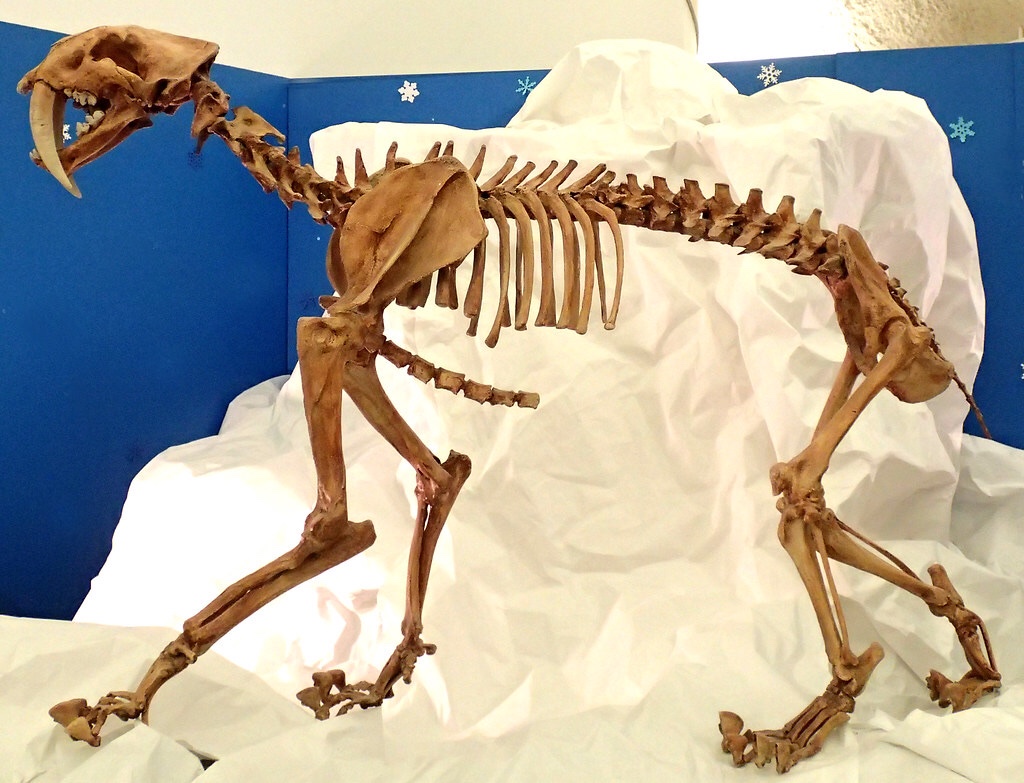
To start with, the first piece of anatomy that everyone notices when looking at Smilodon is its large sabres (which could measure up to 28cm long – almost as long as a school ruler!). Contrary to popular belief Sabre-Tooth Cats like Smilodon were not the first animals to evolve sabre teeth. That title instead goes to animals like the Gorgonopsids, a group of “mammal-like reptiles” that lived in the Late Permian period around 265-250 million years ago. They, and other “mammal-like reptiles” are a fascinating group of animals in their own right which I’m sure I’ll tackle in a later blog. While the sabres in Smilodon look very formidable they were actually surprisingly fragile, and could break easily if used for usual ripping and slashing attacks. Smilodon also had a relatively weak bite, and needed to open its mouth very wide in order to extend the sabres out fully. As a result it is thought that the sabres were used for careful, quick surgical bites to the prey’s neck in order to puncture the neck and ensure a quick end without too much struggle. The iconic positioning of these sabre-teeth is that they’re exposed on the outside. While this continues to be scientific consensus there have been suggestions that Smilodon and other sabre-tooth cats may have had fleshy lips covering them instead.

A reconstructed skeleton of Smilodon fatalis from the Sternberg Museum of Natural History in Hays, Kansas, USA. As you see the sabre-teeth are certainly eye-catching!
Image Credit: James St John, https://www.flickr.com/photos/jsjgeology/15420386216

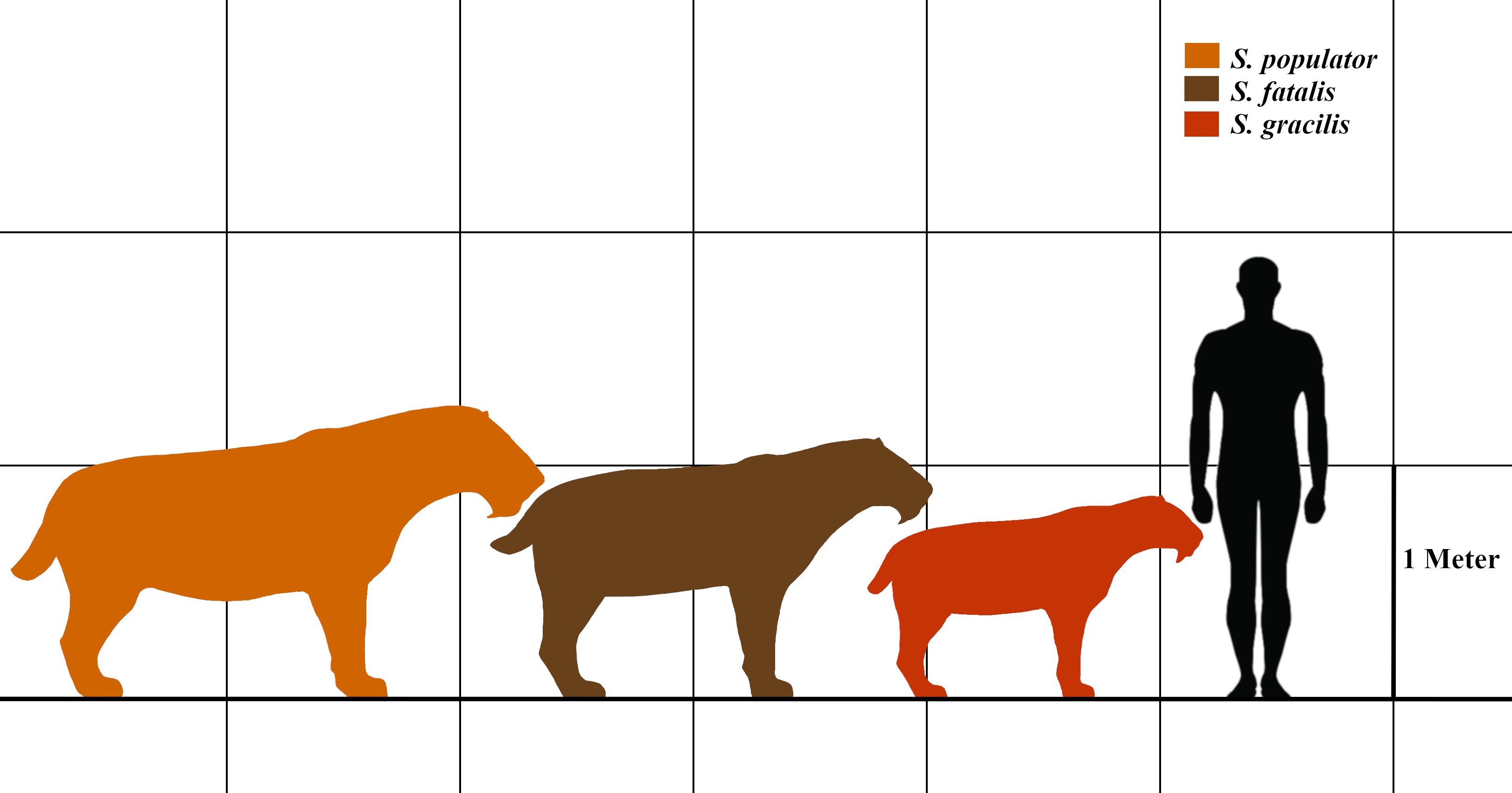
There are other parts of Smilodons anatomy that also set it apart from modern day big cats. It was larger and more heavily built than a modern lion or tiger, measuring up to 1.5 metres long, a metre high and weighing up to 400 kilograms. Smilodon also possessed thick front leg bones with big muscle attachments. This suggests that Smilodon would not have been a pursuit hunter, but instead an ambush predator, stalking its prey, getting close and then leaping out and pinning them down using their powerful front legs, before then employing the sabres. In terms of behaviour it was a matter of debate as to whether Smilodon lived in prides (like lions) or were solitary like tigers, with reconstructions, paleoart and documentaries switching between the two. However some fossil Smilodon show previous serious injury and not only managed to recover but live to an old age. Also a joint study in 2008 by the Zoological Society of London and the University of California, assessed the large number of Smilodon remains found at Rancho La Brea Tar Pits who had turned up at the tar pits in response to prey distress calls. They compared these with the numbers of modern African predators that turned up to similar distress calls at similar traps. The results showed that the number of Smilodon found compared well to the numbers of pack hunting animals, such as lions and hyenas. Both of these observations indicate that these sabre-toothed cats lived in packs. (On a side note; Rancho La Brea is in my top 5 places to visit in the world!)

Smilodon fossils have been found across the Americas, having first evolved in North America before migrating to South America via the newly formed Isthmus of Panama land bridge. The first fossils, being of the South American species Smilodon populator, were discovered by Lund in Brazil in 1840. Further species discovered, all mostly based in North America, include; Smilodon fatalis (discovered by Leidy in 1869) and Smilodon gracilis (discovered in 1880 by the legendary Edward Drinker Cope of dinosaur fossil fame). Of these species Smilodon populator was both the youngest, evolving only 1 million years ago, and the largest.

A size comparison between 3 different Smilodon species and an average human. Smilodon populator of South America was the largest, followed by the North American Smilodon fatalis and Smilodon gracilis.
Image Credit: Aledgn, https://commons.m.wikimedia.org/wiki/File:Wiki_Smilodon_Size.png

Such a beautiful cat would be a sight to witness across the American plains. Sadly, like the rest of the megafauna that lived alongside them, they died out during the last Ice Age around 10,000 years ago. A few reasons have been suggested for this; competition with humans for prey being one of them. However it is likely that a changing climate, resulting in habitat reduction, and the loss of the large megafauna that Smilodon preyed on (which could have partly been a result of human hunting) were the main reasons. With large prey gone and with Smilodon not having the endurance to hunt the smaller, swifter mammal herbivores that remained, their numbers dwindled.

Still, Smilodon has gone down in history as one of the most striking extinct animals yet described. Its sabres have repeatedly captured the imagination of generations of people in museums and in popular media. Personally I’m sure of two things about Smilodon:

1. If I had to pick a fossil skull to own, it would be one of these sabre tooth cats, and

2. If one of them could speak it would have the voice of Denis Leary!

EDIT: A small addition to this blog. As well as being found in the USA Smilodon fatalis has also recently been discovered to live as far north as Canada, with the paper describing the new Canadian fossils (Reynolds, Seymour & Evans 2019) only published in January 2019.

References/Further Reading

Carbone et. al. 2008 paper on pack hunting behaviour in Smilodon

Carbone, Chris, Maddox, Tom, Funston, Paul J, et. al., (2008), Parallels between playbacks and Pleistocene tar seeps suggest sociality in an extinct sabretooth cat, Smilodon, Biol. Lett.5, 81–85, https://doi.org/10.1098/rsbl.2008.0526

An interesting blog by Mark Witton, published on his blog site, on exposed teeth in Paleontological reconstructions. Smilodon is one of the animals he talks about.

Witton, Mark, “Exposed teeth in dinosaurs, sabre-tooths and everything else: thoughts for artists”, markwitton.com/blog, Oct. 9, 2016, markwitton-com.blogspot.com/2016/10/exposed-teeth-in-dinosaurs-sabre-tooths.html

Christiansen & Harris 2005 paper, published in Journal of Morphology, on body size estimates of three Smilodon species

Christiansen, P. and Harris, J.M. (2005), Body size of Smilodon (Mammalia: Felidae). J. Morphol., 266: 369-384. doi:10.1002/jmor.10384

Reynolds, Seymour & Evans paper on the Canadian Smilodon fatalis fossils (For the EDIT).

Reynolds, A. R., et al. (2019). “Late Pleistocene records of felids from Medicine Hat, Alberta, including the first Canadian record of the sabre-toothed cat Smilodon fatalis.” Canadian Journal of Earth Sciences 56(10): 1052-1060.