Giganotosaurus: Giant Southern Hunter

The Giant Southern Hunter compared with a human. As you can see, it was truly a colossal predator!
Image Credit: Durbed, https://www.deviantart.com/durbed/art/Giganotosaurus-carolinii-290866454

In the issue of Empire magazine (released 9th of April 2022), Colin Trevorrow; director of the upcoming film “Jurassic World: Dominion”, talks about the appearance in the film of a Giganotosaurus. He describes Giganotosaurus as “like the Joker” in that “it just wants to watch the world burn”, referencing a quote from the Christopher Nolan film “The Dark Knight”. This didn’t fill me with high hopes for this dinosaur’s portrayal in the film, and instead symbolizes a problem the Jurassic franchise has had since Jurassic Park III; dinosaurs being portrayed as movie monsters, rather than as animals. If any dinosaur started acting like the Joker in behaviour, then it wouldn’t sit well with me because it is applying “human” traits (albeit those of a psychopathic clown!) onto an animal. The animal kingdom can be full of what we might consider dark, cruel and disturbing behaviour. However, there is a difference between giving an animal traits that are plausible based on how the natural world is, and traits that are just not realistic to what an animal would do. I bring this up not to be the stereotypical accuracy obsessed paleo nerd moaning about dinosaur portrayals in popular media (that deserves a blog article of its own). Instead, it is to show why it’s important for any media that communicates palaeontology to have animal behaviour, even speculative ones, that is plausible; people will watch it and believe that what they’re seeing on screen may have at least an element of truth. For example, AppleTV+’s Prehistoric Planet, while being a documentary series rather than a blockbuster film, also has speculative behaviour. But what it does well is that it is behaviour that has a basis in nature (and especially in the animals closest living relatives). Furthermore, it’s behaviour that stems from animals just trying to survive, rather than from more human like motivations. Since a lot of the mainstream publics exposure to dinosaurs is through the Jurassic Park/World series, any unrealistic behaviour that’s shown in these films going to be more embedded into the public consciousness. So, people may come away with thinking that Giganotosaurus was psychopathic. A monster, rather than animal.

So, to link this rant with this blog article, what would the real Giganotosaurus have been like?

Giganotosaurus carolinii (meaning “Carolini’s Giant Southern Lizard, named after it’s discover, the fossil hunter Ruben Dario Carolini), was a large theropod dinosaur that lived roughly 99-96 million years ago in the Patagonia region of Argentina, South America during the “Cenomanian” stage of Late Cretaceous. Its fossils were first found in 1993 and later described in 1995 by Coria & Salgado. These fossils showed that Giganotosaurus had a relatively low skull, robust hind limbs and vertebrae, a reduced shoulder girdle and slightly less forward-facing eyes compared to other large theropods. Furthermore Giganotosaurus and its close relatives (but unlike other large theropods such as Tyrannosaurs), possessed three fingers on each hand rather than two. Giganotosaurus’ skull was also proportionally large compared with its body and was truly massive even for a large theropod (with estimates of up to 1.95 metres long!). You might think such a large head would’ve been a burden, but it was supported by huge neck muscles and had openings in the skull bones, called “fenestrae”, that lightened the skull without sacrificing strength. Also, just like other dinosaurs Giganotosaurus would’ve had a system of air sacs spread throughout its skeleton. These lightened the bones further while also allowing for an extremely efficient, bird like respiratory system where air passed from the lungs into the air sacs during inhalation, then passed from them back through the lungs on expiration, ensuring that a higher proportion of oxygen can be extracted, therefore more is available for aerobic respiration and therefore more energy is available to fuel its metabolism.

A skeleton of Giganotosaurus carolinii on display at the Fernbank Museum of Natural History in Atlanta, Georgia.
Image Credit: Jonathan Chen, https://commons.wikimedia.org/wiki/File:Giganotosaurus_at_Fernbank.jpg

Giganotosaurus belonged to a group of theropod dinosaurs known as the Carcharadontosauridae. These medium-large theropods were generally among the largest land predators around during the early, mid and early stages of the Late Cretaceous, and have been found in most continents, including Africa, North America and Asia as well as South America. The group eventually went extinct sometime in the Late Cretaceous (roughly 80-85 million years ago), with climatic changes playing a role in their downfall. One other suggested theory for their extinction was that they were outcompeted by newer large theropods, with the Tyrannosaurs being one such group. This is not thought to have been the case anymore, with the incredibly short armed, blunt faced Abelisaurs and the long limbed, large clawed Megaraptorans in the south, and the famous Tyrannosaurs in the north instead growing larger and taking advantage of the open niches left vacant by the Carcharadontosaurs.

This Tyrannosaur connection goes further when it comes to Giganotosaurus. When it was revealed to the world via the Coria & Salgado paper in 1995, Giganotosaurus instantly made headlines as theropod dinosaur that was bigger than Tyrannosaurus rex! As a result (since Spinosaurus fossils other than the ones destroyed in World War Two had yet to be described) this made Giganotosaurus the largest known theropod dinosaur at the time. However, there are always caveats with grand statements like this. The chance that any animal will fossilise is incredibly small. Giganotosaurus itself is only known from two partial individuals out of a total population that likely numbered in the tens to hundreds of millions across the entire existence of the species. Therefore, we barely have a minute sample of the total population. So, whilst Giganotosaurus was colossal, with size estimates ranging from 12.5-13.2 metres long and weights between 6-8 tons, it’s hard to say whether this was an average size for this species or not. We may not have discovered the largest Giganotosaurus, just as we may have not found the largest T. rex. So it’s hard to say which animal was bigger based on our small sample sizes. But from what we DO have, on average Giganotosaurus may have been slightly longer, but T. rex was generally heavier. Since mass is often more important when it comes to judging who’s “bigger” (more mass = more muscle and power), T. rex might have been the bigger animal on more occasions. But, this can easily change as more fossils are discovered! This conclusion is further helped by the discover, after Giganotosaurus had been described, of “Scotty”; a Tyrannosaurus bigger than any previously known T. rex specimen. But not to worry Giganotosaurus fans, there would have been size variation within both species. So some Giga’s may have been bigger than some Rexes. This argument also applies to the largest sauropod dinosaurs. Argentinosaurus is considered by many to be the largest sauropod (and largest land animal) that we know of, but there is a lot of overlap with other large sauropods like Patagotitan and Maraapunisaurus. Also, as a quick side note, there’s a trope in media and with dinosaur fans (and I’m guilty of this too!) where any new supersized theropod is always compared to T. rex! There’s no doubt that T. rex is a superstar, but it’s a little annoying that it’s always this benchmark, and that any new theropod that’s even remotely close in size has to be compared to the Rex rather than known purely as its own thing.

A large body size was vital for Giganotosaurus as it allowed it to hunt the big Sauropod Dinosaurs that it lived with, such as the Titanosaur Andesaurus. However despite this, even one Giganotosaurus might not have been enough to take an adult on. So, like any large carnivore Giganotosaurus may have focused on sub-adults, or already weakened adults, or gone after smaller dinosaurs, and scavenged if the opportunity arose. If, that is, it was alone! Fossils of a very close relative of Giganotosaurus (also discovered in Patagonia from slightly older rocks) named Mapusaurus, have been known from multiple individuals of different ages that appear to have been buried together at the same time and place. This has led some to suggest that it, and potentially Giganotosaurus, hung around in groups. So if this giant carnivore wasn’t intimidating enough, imagine a whole group of them! The numbers would have helped to even the odds when hunting giant sauropods. Giganotosaurus was also equipped with sharp, slicing teeth that were like steak knives, perfect for slicing through chunks of flesh and causing, as some documentaries would say, “shock and blood loss”. Furthermore, it’s strong forearms and sharp claws would enable it to grip larger prey, supporting it as it bit and slashed at them. It wouldn’t have hunted just sauropods though, with South American iguanodontid dinosaurs also being on the menu. These could be sprightlier than a sauropod, but Giganotosaurus has been calculated (in Blanco & Mazzetta 2001) to have been capable of reaching speeds of up to 14 metres per second (roughly 31 mph), which is roughly the same as a Grizzly Bear. This would’ve been more than enough, combined with surprise (or at least, as much surprise as a near 13 metre, 6-8 ton giant could get!) to ambush and kept up with its prey. Furthermore, even if the initial attack didn’t finish the job those slicing teeth would inflict deep wounds. The resulting blood loss would weaken the prey considerably, so all a Giganotosaurus (or a group/mob/gang of Giga’s) would need to do is follow and wait.

A close up of Giganotosaurus‘ enormous head, from the same Fernbank Museum skeletal mount. Note the multiple blade like teeth.
Image Credit: James Emery, https://www.flickr.com/photos/emeryjl/3583031860

The idea that Giganotosaurus might have run around in groups raises interesting questions. What would interactions between Giga’s have been like? First off, if they did hunt in groups, it is unlikely that Giga’s would’ve been co-ordinated pack hunters, nor that they had a pride like social structure as Lions do. Just because large carnivores are found buried together doesn’t necessarily complex social groupings, neither does it indicate they had the co-operation to plan lion-like hunting strategies. Instead, it’s more likely they would’ve been more like congregations of Komodo Dragons, Crocodiles or certain Birds of Prey; opportunistic joining together to gang up on prey, but with no co-ordinated strategy. As such when it came to feeding there may have been a free for all! This is where large size would’ve helped. Larger individuals can throw their weight around and intimidate other Giga’s into backing off a juicy part of the carcass, or one that’s being scavenged by another Giga or other large predator. Larger size may also have been a factor in males warding off other males, or females intimidating other females, for the right to attract a mate, with a larger body size equaling a more fit, healthier and therefore more attractive partner. It must also be remembered that even huge carnivores like Giga’s would’ve started as smaller, less able youngsters. Parental care within large carnivorous dinosaurs is often somewhat speculative, as unless there’s a bonebed that preserves multiple individuals of different ages (as has been found with some Tyrannosaurs) or a trackway containing a mix of adults and juveniles together we can only make educated guesses for any animal. In the case of Carcharadontosaurs like Giganotosaurus, as an enthusiast, my own educated guess is that there possibly was some parental care initially (as seen in birds and crocodilians) but then the young would eventually have to fend for themselves. Adolescent Giga’s, being smaller than the adults, likely focused on smaller dinosaurs, the babies of larger dinosaurs, and smaller reptiles and mammals as they were too small to take on giant sauropods. In this way the adolescents would’ve filled a different ecological niche from the adults; the role of medium sized “mesopredator”. Alternatively they joined a gang of adult Giga’s on occasion, picking up the scraps initially inbetween the larger adults. Or maybe they did a mixture of both! These are just ideas I’m throwing around, but maybe in the future there will be an exceptionally preserved fossil or trackway that will give more insight into their behaviour.

Giganotosaurus isn’t the Joker, but an extinct animal whose size and predatorial abilities have made it well known among the paleontological community. Soon, as a result of “Jurassic World Dominion” and other future paleo media, it will be more well known among the general public too, for better or worse!

A scale comparison of some of the largest mega theropods. The Giganotosaurus used in this is on the larger scale compared to the T. rex, which based on the “Sue” specimen (though we now have the even larger “Scotty” specimen). However this T. rex may have been just as if not heavier and there is a lot of overlap between the two!
Image Credit: KoprX, https://commons.wikimedia.org/wiki/File:Longest_theropods.svg

References/Further Reading

• Coria & Salgado 1995, the paper that described the first known fossils of Giganotosaurus carolinii, which had been unearthed 2 years prior.

https://www.nature.com/articles/377224a0#citeas

Coria, R., Salgado, L. A new giant carnivorous dinosaur from the Cretaceous of Patagonia. Nature 377, 224–226 (1995). https://doi.org/10.1038/377224a0

• Calvo & Correa 1998, a follow up paper describing a second specimen of Giganotosaurus that was roughly 8% bigger than the holotype (i.e., the reference specimen that is used as the example of that species and is the specimen all new discoveries are compared to).

https://www.researchgate.net/publication/40662857_New_specimen_of_Giganotosaurus_carolinii_Coria_Salgado_1995_supports_it_as_the_largest_theropod_ever_found

Calvo, Jorge & Coria, Rodolfo. (1998). New specimen of Giganotosaurus carolinii (Coria & Salgado, 1995), supports it as the largest theropod ever found. Gaia. 15.

• Blanco & Mazzetta 2001 paper that evaluated the cursorial abilities of Giganotosaurus.

https://agro.icm.edu.pl/agro/element/bwmeta1.element.agro-article-78acb920-1953-4e1e-85e5-a2ae1686dc49

Blanco, R. E., & Mazzetta, G. V. (2001). A new approach to evaluate the cursorial ability of the giant theropod Giganotosaurus carolinii. Acta Palaeontologica Polonica, 46(2).

• A blog post on fossilera.com by Ashley Strack which gives a wonderful outline of Giganotosaurus, including its discovery, paleobiology, behaviour and more!

https://www.fossilera.com/pages/giganotosaurus-cretaceous-terror-of-argentina

Strack, Ashley, “Giganotosaurus: Cretaceous Terror Of Argentina”, FOSSILERA, www.fossilera.com, https://www.fossilera.com/pages/giganotosaurus-cretaceous-terror-of-argentina

• The Prehistoric Wildlife fact page on Carcharadontosauridae.

http://www.prehistoric-wildlife.com/articles/carcharodontosauridae.html

Prehistoric Wildlife, “Carcharodontosauridae”, Prehistoric Wildlife, www.prehistoric-wildlife.com, http://www.prehistoric-wildlife.com/articles/carcharodontosauridae.html

Xiphactinus: The Beautiful Bull of the Sea

File:XiphactinusDB cropped.png - Wikimedia Commons
An artists impression of Xiphactinus, showcasing its characteristic face, jaws and Tarpon-like body.
Image Credit: Dmitry Bogdanov, https://commons.wikimedia.org/wiki/File:XiphactinusDB_cropped.png

The large (but masked and socially distanced) crowd bubbled with excitement as the artist they had come to see readied himself for the presentation of his masterpiece. Behind him is a large rectangular box covered by a brown sheet. His nervous hands sending flutters through the sheet he is holding, he readies himself for the biggest moment of his life.

“This is my latest and greatest work. An unknown fish pulled from the deep ocean, presented and preserved in exquisite detail in the box behind me using a formalin solution!”.

“I give you. Beauty!”

The artist pulls off the sheet, revealing a 5 metre long fish with upturned, bulldog like jaws filled to the brim with razor sharp teeth! The crowd are in complete shock. Beauty is not a word that comes into their mind. After the surprise wears off the crowd grumble their disappointment.

“Is this another example of unfathomable modern art? One naysayer says.

“Didn’t Damien Hirst once do something like this?” another asks

“I don’t get it? It’s just a weird looking fish?” yet another comments

After a while the crowd, once expectant and now disappointed, move on. The sounds of their footsteps carrying them away from the scene are accompanied by the cries of despair of the disappointed artist. Eventually only one person remains. A shaggy haired man who looked like he hadn’t had a haircut for months stares intently at the fish. He approaches the artist, who is wiping away his tears.

“Firstly, that is indeed beautiful!”

“Oh really?! That means so much! Thank you!” the artist replies with excitement.

“Secondly” the shaggy haired man continues. “Where did you get this fish?! It’s supposed to have been extinct for 66 million years?!!”

First discovered in Kansas, USA, in 1870 and named by Professor Joseph Leidy of the University of Pennsylvania; Xiphactinus (Latin for “Sword-Ray”) was a huge fish that had the size and power to compete with the large Sharks and even the medium sized Mosasaurs that it shared the oceans with. Two species of Xiphactinus are currently known to science. The first is Xiphactinus audax. This was the first species discovered, and is the larger of the two. X.audax had a wide geographical range, with fossils being discovered across North America from Saskatchewan in Canada, to Texas, New Jersey, Mississippi, Georgia and Delaware in the United States. The second species is Xiphactinus vetus. This species was discovered much more recently in 1997 and is known from the Eastern United States. This large range is just the North American distribution however! Fragments of an upper jaw bone and vertebrae from Xiphactinus audax were discovered in Patagonia in Argentina, South America, and described in 2020. These finds have expanded its range much further south west than was previously thought. Furthermore Xiphactinus fossils have also been unearthed in Western Europe and even as far as Australia. This almost worldwide distribution indicates that you would’ve had a good chance of spotting a Xiphactinus no matter where you ventured in the Late Cretaceous seas and that this multi-fanged fish was an incredibly successful animal for its time.

The most striking feature of Xiphactinus was undoubtedly its short, bulldog like face complete with a protruding and upturned lower jaw. This face was attached to a sleek, streamlined body complete with a “wing-like” pair of pectoral fins, a backward pointing dorsal fin, downward facing pelvic and anal fin, a broad tail and smooth scales. In essence Xiphactinus would’ve looked like a modern day Tarpon but larger and with a blunter, more fanged-teeth filled face. Just like the tarpon Xiphactinus was built for speed. Powerful strokes from its tail accelerated it through the water, and combined with jaws filled with large and sharp teeth would’ve made Xiphactinus a formidable hunter. This appearance is unique and begs the question; who was Xiphactinus related to? Well, Xiphactinus was a member of the Teleosts, a large group of bony fish which are also known as the “Ray-Finned Fish”. Teleosts are a massively successful group, so much so that they make up nearly 96% of all modern fish species, and nearly half of all modern vertebrate species. Yes, this includes ALL mammals, birds, reptiles, amphibians and other fish alive today! Within this huge Teleost group Xiphactinus belonged to a family known as the Icthyodectidae; a family of fish that became totally extinct at the end of the Cretaceous period 66 million years ago, leaving no living descendants.

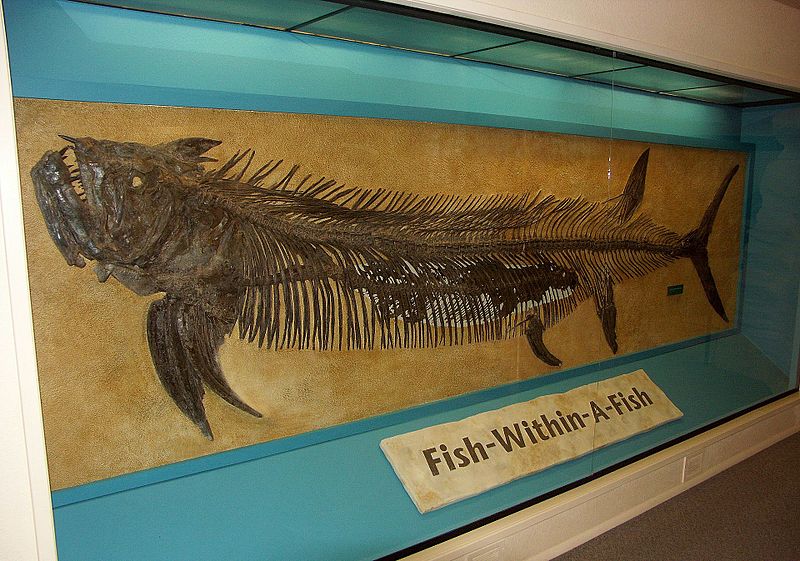
The diet of Xiphactinus included Fish, Small Marine Reptiles, Ancient Seabirds (e.g. Hesperornis, a flightless human sized seabird from the USA) and even Pterosaurs. These potential prey items would have not been easy to catch. But Xiphactinus had a secret weapon. It is theorized that it was endothermic, meaning that it could generate and maintain a higher body temperature than the surrounding environment (in a similar way to mammals and birds). This is actually not unheard of for a fish, who are usually thought to be exothermic, meaning their body heat is determined largely by their surroundings. Bluefin Tuna, Swordfish and Great White Sharks are also able to maintain a higher body temperature, independent of their environment. This strategy gives them the potential to produce the heat (and therefore energy) required to be fast active predators who can swim at high speeds. With this in mind maybe Xiphactinus could’ve leapt out of the water to grab flying animals or while hunting water bound animals in a manner akin to a Great White Shark! Obviously this is speculative behaviour, but what a sight that would have been if it did pull off such manoeuvres! Some remarkable fossils of Xiphactinus have allowed palaeontologists to gain further insight into its hunting behaviour. One fossil, discovered in 1952 at Smokey Hill in Kansas, USA, and stored in the Sternberg Museum (also in Kansas), preserves a complete 4 metre long Xiphactinus skeleton in the process of swallowing a 2 metre long fish named Gillicus. That’s right this Gillicus was half the size of Xiphactinus! It seems that this Xiphactinus perished due to a combination of choking and its internal organs being punctured by the struggling Gillicus. Such a hunting strategy would also helped explain the large fang like teeth and upturned jaw. The teeth would’ve pierced and held the animal in place while the up and down movement of its lower jaw would’ve helped Xiphactinus gulp down its prey. With this beautiful fossil in mind, it’s almost a good thing that Xiphactinus isn’t swimming around in today’s oceans. Being swallowed alive by one would not have been a fun way to go!

File:Xiphactinus audax Sternberg Museum.jpg
The “Fish within a fish” fossil of a Xiphactinus and a Gillicus on display at the Sternberg Museum in Kansas, USA.
Image Credit: Spacini, https://commons.wikimedia.org/wiki/File:Xiphactinus_audax_Sternberg_Museum.jpg

Despite its size and fearsome appearance Xiphactinus was NOT the top predator in its seas. A Xiphactinus audax individual, estimated to have been “only” 3 metres long, discovered in Kansas, and described in 2004, was found to have a shark tooth embedded in its third vertebrae. This tooth belonged to an estimated 3.1 metre long specimen of a Late Cretaceous shark called Cretoxyrinha. What seems to have happened is that the shark inflicted a powerful bite into the back of the Xiphactinus, breaking off and embedding one of its teeth in its vertebrae in the process. While it is not clear whether the shark was actively hunting Xiphactinus, or if it was just scavenging its remains, it is clear is that the two species not only co-existed in the same place and at the same time but also actively interacted with each other. As well as Cretoxyrinha, Xiphactinus would’ve had to look out for other large oceanic predators. One such group were the Mosasaurs; Marine Reptiles that were closely related to lizards and snakes. These Mosasaurs included the 13 metre long Tylosaurus and the 15 metre long Mosasaurus (see my article on Mosasaurus for more about these fascinating sea faring reptiles!), both of whom were powerful predators with strong bites. All of these animals lived together in a large sea known as the “Western Interior Seaway”. This was an ancient sea that covered the middle of North America, and was so big that it split the continent into two large islands; Laramidia to the west (which is where the famous dinosaurs Tyrannosaurus and Triceratops lived) and Appalachia to the east. With Xiphactinus, Cretoxyrinha and the Giant Mosasaurs lurking in the water it’s no wonder that Nigel Marven in the BBC documentary “Sea Monsters” called this Late Cretaceous Sea “Hells Aquarium”! Despite Tyrannosaurus rex stalking Laramidia at the time, you arguably would have been better off sticking to the land!

However despite being incredibly successful and widespread, Xiphactinus would end up being lost to extinction. 66 million years ago a large asteroid 10km wide smashed into the Yucatan Peninsula in Mexico. This resulted in an extinction event known as the “K/T” Extinction Event, which was so devastating that an estimated 70% of all living species at the time went extinct. While it is best known for wiping out all of the Non-Avian (or “non-bird”) Dinosaurs it also had a massive effect on marine life. When the meteorite smashed into the earth it led to the release of massive amounts of sulfur from impacted rocks into the atmosphere, causing a worldwide “rain out” of sulfuric acid. This resulted in a big drop in the pH of the oceans, making them more acidic. This ocean acidification in turn prevented calcifying foraminifera and other tiny invertebrates from making their shells (as the low pH would dissolve the shells before they formed). Furthermore a number of plankton and algae species sensitive to pH changes were badly affected, leading to a mass die off of these species. These tiny organisms may not seem like much but they are the foundations for the survival of all marine life further up the food chain. Once these small species disappeared, there was a massive ecological collapse. This was because the fish that ate the plankton died off from starvation, and then in turn fish that ate those fish died off. It was this horrible domino effect that ultimately ended up causing the extinction of Xiphactinus as eventually there was not enough food to support them. In fact marine life was so badly affected by the K/T extinction event that it would take roughly 3 million years for marine ecosystems to fully recover.

In conclusion, Xiphactinus may not have been the most attractive of prehistoric animals, but it was unique, innovative and successful. It deserves to be regarded as an iconic prehistoric animal, and perhaps the most successful large predator of the Late Cretaceous seas!

File:Styxosaurus and Xiphactinus.jpg - Wikimedia Commons
Xiphactinus would’ve co-existed with many strange creatures in the Western Interior Seaway, including Styxosaurus; a Marine Reptile that was a member of the Plesiosaur group.
Image Credit: ABelov2014, https://www.deviantart.com/abelov2014/art/Styxosaurus-Xiphactinus-audax-var-1-658020267

References/Further Reading

Ferrón 2019: a paper that built upon previous work and provided further evidence for endothermy in Xiphactinus

Humberto G. Ferrón (2019) Evidence of endothermy in the extinct macropredatory osteichthyan Xiphactinus audax (Teleostei, Ichthyodectiformes), Journal of Vertebrate Paleontology, 39:6, DOI: 10.1080/02724634.2019.1724123

Shimada & Everhart 2004: a paper reporting on a Xiphactinus fossil that possesses bite marks made by a large shark

Shimada, K., & Everhart, M. J. (2004). Shark-bitten Xiphactinus audax (Teleostei: Ichthyodectiformes) from the Niobrara Chalk (Upper Cretaceous) of Kansas. The Mosasaur, 7, 35-39.

Schwimmer & Stewart 1997 paper describing the second species of Xiphactinus; Xiphactinus vetus.

Schwimmer, D., et al. (1997). “Xiphactinus vetus and the distribution of Xiphactinus species in the eastern United States.” Journal of Vertebrate Paleontology – J VERTEBRATE PALEONTOL 17: 610-615.

Everhart, Hageman & Hoffman 2010 journal article talking about another “fish within a fish” fossil discovery similar to the Xiphactinus/Gillicus specimen.

Everhart, Michael J., et al. “Another Sternberg ‘Fish-within-a-Fish’ Discovery: First Report of Ichthyodectes Ctenodon (Teleostei; Ichthyodectiformes) with Stomach Contents.” Transactions of the Kansas Academy of Science (1903-), vol. 113, no. 3/4, 2010, pp. 197–205. JSTOR, www.jstor.org/stable/41309609. Accessed 3 Jan. 2021.

Henehan et. al. 2019 paper on the ocean acidification that occurred in the worlds oceans during the K/T extinction event 66 million years ago.

Henehan, M. J., et al. (2019). “Rapid ocean acidification and protracted Earth system recovery followed the end-Cretaceous Chicxulub impact.” Proceedings of the National Academy of Sciences 116(45): 22500-22504.

An online copy of a chapter from Richard Cowans 1999 book titled “History of Life” which details the effects of the K/T extinction

Cowan, Richard, “The K/T Extinction”, History of Life, 1999, www.ucmp.berkeley.edu, https://ucmp.berkeley.edu/education/events/cowen1b.html

The Prehistoric Wildlife website factfile on Xiphactinus

Prehistoric Wildlife, “Xiphactinus”, www.prehistoric-wildlife.com, http://www.prehistoric-wildlife.com/species/x/xiphactinus.html

A short National Geographic profile on Xiphactinus

National Geographic “Xiphactinus audax”, Animals Photo Ark, nationalgeographic.com, https://www.nationalgeographic.com/animals/prehistoric/xiphactinus/

A University of Pennsylvania archives fact file on Professor Joseph Leidy, who first described and named Xiphactinus in 1870

University of Pennsylvania, “Joseph Mellick Leidy”, www.archives.upenn.edu.com, https://archives.upenn.edu/exhibits/penn-people/biography/joseph-mellick-leidy

Hatzegopteryx: The King of Hațeg Island

The Kings of the Island
Image Credit: Mark Witton, https://commons.m.wikimedia.org/wiki/File:Hatzegopteryx.png

A wildlife safari to the island of Hațeg was going to be perfect they said. Warm sunny beaches, unspoiled wilderness and herbivorous dinosaurs small enough to ride like ponies. What could possibly go wrong!

But now the tourists are running for their lives through the fields of ferns, not daring to stop as the top predators of the island follow closely behind. They had been warned that they were dangerous, but their guide had said that they would be fine, they wouldn’t get too close and he would use his gun if they did. Sadly the guide had been eaten about fifteen minutes ago. The tourists keep going, trying to get as far away from the rasping squawks as they can. One of them is picked up of the ground, disappearing out of sight. Another suffers the same fate. Suddenly the last one trips and rolls forward. Coughing and spluttering he turns around, and sees one of the beasts towering over him. It regards him with its beady eyes before leaning its large head down and grabbing his leg with its beak. The beast leans its head back and with one final gulp the tourist joins his friends. The island once again belongs to its king.

The movie executives look up from the script they’d just read. “Okay who sent this in?”, one asks. “I think it was the same guy who sent in the one about the giant killer centipede, Arthro-something?” the other replied. With a sigh the first executive tosses the script onto a large pile in the corner.

Who needs alien monsters when prehistory keeps giving us animals to make movies about! First there was the giant creepy-crawlies of the Carboniferous, now this!

Hatzegopteryx (meaning “Hațeg basin wing”) was a wonder of the Late Cretaceous. It was first discovered only 17 years ago in 2002, and described from fragmentary remains of skull, humerus and femur. Initially these fossils were thought to belong to a large carnivorous dinosaur. However further study showed that they belonged to a flying reptile – a Pterosaur. Pterosaurs were a group of reptiles that dominated the skies during the Mesozoic era, going extinct sixty five million years ago at the end of the Cretaceous period. They had wings consisting of thin complex structures that stretched from their lower bodies to the end of an elongated fourth finger. Hatzegopteryx in particular belonged to the sub group of pterosaurs known as the azhdarchids. The azhdarchids appeared in the Late Cretaceous and grew to gigantic proportions even by pterosaur standards. They were the largest flying animals to ever live. Hatzegopteryx was no exception, with a wingspan of up to twelve metres long. Despite its large size (and some palaeontologists claiming that they had evolved to be flightless) such a large animal was able to fly because it was surprisingly lightweight. Even the largest azhdarchid pterosaurs have been estimated to weigh only 550 pounds. This is due to a combination of weight saving hollow bones and soft tissue air sacs, which also provided an oxygen reserve for powered flight. In flight azhdarchids such as Hatzegopteryx would have wasted little energy flapping, instead soaring on rising air currents like a modern day vulture. This allowed them to cover great distances, up to 10,000 miles in some estimates. Like almost all pterosaurs Hatzegopteryx would also likely have had a body covering of soft down known as pycnofibres. This down, while feather-like, was different to the feathers of birds and used in insulation rather than for display or flight.

Hatzegopteryx humorous bones from above (A) and from the side (B)
Image Credit: Mark Witton & Michael Habib, http://www.plosone.org/article/info%3Adoi%2F10.1371%2Fjournal.pone.0013982

However despite being able to fly Hatzegopteryx would not have done its hunting whilst airborne. Instead, and rather unusually for a pterosaur, it hunted on the ground. When grounded Hatzegopteryx stood at a height of around five metres, which is as tall as a modern day giraffe! From this high vantage point Hatzegopteryx could survey the landscape, looking for any small dinosaurs it could catch. Able to comfortably stride across the landscape using all four limbs, Hatzegopteryx would pick up and swallow whole any small animals it could find while using its sharp beak to kill any larger individuals. Such a hunting strategy is not too dissimilar to that employed by modern day storks and hornbills, except on a much larger scale. Hatzegopteryx managed this hunting style because of its huge skull. At three metres long and half a metre wide it was the longest skull of any land based animal. This was a powerful beaked weapon that was supported by a relatively short but hugely muscular neck. This short neck is a relatively new discovery and stems from a 2017 paper written by Palaeontologists Mark Witton and Darren Naish. This skull and neck is different to other azhdarchids, such as Quetzelcoatlus and Cryodrakon, which tended to have longer necks and thinner skulls.

A 3 metre long skull of Hatzegopteryx (Top) compared with the 1.5 metre long skulls of Spinosaurus (Bottom right) and Giganotosaurus (bottom left)
Image Credit: Wikimedia Commons, https://commons.m.wikimedia.org/wiki/File:Skulls_length_comparison_of_Hatzegopteryx,_Spinosaurus_and_Giganotosaurus.png. Based on images from Therrien & Henderson 2007 and Buffetaut, Grigorescu & Csiki 2002.

Hatzegopteryx was first discovered in Transylvania in Romania, in the same area that Bran Stokers Dracula lived (though I’m sure Hatzegopteryx would have eaten Dracula for lunch then eyed up Van Helsing as seconds!). 70 million years ago this area was an island, roughly the size of Ireland, known as Hațeg Island. Hațeg was a subtropical environment, consisting of broadleaf forests, open plains and a hot climate. If it were around today it would be heaving with tourists – Hatzegopteryx permitting. What makes the island uniquely interesting were the dinosaurs that lived there. Consisting of a mix of sauropods, hadrosaurs and small theropods, they were of a smaller size compared to their mainland counterparts. For example Magyarosaurus dacus, a species of titanosaur sauropod, had a maximum length of only six metres on Hațeg, compared to fifteen metres on mainland species. This is equivalent to finding an elephant the size of a donkey and is an example of “insular dwarfism”. This is when animals on an isolated island adapt to the limited resources by growing to smaller sizes. Hatzegopteryx on the other hand is an example of “island gigantism”, where in order to fill an empty ecological niche (in this case the role of “top predator” – there were no large carnivorous dinosaurs on Hațeg) an animal grows larger than usual. A modern day counterpart to Hațeg Island would be the Galapagos Islands, where we see similar diverged island evolutionary processes (e.g. the giant tortoise and numerous species of finches). Another example would be New Zealand, where in the absence of large mammals birds such as the Kiwi, the Moa and the Haast Eagle evolving to occupy the major ecological niches (the latter two only going extinct within the last 1000 years).

Hatzegopteryx would have been a marvel to witness flying. An extraordinary and complex achievement of natural aeronautical engineering, there has never been an animal quite like it. If Hatzegopteryx was alive today I’m sure the reptile/stork/giraffe hybrid would generate the same (if not more) fear as another famous blood sucking Transylvanian does.

EDIT: By a weird coincidence 3 days after this blog went up a new paper came out by (Solomon et. al. 2019) about the discovery of a new species from azhdarcid pterosaur from Transylvania! Known from fragments of beak and vertebrae and thought to represent a juvenile this new pterosaur has been named Albadraco tharmisensis. It has been estimated to have been only a little bit smaller than Hatzegopteryx and further illustrates the wide range of life that was present on Hațeg Island 70 million years ago!

References/Further Reading

Solomon et. al. 2019 paper on the new azhdarchid pterosaur Albadraco, which lived at the same place and time as Hatzegopteryx.

Solomon, A. A., et al. (2020). “A new species of large-sized pterosaur from the Maastrichtian of Transylvania (Romania).” Cretaceous Research 110: 104316.

A paper by Darren Naish and Mark Witton (Naish & Witton 2017) on Hatzegopteryx neck length and biomechanics

Naish D, Witton MP. 2017. Neck biomechanics indicate that giant Transylvanian azhdarchid pterosaurs were short-necked arch predators. PeerJ 5:e2908 https://doi.org/10.7717/peerj.2908

A paper, written by a team led by Michael Benton (Benton et. al. 2010), on the dwarf dinosaurs of Haţeg Island.

Benton, M. J., et al. (2010). “Dinosaurs and the island rule: The dwarfed dinosaurs from Haţeg Island.” Palaeogeography, Palaeoclimatology, Palaeoecology 293(3): 438-454.

An article, written by Elizabeth Martin-Silverstone and published on The Conversation website, on Azdarchid Pterosaur flight.

Martin-Silverstone, Elizabeth, “Pterosaurs should have been too big to fly – so how did they manage it?”, The Conversation, Jun. 30, 2016, theconversation.com/pterosaurs-should-have-been-too-big-to-fly-so-how-did-they-manage-it-60892

Another interesting paper, Yang et. al. 2018, on Pterosaur’s feather-like pycnofibres

Yang, Z., Jiang, B., McNamara, M.E. et al. Pterosaur integumentary structures with complex feather-like branching. Nat Ecol Evol 3, 24–30 (2019). https://doi.org/10.1038/s41559-018-0728-7