Aepyornis and the Elephant Birds of Madagascar

File:Aepyornis maximus 01 L.D..jpg
A front view reconstruction of Aepyornis.
Image Credit: Acrocynus, https://it.wikipedia.org/wiki/File:Aepyornis_maximus_01_L.D..jpg

While it seems like I already know a bit about prehistoric life, before each of these blog articles I make sure to do my research on the animal that I aim to talk about, as any blog writer should do regardless of their subject area. During my research I not only broaden my knowledge, but also gain an extra appreciation for the animal in question. In the case of todays subject, Aepyornis (Greek for “high bird”), more commonly known as the “Elephant Bird”, my research showed just how little I actually knew about it. Aepyornis was a much more fascinating animal than I had realised (not just “a big ostrich”), and in this blog I aim to put the spotlight on this underrated animal.

For starters there wasn’t just one “Elephant Bird”; there was a whole family of them! “Elephant Bird” is the common name given to a family of flightless, bipedal, ostrich-like herbivorous birds from Madagascar known as the Aepyornithae. The “Elephant Bird” name originates from tales of the “Roc”; a legendary giant bird spoken of by Arab traders and written about by the famous explorers Marco Polo (13th century) and Ibn Battuta (14th century). It was also one of the monsters that the adventurer Sinbad encountered in “The Arabian Nights” tales (first published in the 18th century). It was said to be so big that it could carry an elephant in its talons. Polo in all likelihood based his Roc description on accounts of large, lemur hunting Malagasy Crowned Eagles that lived on Madagascar until the 16th century. However reports from other travellers of massive eggs, which belonged to Aepyornis, became associated with the Roc, and so the Aepyornithae family became collectively known as “Elephant Birds”. The Aepyornithae belonged to a larger order of birds known as the Ratites. This is the same group that contains ostriches, emus and cassowaries. You may think that since the Elephant Birds lived on Madagascar their closest relatives would be African ostriches since Madagascar lies off the East African coast. However this is not the case. Their closest living relatives are actually kiwis; small flightless birds which have long, thin beaks, reduced eyesight and are also ratites. Kiwis live only on New Zealand, which is 7,000 miles east of Madagascar! So how are these two birds so closely related despite living so far apart? Well the theory is that around 60 million years ago the common ancestor of kiwi’s and Elephant Birds still possessed flight and flew to these two separate islands, establishing colonies. Then, over millions of years, the two islands drifted further apart from each other (out of flying range) and the two separated populations both evolved flightlessness, independently of one another.

Another result of living on an isolated island for much of their evolution, and with no large mammalian herbivores to compete with, is that the Elephant Birds could grow to massive sizes. Aepyornis was no different and was thought to have been the largest bird that ever lived until relatively recently. Originally it was believed that Aepyornis maximus could grow to heights of more than 3 metres and weigh up to 800kg. However a study in 2018 by Hansford & Turney showed that there were enough skeletal differences between these largest specimens and other Aepyornis for these large Aepyornis to be re-classified as a new member of the Aepyornithae family (alongside Aepyornis and another Elephant Bird named Mullerornis). It was given the rather striking name of Vorombe titan, which is a combination of Malagasy and Greek and translates to “big bird” (Vorombe = Malagasy for bird, titan = Greek for big). As a result the size estimates of Aepyornis is now considered to be a more modest 2.5 metres tall and 400-500kg in weight on average, which is still larger than any living bird! Another of Aepyornis’ (and other Elephant Birds’) claims to fame is their humongous eggs. At their biggest they measured 34cm long, had a circumference of a metre and weighed 15 kilos. That’s 150 times bigger than a chicken egg, larger than any dinosaur egg and the largest eggs of any animal ever. Imagine the fried egg you would get from that! It wouldn’t just be enough for your breakfast; it would be enough to feed your entire family for the whole day! Such huge eggs would have meant that Elephant Bird chicks would have been more highly developed compared to other birds and the lack of any large egg thieves (before humans arrived) meant that it would have been safer for Elephant Birds to lay these eggs.

An Aepyornis egg (the large one!) from Museo Capellini in Bologna, Italy.
Image Credit: Ghedoghedo, https://commons.m.wikimedia.org/wiki/File:Aepyornis_egg.JPG

Aepyornis held the ecological niche of “large herbivore” on Madagascar. Its diet consisted of fruit, grasses and leaves and Aepyornis used its strong neck and overall size to reach them, before biting off and swallowing chunks with its beak. Unlike a lot of other large herbivores recent research has suggested that Aepyornis was a mostly nocturnal animal. The evidence comes from another 2018 study (by Torres & Clarke) where Aepyornis braincases were examined with a CT scanner. This produced a 3D model that the researchers could manipulate and examine in detail. Using this they discovered that Aepyornis had enhanced olfactory lobes (the part of the brain that processes smells) and reduced optic lobes (the part of the brain that processes vision). This is a similar, albeit less extreme, version of the brain structure of kiwis; which are nocturnal birds with limited vision and a reliance on smell to sense their environment. Furthermore Torres & Clarke also showed that different Aepyornis species had slightly different sensory lobes. You see there are two recognised species of Aepyornis; Aepyornis maximus (the larger, forest dwelling one) and Aepyornis hildebranti (the smaller, plains dwelling one). In A.maximus the olfactory lobes were proportionally larger, and the optic lobes proportionally smaller, than in A.hildebranti. This is presumably because A.maximus lived in dense rainforests, where eyesight is less useful due to the dense trees, while A.hildebranti lived in the open plains where the lack of dense trees meant they could see greater distances.

Aepyornis shared its Madagascan home with a menagerie of recognisable animals still alive today, such as Ring-tailed lemurs, Fossas and Chameleons. However it also lived alongside some strange animals that are no longer around. These included Archaeoindris, a giant lemur that was the size of a Silverback gorilla, the aforementioned Malagasy crowned eagle which modern lemurs still possess an innate fear of even though it is now extinct, and giant tortoises similar in size and lifestyle to the modern day Galapagos giant tortoise. So once upon a time Madagascar had an even greater diversity of life than it does now. However there are no Elephant Birds, giant lemurs, huge tortoises or giant eagles anymore. This is thought to have been mainly due to change in climate, which lead to changes in food availability. The actions of humans are also commonly linked to the disappearance of many Madagascan animals. However they may not have played as big of a role as previously thought. Yet another 2018 study (2018 should be renamed “Year of the Elephant Bird” due to all the studies carried out that year!) dated Elephant Bird bones that showed distinctive cut marks made by human tools to 10,500 years ago, the end of the Pleistocene period and start of the Holocene period. This was a whole 8,000 years earlier than humans had previously been thought to have reached Madagascar. Since Aepyornis and other Elephant Birds became extinct sometime between the 10th-12th Centuries (though sightings had been reported to as late as the 17th century) this means that humans co-existed with the birds for longer than previously thought. So they couldn’t have quickly hunted them to extinction as had been previously assumed. However this doesn’t mean that Aepyornis wasn’t a target for humans or that human activity wouldn’t have affected their numbers. For one the sheer size of both the animal and especially its eggs (which could be quickly poached from Aepyornis nests) would have been an attractive prospect for human hunters. For another humans were converting the Madagascan forests and plains into farmland, destroying Aepyornis’ habitat, and domesticated chickens and guinea fowl brought to Madagascar may have passed on bird related diseases to Aepyornis, which it had no immunity to.
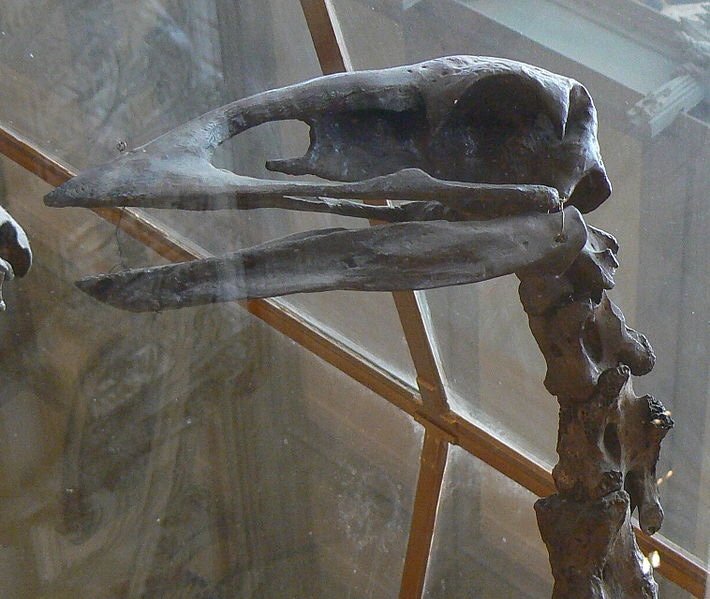
Aepyornis skull from a skeleton at the Muséum national d’Histoire naturelle in Paris, France
Image Credit: LadyofHats, https://zh.m.wikipedia.org/wiki/File:Aepyornis_skull.JPG

So overall, Aepyornis was a truly splendid animal, with a much more varied and detailed history and lifestyle than at first glance. The Elephant Birds are reminiscent of a time 65 million years ago when the close relatives of birds ruled the world. The dinosaurs were long gone, but in this little corner of the world Aepyornis and its family carried on their legacy.

References/Further Reading

Torres & Clarke 2018: a study of the braincases of the Elephant Bird, and what it tells us about their noctournalism

Christopher R. Torres and Julia A. Clarke 2018, Nocturnal giants: evolution of the sensory ecology in elephant birds and other palaeognaths inferred from digital brain reconstructions, Proc. R. Soc. B.28520181540, http://doi.org/10.1098/rspb.2018.1540

Hansford & Turney 2018: a study on the diversity of the Elephant Bird (Aepyornithae) family, showing that the largest Aepyornis were actually a different species of Elephant Bird: Vorombe Titan

James P. Hansford and Samuel T. Turvey 2018, Unexpected diversity within the extinct elephant birds (Aves: Aepyornithidae) and a new identity for the world’s largest bird, R. Soc. open sci.5181295, http://doi.org/10.1098/rsos.181295

Hansford et. al. 2018: a study on Elephant Bird bones with human made cut marks dating from as far back as 10,500 years ago

James Hansford, Patricia C. Wright, Armand Rasoamiaramanana, Ventura R. Pérez, Laurie R. Godfrey, David Errickson, Tim Thompson, Samuel T. Turvey. Early Holocene human presence in Madagascar evidenced by exploitation of avian megafauna. Science Advances, 2018; 4 (9): eaat6925 DOI: 10.1126/sciadv.aat6925

An American Museum of Natural History page about the association of the Roc and Aepyornis, part of their “Mythic Creatures” exhibition

“Strike from the Sky”, Mythic Creatures Exhibition, American Museum of Natural History, https://www.amnh.org/exhibitions/mythic-creatures/air/strike-from-the-sky

A Smithsonian magazine article about the giant eggs of the Elephant Birds

Katz, Bridget, “Giant, Intact Egg of the Extinct Elephant Bird Found in Buffalo Museum”, Smithsonian Magazine, April 23rd, 2018, https://www.smithsonianmag.com/smart-news/giant-intact-egg-extinct-elephant-bird-found-buffalo-museum-180968850/

Bolton, Houston & Monaghan 1992: A study on the link between large eggs and survivability of baby birds

Bolton, M., Houston, D., & Monaghan, P. (1992). Nutritional Constraints on Egg Formation in the Lesser Black-Backed Gull: An Experimental Study. Journal of Animal Ecology, 61(3), 521-532. doi:10.2307/5607
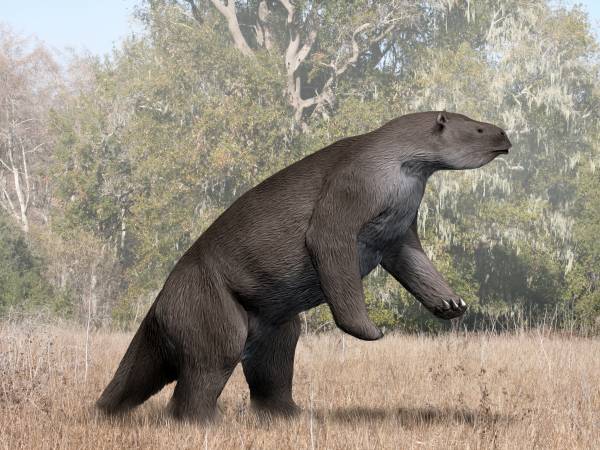
“All hail the Great Beast Megatherium!”

File:Megatherium NT small.jpg - Wikimedia Commons
A reconstruction of the Great Beast
Image Credit: Nobu Tamura, (© N. Tamura), http://spinops.blogspot.com/2015/02/megatherium-americanum.html

“Deluded! Madman! Fake Scientist!”

The Cryptozoologist had been called these a lot throughout his professional career, (as well as other, more mean things). Time after time after time he had failed to discover any of the amazing creatures’ people claimed to have seen, with the majority being proven to never have existed in the first place. Now, nearing his retirement, he was wandering the amazon rainforest looking for yet another cryptid; the “Mapinguari”. “Just turn around” the voice in his head said (not for the first time). “They’re just stories made up to attract tourists or hoaxers trying to make a name for themselves or misidentified animals. None of them are real!”. The Cryptozoologist sighed, and for the first time in his life he wondered “Maybe I am a crazy old man”. Then he heard it, a crash of vegetation coming from the trees just to the left of him. He turned round, straining to locate exactly where the noise had come from. Then he saw it, and his jaw dropped. What he was seeing was an animal believed to have gone extinct 8,000 years ago. It was a great beast taller than an elephant and just as bulky, which possessed huge claws that it was currently using to pull down branches from a nearby tree towards its mouth. As he took out his camera and frantically took pictures two more large adults shuffled out of the forest, one of which had a baby clinging onto to its back. “They wouldn’t believe me” the Cryptozoologist thought. “But just wait till they see you!”

This “Great Beast” is known scientifically as Megatherium Americanum (meaning “Great Beast from the Americas”). Megatherium is an animal that palaeontologists have known about for a very long time. The first fossils were discovered in 1787, four decades before the first dinosaurs would be found, in Argentina by a man named Manuel Torres. After their discovery these bones were shipped to the Museo Nacional de Ciencias in Madrid, Spain, where they still reside today (another reason to visit Spain!). It was from these bones that French naturalist Georges Cuvier first described and named Megatherium, noting its close relation to modern day tree sloths. After these first fossils more were discovered, including bones found by Charles Darwin from 1832-1833 during the first Beagle expedition. Even nowadays new discoveries are revealing more insights. For example a paper published in 2017 (by Bocherens et. al.) looked at preserved collagen proteins in Megatherium fossils to give insights into its diet. Some people have gone a step further and claimed that Megatherium is still alive somewhere in South America. Stories from Brazil tell of the “Mapinguari” or “sloth monster”; a shaman who was transformed by the gods into a giant sloth-like creature. Cryptozoologists (like the one in the story) think the Mapinguari is actually a late surviving species of Megatherium, however scientists (and yours truly) don’t take these stories seriously due to absence of any concrete evidence.

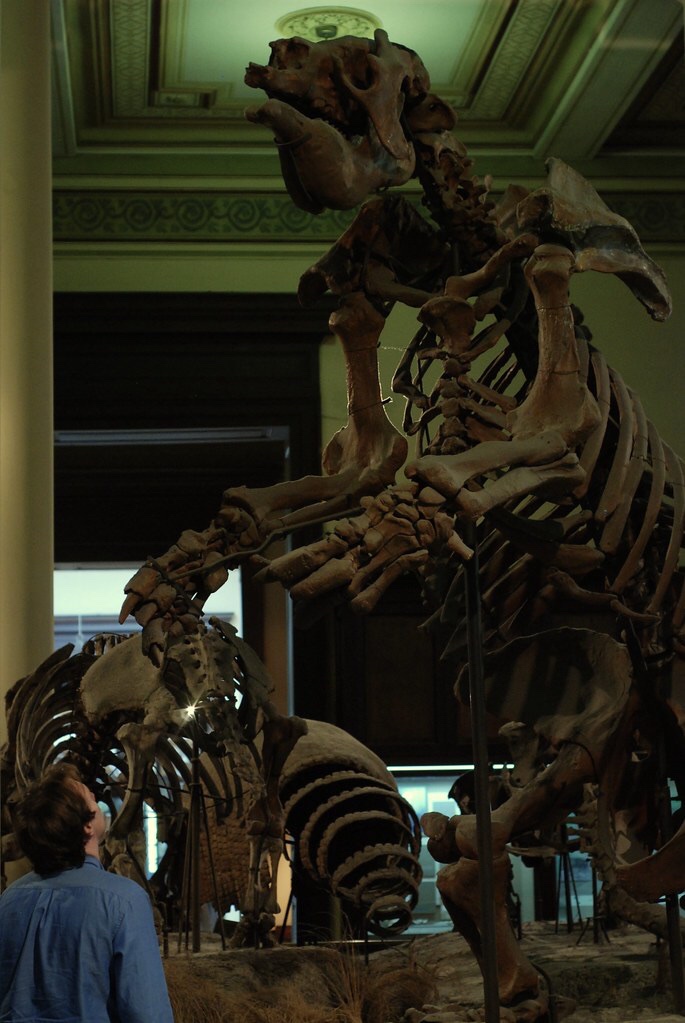
A mounted skeleton of Megatherium with a awe inspired human for scale!
Image Credit: Beatrice Murch, https://www.flickr.com/photos/blmurch/3495336846

Megatherium belonged to a large order (or “superorder”) of mammals known as the xenarthans. Modern xenarthans include Tree Sloths, Anteaters & Armadillos, but during the Cenozoic era this group was much more diverse. From their origins in South America they ended up colonising North America, grew to a range of shapes and sizes and occupied a wide variety of habitats ranging from the treetops (e.g. modern tree sloths) to even the ocean (e.g. the swimming ground sloth Thalassocnus). Megatherium itself belonged to a sub-order of xenarthans commonly known as the “Giant Ground Sloths”. These sloths were very different from their slow moving and tree dwelling modern counterparts. They were bulky, ground living herbivores with large and sharp claws. While Megatherium itself was confined to South America other species of Giant Ground Sloths migrated across the Isthmus of Panama into Central and North America. This was during the great American interchange; a time where multiple species from South America migrated into North America (and vice-versa). As a result Giant Ground Sloths established populations in places such as Costa Rica, Texas and California.

Because multiple fossils of the “Great Beast” have been known to palaeontologists for some time we have a pretty good idea of what it would have been like. Megatherium roamed the South American pampas, mostly in Argentina, Bolivia and Uruguay, from the Pleistocene (roughly 400,000 years ago) to Early Holocene (roughly 8,000 years ago) periods of the Cenozoic era (a timespan commonly known as the “Ice Age”). This beast stood over 3.5 metres tall when fully upright and weighed up to 4 tonnes, making it the largest animal in South America during the Ice Age and the largest xenarthan ever. Its potbellied frame was supported by column-like hind legs that would have given it a long reach. Furthermore preserved Megatherium track-ways and its skeletal anatomy indicate that it could have walked on two legs as well as on all fours. Its front limbs were tipped with large, non-retractable claws which were used for pulling branches closer to them to eat and for digging up roots and tubers. In fact the claws were a reason that Megatherium was initially thought to have been a burrower, living like giant mole! Big claws would have undoubtedly been very effective defensive weapons with Megatherium using them, alongside its large size, to protect itself from predators, such as the large Sabre-Tooth Cat Smilodon populator. Other distinctive features include a relatively narrow snout, a prehensile upper lip (like a black rhino) and a thick shaggy coat. This coat is found on most Megatherium reconstructions and is based on the discovery of exceptionally preserved hair and hide specimens of related Giant Ground Sloths. However a study from 2002 (Fariña 2002) has speculated that Megatherium might’ve been nearly hairless! This is based on the observation that modern large mammals, such as elephants and rhinos, are mostly hairless to prevent them from overheating in hot climates (large animals produce a lot more excess heat). Megatherium may seem very different to what we would think of a typical large herbivore today. However the overall body plan of a large, bulky, bipedal herbivore with large claws has actually appeared a few times throughout earth’s history. One example is the Therizinosaur dinosaurs; a group which lived a full 65 million years earlier than Megatherium but is thought to have lived a similar lifestyle. This is an example of convergent evolution; where two completely unrelated organisms, often separated by millions of years of evolution, evolve similar body plans to live in similar ways. It’s a very fascinating phenomenon that has resulted in a lot of symmetry between modern and extinct animals (e.g. Dolphins and Ichthyosaurs).

A Megatherium looking at the horizon as two glyptodonts waddle by!
Image Credit: D. Bogdanov (DiBgd), https://commons.m.wikimedia.org/wiki/File:Pleistocene_SA.jpg#mw-jump-to-license

Such a majestic animal is another example how diverse the megafauna were during the last Ice Age. However the majority of these animals are not around anymore. Megatherium’s story is similar to other megafauna. Climate change at the end of the last Ice Age played a part, resulting in a loss of habitat and decline in population. This was combined with the arrival of modern humans into South America roughly 14,500 years ago. Some Megatherium bones bear distinct marks on them that indicate that they were cut by human tools. Furthermore other bones have been unearthed alongside human made stone tools and weapons. Tools, high intelligence and co-operation made humans a terrifying predator for a Megatherium to try and defend itself against and humans were so efficient that Megatherium numbers dwindled further. Eventually the dynasty of the Great Beast would come to a close 8,000 years ago. This unfortunate end makes one wish that the Cryptozoologists were right, and that Megatherium was somehow still living in South America to this day. If this were the case then I’m sure many more people would see what a “Great Beast” it really was.

References/Further Reading

Bocherens et. al. 2017 paper reconstructing the diet of Megatherium from analysis of collagen in the fossils

Bocherens et. al. (2017), Isotopic insight on paleodiet of extinct Pleistocene megafaunal Xenarthrans from Argentina. Gondwana Research, 2017; 48: 7 DOI: 10.1016/j.gr.2017.04.003

Billet et. al. 1997 paper examining the inner ear anatomy of Megatherium and what it tells us about its body mass and agility

Billet, G et al. “The inner ear of Megatherium and the evolution of the vestibular system in sloths.” Journal of anatomy vol. 223,6 (2013): 557-67. doi:10.1111/joa.12114

Natural History Museum website article profiling Megatherium and detailing a project that was digitally scanning all the fossils Charles Darwin collected on the 1831-1836 Beagle voyage

Brewer, Pip, “What was Megatherium?”, Natural History Museum, https://www.nhm.ac.uk/discover/what-was-megatherium.html

Fariña 2002 paper suggesting that the largest Giant Ground Sloths, such as Megatherium, were mostly hairless

Fariña, Richard. (2002). Megatherium, the hairless: appearance of the great Quaternary sloths (Mammalia;Xenarthra). AMEGHINIANA. 39. 241-244.

Politis et. al. 2019 paper, published in Sciences Advances, on the discovery of Megatherium remains that show evidence of Human Hunting

Politis, Gustavo & Messineo, Pablo & Stafford Jr, Thomas & Lindsey, Emily. (2019). Campo Laborde: A Late Pleistocene giant ground sloth kill and butchering site in the Pampas. Science Advances. 5. eaau4546. 10.1126/sciadv.aau4546.