Aepyornis and the Elephant Birds of Madagascar

File:Aepyornis maximus 01 L.D..jpg
A front view reconstruction of Aepyornis.
Image Credit: Acrocynus, https://it.wikipedia.org/wiki/File:Aepyornis_maximus_01_L.D..jpg

While it seems like I already know a bit about prehistoric life, before each of these blog articles I make sure to do my research on the animal that I aim to talk about, as any blog writer should do regardless of their subject area. During my research I not only broaden my knowledge, but also gain an extra appreciation for the animal in question. In the case of todays subject, Aepyornis (Greek for “high bird”), more commonly known as the “Elephant Bird”, my research showed just how little I actually knew about it. Aepyornis was a much more fascinating animal than I had realised (not just “a big ostrich”), and in this blog I aim to put the spotlight on this underrated animal.

For starters there wasn’t just one “Elephant Bird”; there was a whole family of them! “Elephant Bird” is the common name given to a family of flightless, bipedal, ostrich-like herbivorous birds from Madagascar known as the Aepyornithae. The “Elephant Bird” name originates from tales of the “Roc”; a legendary giant bird spoken of by Arab traders and written about by the famous explorers Marco Polo (13th century) and Ibn Battuta (14th century). It was also one of the monsters that the adventurer Sinbad encountered in “The Arabian Nights” tales (first published in the 18th century). It was said to be so big that it could carry an elephant in its talons. Polo in all likelihood based his Roc description on accounts of large, lemur hunting Malagasy Crowned Eagles that lived on Madagascar until the 16th century. However reports from other travellers of massive eggs, which belonged to Aepyornis, became associated with the Roc, and so the Aepyornithae family became collectively known as “Elephant Birds”. The Aepyornithae belonged to a larger order of birds known as the Ratites. This is the same group that contains ostriches, emus and cassowaries. You may think that since the Elephant Birds lived on Madagascar their closest relatives would be African ostriches since Madagascar lies off the East African coast. However this is not the case. Their closest living relatives are actually kiwis; small flightless birds which have long, thin beaks, reduced eyesight and are also ratites. Kiwis live only on New Zealand, which is 7,000 miles east of Madagascar! So how are these two birds so closely related despite living so far apart? Well the theory is that around 60 million years ago the common ancestor of kiwi’s and Elephant Birds still possessed flight and flew to these two separate islands, establishing colonies. Then, over millions of years, the two islands drifted further apart from each other (out of flying range) and the two separated populations both evolved flightlessness, independently of one another.

Another result of living on an isolated island for much of their evolution, and with no large mammalian herbivores to compete with, is that the Elephant Birds could grow to massive sizes. Aepyornis was no different and was thought to have been the largest bird that ever lived until relatively recently. Originally it was believed that Aepyornis maximus could grow to heights of more than 3 metres and weigh up to 800kg. However a study in 2018 by Hansford & Turney showed that there were enough skeletal differences between these largest specimens and other Aepyornis for these large Aepyornis to be re-classified as a new member of the Aepyornithae family (alongside Aepyornis and another Elephant Bird named Mullerornis). It was given the rather striking name of Vorombe titan, which is a combination of Malagasy and Greek and translates to “big bird” (Vorombe = Malagasy for bird, titan = Greek for big). As a result the size estimates of Aepyornis is now considered to be a more modest 2.5 metres tall and 400-500kg in weight on average, which is still larger than any living bird! Another of Aepyornis’ (and other Elephant Birds’) claims to fame is their humongous eggs. At their biggest they measured 34cm long, had a circumference of a metre and weighed 15 kilos. That’s 150 times bigger than a chicken egg, larger than any dinosaur egg and the largest eggs of any animal ever. Imagine the fried egg you would get from that! It wouldn’t just be enough for your breakfast; it would be enough to feed your entire family for the whole day! Such huge eggs would have meant that Elephant Bird chicks would have been more highly developed compared to other birds and the lack of any large egg thieves (before humans arrived) meant that it would have been safer for Elephant Birds to lay these eggs.

An Aepyornis egg (the large one!) from Museo Capellini in Bologna, Italy.
Image Credit: Ghedoghedo, https://commons.m.wikimedia.org/wiki/File:Aepyornis_egg.JPG

Aepyornis held the ecological niche of “large herbivore” on Madagascar. Its diet consisted of fruit, grasses and leaves and Aepyornis used its strong neck and overall size to reach them, before biting off and swallowing chunks with its beak. Unlike a lot of other large herbivores recent research has suggested that Aepyornis was a mostly nocturnal animal. The evidence comes from another 2018 study (by Torres & Clarke) where Aepyornis braincases were examined with a CT scanner. This produced a 3D model that the researchers could manipulate and examine in detail. Using this they discovered that Aepyornis had enhanced olfactory lobes (the part of the brain that processes smells) and reduced optic lobes (the part of the brain that processes vision). This is a similar, albeit less extreme, version of the brain structure of kiwis; which are nocturnal birds with limited vision and a reliance on smell to sense their environment. Furthermore Torres & Clarke also showed that different Aepyornis species had slightly different sensory lobes. You see there are two recognised species of Aepyornis; Aepyornis maximus (the larger, forest dwelling one) and Aepyornis hildebranti (the smaller, plains dwelling one). In A.maximus the olfactory lobes were proportionally larger, and the optic lobes proportionally smaller, than in A.hildebranti. This is presumably because A.maximus lived in dense rainforests, where eyesight is less useful due to the dense trees, while A.hildebranti lived in the open plains where the lack of dense trees meant they could see greater distances.

Aepyornis shared its Madagascan home with a menagerie of recognisable animals still alive today, such as Ring-tailed lemurs, Fossas and Chameleons. However it also lived alongside some strange animals that are no longer around. These included Archaeoindris, a giant lemur that was the size of a Silverback gorilla, the aforementioned Malagasy crowned eagle which modern lemurs still possess an innate fear of even though it is now extinct, and giant tortoises similar in size and lifestyle to the modern day Galapagos giant tortoise. So once upon a time Madagascar had an even greater diversity of life than it does now. However there are no Elephant Birds, giant lemurs, huge tortoises or giant eagles anymore. This is thought to have been mainly due to change in climate, which lead to changes in food availability. The actions of humans are also commonly linked to the disappearance of many Madagascan animals. However they may not have played as big of a role as previously thought. Yet another 2018 study (2018 should be renamed “Year of the Elephant Bird” due to all the studies carried out that year!) dated Elephant Bird bones that showed distinctive cut marks made by human tools to 10,500 years ago, the end of the Pleistocene period and start of the Holocene period. This was a whole 8,000 years earlier than humans had previously been thought to have reached Madagascar. Since Aepyornis and other Elephant Birds became extinct sometime between the 10th-12th Centuries (though sightings had been reported to as late as the 17th century) this means that humans co-existed with the birds for longer than previously thought. So they couldn’t have quickly hunted them to extinction as had been previously assumed. However this doesn’t mean that Aepyornis wasn’t a target for humans or that human activity wouldn’t have affected their numbers. For one the sheer size of both the animal and especially its eggs (which could be quickly poached from Aepyornis nests) would have been an attractive prospect for human hunters. For another humans were converting the Madagascan forests and plains into farmland, destroying Aepyornis’ habitat, and domesticated chickens and guinea fowl brought to Madagascar may have passed on bird related diseases to Aepyornis, which it had no immunity to.
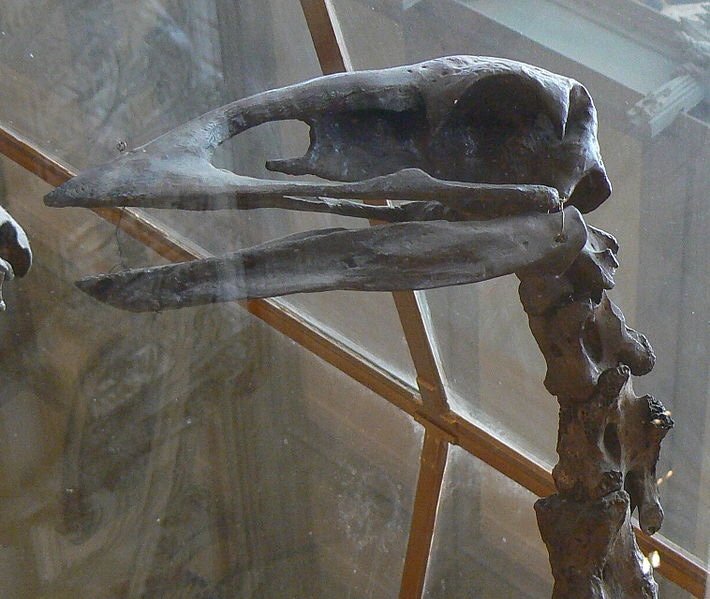
Aepyornis skull from a skeleton at the Muséum national d’Histoire naturelle in Paris, France
Image Credit: LadyofHats, https://zh.m.wikipedia.org/wiki/File:Aepyornis_skull.JPG

So overall, Aepyornis was a truly splendid animal, with a much more varied and detailed history and lifestyle than at first glance. The Elephant Birds are reminiscent of a time 65 million years ago when the close relatives of birds ruled the world. The dinosaurs were long gone, but in this little corner of the world Aepyornis and its family carried on their legacy.

References/Further Reading

Torres & Clarke 2018: a study of the braincases of the Elephant Bird, and what it tells us about their noctournalism

Christopher R. Torres and Julia A. Clarke 2018, Nocturnal giants: evolution of the sensory ecology in elephant birds and other palaeognaths inferred from digital brain reconstructions, Proc. R. Soc. B.28520181540, http://doi.org/10.1098/rspb.2018.1540

Hansford & Turney 2018: a study on the diversity of the Elephant Bird (Aepyornithae) family, showing that the largest Aepyornis were actually a different species of Elephant Bird: Vorombe Titan

James P. Hansford and Samuel T. Turvey 2018, Unexpected diversity within the extinct elephant birds (Aves: Aepyornithidae) and a new identity for the world’s largest bird, R. Soc. open sci.5181295, http://doi.org/10.1098/rsos.181295

Hansford et. al. 2018: a study on Elephant Bird bones with human made cut marks dating from as far back as 10,500 years ago

James Hansford, Patricia C. Wright, Armand Rasoamiaramanana, Ventura R. Pérez, Laurie R. Godfrey, David Errickson, Tim Thompson, Samuel T. Turvey. Early Holocene human presence in Madagascar evidenced by exploitation of avian megafauna. Science Advances, 2018; 4 (9): eaat6925 DOI: 10.1126/sciadv.aat6925

An American Museum of Natural History page about the association of the Roc and Aepyornis, part of their “Mythic Creatures” exhibition

“Strike from the Sky”, Mythic Creatures Exhibition, American Museum of Natural History, https://www.amnh.org/exhibitions/mythic-creatures/air/strike-from-the-sky

A Smithsonian magazine article about the giant eggs of the Elephant Birds

Katz, Bridget, “Giant, Intact Egg of the Extinct Elephant Bird Found in Buffalo Museum”, Smithsonian Magazine, April 23rd, 2018, https://www.smithsonianmag.com/smart-news/giant-intact-egg-extinct-elephant-bird-found-buffalo-museum-180968850/

Bolton, Houston & Monaghan 1992: A study on the link between large eggs and survivability of baby birds

Bolton, M., Houston, D., & Monaghan, P. (1992). Nutritional Constraints on Egg Formation in the Lesser Black-Backed Gull: An Experimental Study. Journal of Animal Ecology, 61(3), 521-532. doi:10.2307/5607
Basilosaurus: The Tale of King Basil

File:Basilosaurus1DB.jpg
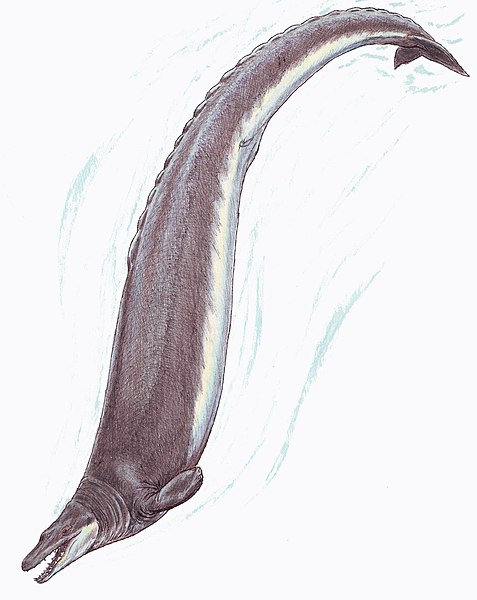
A Reconstruction of how Basilosaurus (and the one and only King Basil) would have looked!
Image Credit: Dmitry Bogdanov, https://commons.wikimedia.org/wiki/File:Basilosaurus1DB.jpg

35 Million years ago during the Late Eocene period, in a shallow sea that would one day become the Sahara Desert, a king ruled the waters. His name was Basil, he was 20 years old and one of the largest of his kind. He has reached this age in large part because of the excellent early parental care of his mother, a key trait of mammals like him. He was taught how to navigate, to hunt and his mother used every ounce of her might to protect him from danger. Now he is in his prime, has fathered many offspring and has his pick of food that sustains his enormous appetite. Life is good for the king and there is nothing that can threaten him……for now.

Basil is a Basilosaurus, a name meaning “King Lizard” in Latin. However Basil and his kind are far from lizards! They are part of what was at the time a relatively new group of sea faring animals; the whales. Two species of Basilosaurus have been discovered. The first is Basilosaurus cetoides, which ranged from the coast of what is now Alabama and New Mexico in the USA to Egypt. The second is Basilosaurus isis, which swam in waters covering much of Morocco and Egypt. Combining the localities of these two species we can see that Basilosaurus had a wide geographical distribution, stretching across almost half the globe. Along this distribution both Basilosaurus species are thought to have resided in coastal and shallow water regions rather than the deep ocean; a slightly unusual habitat considering their huge size. Furthermore both Basilosaurus species lived in an ocean which no longer exists! This ocean was known as the Tethys, a once mighty watery expanse that linked the Indian and Atlantic Ocean. During the Late Eocene period it covered where much of Arabia, North Africa and the Mediterranean Sea area are now. The Tethys would eventually disappear around 23 million years ago but the coastal margins of this strange, primordial ocean was a place where Basilosaurus (and many other marine fauna) called home.

The fossilised skull of Basilosaurus isis (top) and Basilosaurus cetoides (bottom). Note the slight differences in teeth and skull shape between the two species.
Image Credit: Ghedoghedo, Ninjatacoshell, https://en.m.wikipedia.org/wiki/File:Basilosaurus_isis_and_cetoides_skulls_compared.png

The first Basilosaurus fossils were found in the 1830s. Rather curiously, when they were first unearthed, the large vertebrae were used as furniture! After this the fossils were initially studied by Richard Harlan, a Philadelphia based Naturalist, before being passed on to Sir Richard Owen, the famous British Naturalist who’s best known for coining the term “dinosaur” and for founding the Natural History Museum in London. Harlan at first thought that these bones belonged to a giant marine reptile, partly due to the animal’s unusually long body (like an actual sea serpent!) and superficially reptile-like skull. This is why it was given the name of Basilosaurus, or “King Lizard”. However later studies revealed Basilosaurus’ characteristic mammalian features. For example it was found to have heterodont dentition, which means they have teeth of various shapes each with their own function (in this case sharp incisors and flattened serrated molars). In contrast reptiles have homodont dentition, meaning their teeth are all the same shape and have the same function. Once he realised the mistake Sir Richard Owen suggested that this animal’s name should be changed to Zeuglodon; which means “Yoke Teeth” on account of their distinct shape. However this would have violated the golden rule of scientifically naming an organism; “The first name that is given is the one that is always used (unless the name is already in use or the new organism turns out to actually be one we’ve previously discovered and named)”. Therefore the name Basilosaurus stayed, resulting in the rather bizarre situation where a whale (which is a mammal) is called a lizard (which is a reptile). A great example of how palaeontology is full of weird names that sometimes don’t make sense!

A serpentine shape isn’t the only feature that differentiated Basilosaurus from modern whales. It also possessed small, stumpy and external hind limbs. While modern whales also possess hind limbs they are internal, hidden beneath the large layers of fat, muscle and skin. These tiny legs are remnants from a time (roughly 20 million years or so before Basilosaurus) when the ancestors of whales were small, four-legged hoofed mammals that were first dipping their toes back into water. Whereas these ancestors used their hind limbs for walking, Basilosaurus’ were way too small and stumpy for such a “feet” (sorry, couldn’t resist the pun). Instead it’s thought that the hind limbs were used to help lock and intertwine the long bodies of two Basilosaurus’ together during mating. Basilosaurus also lacked some characteristic anatomy that modern whales possess. This included a “melon” in their heads; a mass of tissue which modern whales use for echolocation. Furthermore Basilosaurus’ blowhole, which it used to take breaths at the surface, was positioned further forward (between the snout and top of its head) than in modern whales. As Basilosaurus preferred shallow water environments it is also thought that they didn’t dive to great depths (like Sperm Whales and Cuvier’s beaked whales do).

Mounted skeleton of Basilosaurus isis from the Museum d’Histoire Naturelle in Nantes, France
Image Credit: Asmoth, https://commons.m.wikimedia.org/wiki/File:Basilosaurus_isis_fossil,_Nantes_History_Museum_01.jpg

Basilosaurus was a giant of its time; measuring up to 20 metres long and weighing up to 20 tons. This meant that it was the undisputed top predator of the Late Eocene seas. The size of Basilosaurus varied between the two species; with B.cetoides measuring between 17-20 metres while B.Isis was between 15-18 metres. As you can see from this range in lengths there was also size variation between members of the same Basilosaurus species. One reason for this is that they exhibited sexual dimorphism. We know this because on average male Basilosaurus vertebrae measure 20% longer than in females of the same age. In terms of its lifestyle a modern day comparison to Basilosaurus might be the Orca (aka “The Killer Whale”). Both are large predatory whales that are top predators in their environments. Like Orcas, the diet of Basilosaurus consisted of fish (e.g. Pycnodus) and other marine mammals. One particular marine mammal that was on the menu was Dorudon atrox, a 5 metre long prehistoric whale which actually belonged to the same family as Basilosaurus; “The Basilosauridae” (guess what animal the family was named after). Fossils discovered in the last two decades have shown a direct predator-prey relationship between these two whales. Skulls of Dorudon have been found with bite marks that perfectly match the size and shape of Basilosaurus teeth. Furthermore these marks form a pattern on the Dorudon skull that indicate that the bite was across the head, a tactic that’s often used by predators to quickly immobilise and cripple their prey. In addition approximately 50% of these skulls were deduced to be of young Dorudon. This was due to the presence of deciduous (i.e. baby) teeth, while accompanying vertebrate had open growth plates which is the part of the bone that grows, before hardening when animal matures. This suggests that Basilosaurus targeted Dorudon “nursery groups” that consisted of young Dorudon and a few adults. It undoubtedly would have been a waking nightmare for the young Dorudon to see a large and hungry Basilosaurus burst into their nursery. But from the Basilosaurus’ perspective hunting the more vulnerable prey (e.g. young, old, injured and/or sick) gives them a greater chance of getting a vital meal, one that could prevent them from starving, and is a tactic employed by every predator from Lions, to Eagles, to Orcas.

King Basil eventually reached the end of his road as the years of swimming, hunting and fighting finally caught up to him. His latest wounds, sustained from a fight with a younger and faster male, are this time going to be fatal. As blood loss starts to take its toll Basil takes one last breath at the surface, before his body eventually gives out. The king has been dethroned. The younger male has long since swum off to start his own reign, but the line of succession will eventually end 33 million years ago. A drop in sea levels and a changing climate would push all Basilosaurus to extinction. As for Basil his body eventually sinks to the bottom of the sea and over time is picked clean by scavengers, buried by ocean sediment, and undergoes the fossilisation process that will turn his bones into hard rock. 35 million years later his bones will eventually resurface as another Basilosaurus fossil, with an intrepid palaeontologist meticulously dusting the sand of the Sahara Desert away to expose his remains. His final resting place is Wadi Al Hitan, a fossil site located 150km South-West of Cairo in Egypt. This place is also known as the “Valley of the Whales”. This is fitting, as just like the Egyptian pharaohs buried in the “Valley of the Kings”, Basil was a monarch among his own kind.

References/Further Reading

Fahlke 2012 paper that further examined the bite marks on Dorudon skulls, reinforcing the hypothesis that they match the teeth of Basilosaurus and that Basilosaurus actively hunted Dorudon

Fahlke, J. M. (2012). Bite marks revisited—evidence for middle-to-late Eocene Basilosaurus isis predation on Dorudon atrox (both Cetacea, Basilosauridae). Palaeontologia Electronica, 15(3), 32A.

Voss et. al. 2019 paper describing the preserved stomach contents of a Basilosaurus isis fossil

Voss M, Antar MSM, Zalmout IS, Gingerich PD (2019) Stomach contents of the archaeocete Basilosaurus isis: Apex predator in oceans of the late Eocene. PLoS ONE 14(1): e0209021. https://doi.org/10.1371/journal.pone.0209021

Uhen 2004 paper that first described the bite marks on Dorudon skulls and suggested that they were due to Basilosaurus predation

Uhen MD. Form, function, and anatomy of Dorudon atrox (Mammalia, Cetacea): an archaeocete from the middle to late Eocene of Egypt. University of Michigan Papers on Paleontology. 2004; 34: 1–222.

Fossilworks database on Basilosaurus species, synonyms and papers related to it

Fossilworks, “Basilosaurus Harlan 1834 (whale)”, Fossilworks, http://fossilworks.org/cgi-bin/bridge.pl?a=taxonInfo&taxon_no=36681

The New York Institute of Technology College of Osteopathic Medicine (try saying that five times fast!) page describing Basilosaurus (written by Robert Boessenecker and Jonathan Geisler)

Boessenecker, Robert, Geisler, Jonathan, “Basilosaurus spp.”, College of Osteopathic Medicine, The New York Institute of Technology, https://www.nyit.edu/medicine/basilosaurus_spp#

A Comparative Anatomy website page, from the University of the Cumberlands, giving an overview of Heterodont and Homodont Dentition

Comparative Anatomy, “The Teeth of Vertebrate Animals”, Comparative Anatomy, https://inside.ucumberlands.edu/academics/biology/faculty/kuss/courses/Digestive%20system/TeethOf%20Vertebrates.htm