Crows: The Next Great Intelligence?

A Carrion Crow (Corvus corone). A Crow like this, or a similar species, is often what you would typically see if you spotted one outside your window.
Image Credit: Christine Matthews, https://www.geograph.org.uk/photo/658585

Crows have had it rough over the years.

Known as black feathered, small to medium sized birds that caw day and night, they often are seen to have a close connection with death. They were known to be found near the dead, with historical accounts and media depicting them feeding on the corpses of hanging victims and soldiers on battlefields. Even the terms “a murder of Crows” and “an unkindness of Ravens” (referring to groups of these birds) is a language linked to misery. They’re often considered the companions of the Grim Reaper, or other shadowy, dark mystical figures. These have even included gods, such as the Norse god Odin, who had two Ravens named Hugin (Thought) and Munin (Memory). These would fly around the whole world and report back to him. Crows have even been adopted as symbols or names for groups of people, such as the Apsáalooke or “The Crow/Crow People” of the Northern Plains of the USA. Even modern-day stories of dark god like beings can have these birds linked with them (such as “The Sandman”, who is accompanied by his personal Raven). Stories involving them have even cast them as gods themselves who helped create humanity and the world itself. One example are stories from the American Northwest Coast. Others consider them as omens of ill times and linked with superstition. A small group of Ravens are kept at the Tower of London with their wings clipped because, as the story goes, if they were ever to leave the tower the United Kingdom would fall. To add further to a grisly and complicated depiction, they are considered as “greedy”, with the Magpie particularly linked to collecting and hoarding shiny objects. This connection goes beyond stories and into direct human interaction. Feeding on crops and even (in the case of Ravens) going after newly born lambs has brought them into conflict with farmers. Under a licence (though illegal shootings happen too) they poison carcasses, trap the birds in specialized traps known as Larson Traps, and even use a gun to cull them. But more peaceful measures are used too. The most famous of which is the “Scarecrow”. As the name suggests they are used to scare off crows but can also ward off other birds too. It works because the birds, at least initially, confuse the straw dummy for a living human that could harm them. However, this isn’t always a long-term solution as the birds are often smart enough to eventually figure out that it’s a fake.

Despite this notoriety among humanity, Crows are everywhere. They’re found in urban areas and countryside alike, right across the world and in sizable populations. You are likely to spot a Crow every time you walk outside your door and even just outside your window!

It’s easy to dismiss them when you see them. But there is more to the average Crow than meets the eye. For one, they’re intelligent. Extraordinarily so. So much so that they have often been compared to members of the primate group, including Great Apes (they’ve even been called “Flying Apes”). Some crows have even solved tests that require intelligence equivalent to a 7 year old child!

It’s amazing to think that such smart animals are all around us.

But what do we mean by a “Crow”? Well, it depends on who you ask. A “Crow” can be a colloquial term for any bird that is a member of the Corvidae family (who are part of the songbird line). In the UK Corvid species include Carrion & Hooded Crows, Jays, Jackdaws, Magpies, Ravens, Rooks and Choughs. However a “Crow” is also used to refer specifically to any bird in the genus Corvus, which from the previous list covers Carrion & Hooded Crows, Jackdaws, Magpies, Ravens and Rooks only. Finally, a “Crow” can also just refer to the True Crow species, Carrion Crows and Hooded Crows. Understandably that is a lot of bird to cover. To distinguish between them I will use the term “Corvid” when talking about the group as a whole and use the specific names of each member, including using “crow” to refer to any of the true crows.

The next question is what the difference between all these “Crows”? If “Crow” is used as a colloquial term for all Corvids then differences may not always be recognized. First there is size. They range from Jays, who have wingspans of 52-58cms, to Ravens, who have a wingspans of a whopping 1.3 metres! Then there is colour. While it’s true that most Corvids have black feathers, the extend of this varies from one species to the next. For example, Magpies have white bellies, Rooks have white beaks and Jays are mostly brown/cream coloured. There is also body proportion. For example, Jackdaws are covered in black feathers just like Carrion Crows, but have more rounded heads and blunter beaks on top of a smaller size. Finally, Corvids can vary according to geographical distribution. For example, in the UK, Hooded Crows are only found in the Northwest of Scotland and across Northern Ireland, while Carrion Crows are found everywhere else except those areas. Ravens are widespread in the West side of the UK, but not in the East. So, as you can see, one “Crow” is not the same as another. Indeed, it was only recently that Carrion & Hooded Crows were thought to be the same species until relatively recently!

While the colour is typical of Corvids, they are not all fully Black. This Magpie for instance also possesses beautiful blue and white feathers too!
Image Credit: Keith Williams, https://www.flickr.com/photos/keithmwilliams/7022480497

For the most part Corvids eat almost anything, with different species having preferences for specific foods (e.g., Jays mostly focus on seeds and insects). So, you may find a Corvid picking seeds from a birdfeeder, pulling earthworms and other invertebrates from a farmer’s field, raiding other bird’s nests and eating eggs and young, and exploiting the huge quantities of human food waste. Corvids are also notorious for scavenging carcasses, including wild animals, livestock (of which there is an abundance) and yes, even humans (hence the name “Carrion Crows”). So, in places like the UK, they fill a similar role to Vultures and act as “ecosystem cleaners”, helping to strip carcasses and prevent an overflow of decaying bodies. Even if you somehow haven’t seen a Corvid as of late, then chances are you’ve heard one! Crows and Rooks have a very distinctive cawing cry. In media you’d stereotypically hear a “caaaw, caaaaw” after a death or to set a spooky mood. In real life these cries are usually due to one of two things; either the crow is trying to communicate with others in the immediate area or further afield (in which case the calls are of a structured frequency) or it is a warning of a predator being about (in which case it is an unstructured call). Communication between Corvids is of particular importance as it helps them build bonds (Ravens have even been seen to show “empathy” with others that’ve been attacked) and to get a sense of the character of others (“are they trustworthy?”). Relations between Corvids of the same species are important as it allows them to co-exist in adjacent territories. Corvids are also capable of mimicking sounds (like a passing vehicle for instance) and pet Corvids have even been observed mimicking human speech! While a lot of Corvids are solitary, with young being raised by pairs who mate for life, there are others (often youngsters who have left the nest) that live together for a time in small gangs, and other Corvids (e.g., Rooks) will congregate together into large flocks if there’s an opportunity. Furthermore, there are recorded instances where young crows are raised not just by the mated pair but also by older siblings from the previous year, who bring food to the chicks and even help build the nests. These older siblings are like adult humans who still live with their parents! And chicks can stay with their parents for up to 2-6 years in some cases, which is a long time for a bird!

A “murder” of Crows in a tree. Crows often feed and live alone but they can gang together like this if there’s plentiful food or even if they are young. Its pretty likely that each Crow in this photo knows and can recognise other Crows and what they’re like!
Image Credit: Stockvault, https://www.stockvault.net/photo/266546/crows-in-a-tree

However, the single most extraordinary thing about Corvids is undoubtedly their intelligence. They have the largest brain to body size ratio of any bird and have a lot of neurons packed into their brains (1.5 million in a typical crow which is similar to some species of monkeys), especially concentrated in the forebrain (the area that controls language, memory and spatial awareness). This tight packing allows them to fit a lot of neural activity and transmit signals faster through a relatively small braincase. This is important if you need to be light enough to fly. While they don’t have a neocortex (the large front and top part of the brain where cognition, spatial awareness, perception and more is controlled from) as in mammals, they instead have a Pallium (i.e., a big middle part of their brain) with nerve fibers arranged in a similar way to mammals. The extent of their intelligence is mind boggling. The most famous Corvid intelligence feats come from studies on New Caledonian Crows (so named for their home of New Caledonia in the Southwest Pacific). One test observed a female crow deliberately bend a metal wire into a hook shape so she could lift a bucket of food from a vertical pipe. This is even more amazing because this event happened spontaneously, without any training, after a test where the birds had to choose between a straight and hooked wire to get the food. Another test showed that these Crows can combine sticks together to make longer sticks to reach food. Compound tool construction like this has only been observed outside humans in a few select Great Apes. These tests showed that Crows (and other Corvids such as Rooks that have been observed in tests to do similar feats) are able to not only use tools, but also to make tools based on previous learning. Other tests have showed that some Rooks are able to use stones to raise the level of water in a beaker (a stone takes up space in the beaker therefore displacing the water upwards) in order to “float” the food to within reach. Furthermore, these Rooks could judge precisely how many stones to use, knew that larger stones were more effective, and that the technique didn’t work as well with sawdust!

While these tests show specific examples of how Corvids can use their smarts to solve specific problems, it’s been suggested that they share many other intelligence similarities with “smart” animals like us. These include language, passion, play, risk-taking, deception, facial recognition, holding grudges, foresight (e.g., storing food in different places and remembering where they all are) and even insight. However as impressive as these feats are, it must be stressed that the level of intelligence, while exceptionally high, varies across different Corvid species and different populations, with not all Corvids being able to use their intelligence in the same way. However even your average Corvid is still likely to be one of the smartest animals around. For example, there has been a case in the UK where a group of Rooks at Membury Motorway Service Station on the M4 have learned to acquire food from bins by working together to pull up the bin bag so others can access food directly or throw food out of it so all can eat. Combining intelligence with a generalist diet, good senses (particularly eyesight), relatively long-lasting parental care and family bonds and flight (to allow for easy travel over great distances) allows them to exploit most environments and maintain a strong population despite the destructive nature of humanity.

Its not just in tests that tool use is seen in Corvids. Here a juvenile wild New Caledonian Crow is using a twig to probe in a log for insects!
Image Credit: Natalie Uomini, https://www.flickr.com/photos/corvus_moneduloides/35688881002

This blog article has only scratched the surface. There are many examples of Corvid intelligence I could list (for example, Crows in the city of Akita in Japan, and in the American State of California, drop nuts onto roads for cars to run the nut over, then they eat the contents when the light signals allow!) and you could write whole books about Corvid behaviour and diversity. So if you’re interested, I’d highly recommend looking at the Further Reading section or research them more! I hope with this piece you, the reader, can see that Crows, Magpies, Jackdaws and other Corvids that you see all around you are way more complex than you might realize. Despite everything humanity has done they are still able to thrive, perched in trees, on fences and cawing across the countryside’s, towns and cities of our world. You may only glance at them, but don’t be surprised to see them studying you back!

People have held superstitions with Corvids for centuries. Here are two of the Tower of London Ravens, their wings clipped to prevent the UK from falling!
Image Credit: ingo zwank, https://commons.wikimedia.org/wiki/File:London_tower_ravens.jpg

References/Further Reading

RSPB website resource on Corvids; including Crows, Magpies and Ravens.

RSPB, “Crows”, RSPB, www.rspb.org.uk, https://www.rspb.org.uk/birds-and-wildlife/wildlife-guides/bird-a-z/crow-family/

Bird & Emery 2009 study that showed that Rooks could use stones to manipulate water levels in order to reach food.

Christopher David Bird, Nathan John Emery, “Rooks Use Stones to Raise the Water Level to Reach a Floating Worm”, Current Biology, Volume 19, Issue 16, 2009, Pages 1410-1414, ISSN 0960-9822, https://doi.org/10.1016/j.cub.2009.07.033.

Bird & Emery 2009 study that further looked at tool modification and problem solving in Rooks.

Christopher D. Bird, Nathan J. Emery, “Insightful problem solving and creative tool modification by captive nontool-using rooks”, PNAS Biological Sciences, June 23, 2009, 106 (25) 10370-10375, https://doi.org/10.1073/pnas.0901008106

Emery & Clayton 2004 looking at the convergent evolution of intelligence in Corvids and Apes.

Nathan J. Emery, Nicola S. Clayton, “The Mentality of Crows: Convergent Evolution of Intelligence in Corvids and Apes”, Science, 10 Dec 2004, Vol 306, Issue 5703, pp. 1903-1907, DOI: 10.1126/science.1098410

Marzluff & Angell’s book “Gifts of the crow: how perception, emotion, and thought allow smart birds to behave like humans” which explores intelligence on birds, including Corvids.

Marzluff, J. and Angell, T., 2013. “Gifts of the crow: how perception, emotion, and thought allow smart birds to behave like humans”. Simon and Schuster.

The “Norse Mythology for Smart People” website page on Odin’s two Ravens Hugin and Munin.

Norse Mythology for Smart People, “HUGIN AND MUNIN”, www.norse-mythology.org, https://norse-mythology.org/gods-and-creatures/others/hugin-and-munin/

American Museum of Natural History website page on the “Raven the Trickster” story.

American Museum of Natural History, “Raven the Trickster”, www.amnh.org, https://www.amnh.org/exhibitions/totems-to-turquoise/native-american-cosmology/raven-the-trickster

lake forest website page on the Apsáalooke, their history, language and the threats to them, both past and present.

Leffner, Nikolai, “Apsáalooke: The Story of the Crow Language”, www.lakeforest.edu, https://www.lakeforest.edu/academics/majors-and-minors/environmental-studies/apsaalooke-the-story-of-the-crow-language

A nature article by Nicola Clayton on Corvid intelligence

Clayton, N., Corvid cognition: Feathered apes. Nature 484, 453–454 (2012). https://doi.org/10.1038/484453a

Veit & Nieder 2013 paper looking at brain activity and structure in Corvids.

Veit, L., Nieder, A. Abstract rule neurons in the endbrain support intelligent behaviour in corvid songbirds. Nat Commun 4, 2878 (2013). https://doi.org/10.1038/ncomms3878

Clayton & Emery 2005 paper studying Corvids and Corvid cognition.

Clayton, Nicola, Emery, Nathan, “Corvid Cognition, Current Biology, Vol. 15, Issue 3, (2005), DOI:https://doi.org/10.1016/j.cub.2005.01.020

Weir, Chappell & Kacelnik 2002 paper describing tests they undertook on New Caledonian Crows.

Weir, Alex A. S., Chappell, Jackie, Kacelnik, Alex, “Shaping of Hooks in New Caledonian Crows”, Science, Vol. 297, Iss. 5583, 2002, https://doi.org/10.1126/science.1073433

• The amazing Beak, Tooth and Claw, a book written by Mary Colwell and published in 2021. The chapter on Ravens and Crows was a very helpful source for this article but the rest of this book is also worth reading if you’re interested in nature.

Colwell, Mary, “Beak, Tooth and Claw: Living with Predators in Britain”, 2021, Chapter 3, pg 71-98, William Collins Publishers

A Smithsonian magazine article written by Dirk Schulze-Makuch, a Professor at the Technical University in Berlin, on Crow intelligence and what it means for the evolution of consciousness in nature (including dinosaurs).

Schulze-Makuch, Dirk, “Crows Are Even Smarter Than We Thought”, Smithsonian Magazine, February 10th, 2021, www.smithsonianmag.com, https://www.smithsonianmag.com/air-space-magazine/crows-are-even-smarter-we-thought-180976970/#:~:text=The%20total%20number%20of%20neurons,Apes%20such%20as%20the%20gorilla.

A YouTube video by Real Science on Crow intelligence tests and the reasons for their intelligence

A PBS article about Crows using cars to run over and crack open nuts for them to eat and other feats of intelligence in birds.

Davies, Gareth Huw, “Bird Brains”, PBS, www.pbs.org, https://www.pbs.org/lifeofbirds/brain/

Paleo Safaris: Ice Age Australia

Queensland, Australia, 50,000 years ago

The last Ice Age is usually associated with cold, frozen landscapes with Mammoths, Sabre Toothed Cats, Woolly Rhinos and Ground Sloths dominating the landscape. However in some places on earth these conditions and animals weren’t present at all. For an example of this look no further than Australia. Instead of colder temperatures, the Ice Age caused Australia to become drier in glacial periods and wetter in interglacials. During interglacial periods conditions were mild enough to allow for more extensive temperate forests and dry grassland to grow and encircle the vast central desert. Just like today, Australia was home to a host of weird and unusual animal species exclusive to the continent. For example there were (and still are) not many placental mammals; the large phylum that encompasses the majority of all mammal families elsewhere in the world, from cats, to whales, to cows and to humans. Instead a completely different type of mammal is dominant here. They are the marsupials. Their main distinguishing trait is their young being born very early in development and then spending the rest of the development cycle maturing in an external skin pouch instead of internally in a placental linked womb. If we journey back 50,000 years we find that Australia’s signature marsupials can still be spotted; Kangaroos leap across the arid land, Koalas snooze in the afternoon sun and Wombats lumber along the forest undergrowth. However among these animals also live a large cast of unfamiliar Australian fauna.

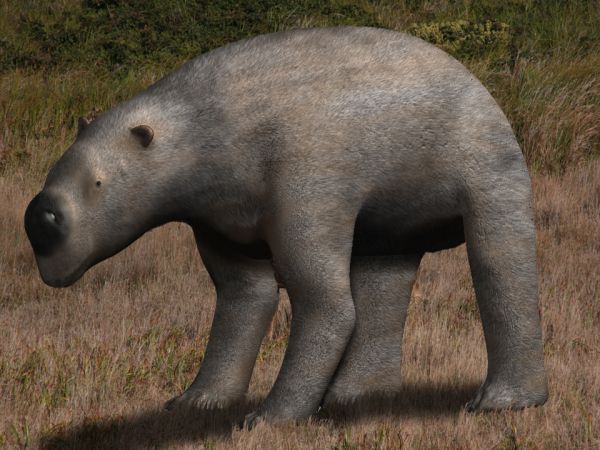
It’s late April, and on the arid plains of Queensland, Central Australia one marsupial munches on the dry grass in the dead of night. It’s bigger than any Australian animal alive today, about the same size as a Rhino but is a close relative of the Wombat. This is Diprotodon; at 3 metres long, 1.8 metres tall and roughly 2.8 tonnes it is the largest marsupial that has ever lived. Diprotodon usually live in big herds that seasonally migrate across the Australian outback, but this young male has become separated from the rest of the herd. He picks up the sound of a disturbance in the bush and notices something moving quickly through it. He looks up towards the sound and readies himself for an attack! The animal emerges! But to the Diprotodons relief it’s not what it was fearing. Instead it is a female Thylacine, on the hunt for prey that is more her size. Thylacines are only a metre long and weigh 17 kilos (smaller than a medium-sized dog) and as such usually stay out the way of the larger animals. Once he realises that the Thylacine is no threat the big Diprotodon goes back to munching on the surrounding grass. In fact the female Thylacine that is more relieved that there was no escalation in this encounter. Getting trampled by the rhino sized marsupial would have been fatal not only to her, but to her unborn baby.

File:Diprotodon optatum.jpg
Diprotodon. The largest Marsupial to ever exist!
Image Credit: Nobu Tamura, http://2.bp.blogspot.com/-5Ckt4LUHKz8/T9dwmTycaMI/AAAAAAAABt8/70-K8CMYL5k/s1600/Diprotodon_BW2.jpg

By late May when we next see her, the female Thylacine has now officially become a mother! Within the safety of her pouch pokes out the head of her joey. Sadly he is the only survivor of an original litter of four. Two of his siblings were stillborn and the other couldn’t reach the pouch and perished in the harsh Australian environment. He is not yet strong enough to leave it yet and is still totally dependent on milk he gets from mammary glands within the pouch. While she’s carrying around this new arrival, the female Thylacine will be keen to take any free meal she can find. She is in luck as the distinctive smell of carrion wafts through the wind. Using her keen sense of smell she tracks the scent towards its source; a Diprotodon that has succumbed to old age and the battering heat of the Australian sun. However she is not the only predator drawn to the carcass. To her left emerges a crocodile! But there is no river or lake for miles around. How can this be?! This is no ordinary crocodile! This is a Quinkana. A 6 metre long crocodilian who, unlike its water loving relatives, is almost entirely terrestrial with legs that are located more underneath its body to allow it to chase down prey. Quinkana is another animal that dwarfs the Thylacine. However she is more nimble, and if she’s careful she can sneak up to the carcass and steal a mouthful or two before the Quinkana notices. She starts to stealthily venture towards the other side of the carcass as the Quinkana tears into it. But then she hears a sharp hiss from the thicket! She flees the scene as another giant reptile enters stage right! Megalania. A 7 metre long monitor lizard, roughly twice the size of a Komodo Dragon! It too has smelt the carcass and unlike the Thylacine it has the size and power to potentially muscle the Quinkana off the carcass. The Megalania grabs the hind leg of the carcass and attempts to drag it away. But the Quinkana isn’t going to let go easily and proceeds to grab onto the carcasses’ neck. A massive tug of war ensues between the two reptiles, one that could potentially escalate further! Understandably the Thylacine isn’t willing to stick around to find out the result and with the two giant predators all over the carcass there is no chance of her stealing anything now. Frustrated, she is forced to move on.

File:Quinkana fortirostrum.JPG
Quinkana. One of the many large predators our Thylacine family has to avoid!
Image Credit: Mr Fink, https://commons.wikimedia.org/wiki/File:Quinkana_fortirostrum.JPG

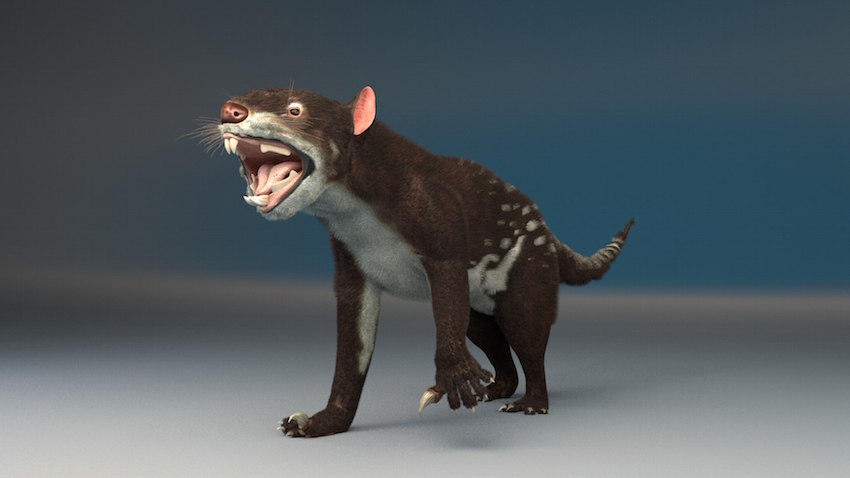
It is now late November and the baby Thylacine has finally left the safety of the pouch and is taking his first independent steps into a wider world. The Australian summer is now in full swing. Conditions are much hotter and drier, and all animals are feeling the strain. One such animal is Genyornis. Genyornis is a flightless bird that is part of the ratite family; the same family that contains the Ostrich of Africa and another Australian bird called the Emu. However Genyornis is a giant, and at 2 metres tall it is about 6 times bigger than a regular Emu. Genyornis is a vegetarian, feeding on leaves and seeds, and it is this that draws it close to a nearby tree. The tree also provides much needed shade and allows the Genyornis some respite from the hot sun. But it is not as safe as it thinks it is. The Genyornis looks round, alerted by a sound coming from the nearby bush. But before the bird can even react a powerful marsupial slams into it and bites very hard into the Genyornis’ neck. It’s all over in just a few seconds. This predator is the largest Mammalian carnivore in Australia; a Thylacoleo. The Thylacoleo looks around, checking that no other large predator has caught wind of the fresh kill, then drags the big carcass up into the safety of the tree to consume at her leisure. Unbeknownst to her the female Thylacine and her joey have been awoken by the disturbance. Thylacines are nocturnal, meaning they operate mostly between Dusk and Dawn, and so the pair were taking the opportunity to have a daily siesta! The mother knows better than to linger around a full grown Thylacoleo and ushers her joey away to find a quieter place to nap. At first glance Thylacoleo looks similar to the big cats that occupy the rest of the world. However like Diprotodon this “Marsupial Lion” is actually another relative of the wombat. Thylacoleo is an incredible animal, perhaps the most unique mammalian carnivore to ever live. The bite that instantly ended the Genyornis’ life is the strongest pound for pound bite of any mammal ever! It’s even stronger than an African Lion despite Thylacoleo being nearly half its size! Like big cats Thylacoleo possesses large retractable claws and these, along with its dentition of large stabbing incisors and sharp shearing carnassials (i.e. molars) make this marsupial quite the formidable hunter. The Thylacine family definitely made the right choice in avoiding it!

File:Leon marsupial, Thylacoleo carnifex 3d restoration.jpg - Wikimedia  Commons
Thylacoleo. The most unique Mammalian carnivore to ever exist.
Image Credit: Jose Manuel Canete, https://commons.wikimedia.org/wiki/File:Leon_marsupial,_Thylacoleo_carnifex_3d_restoration.jpg

Fast forward to early February and the end of the Australian summer is approaching. With each passing day the baby Thylacine grows stronger and more independent. He also isn’t the only youngster around anymore. Not far from the Thylacine family a group of Procoptodon (or “Short Faced Kangaroos) lie in the shade of the nearby trees. These giant members of the Kangaroo family grow up to 2 metres tall and weigh 230 kilograms. Despite this size, they are still capable of hopping and reaching great speeds as other kangaroo species are*. They’re also just as dangerous, a fact that two males are demonstrating by sparring together. The kicks from their strong legs can crack bones and result in serious internal bleeding. But in this session both males walk away scot free. The Procoptodon joeys are also sparring, copying the behaviour of the males. But for these youngsters this is more playfighting than real sparring! Life for our Thylacine family finally seems peaceful. But there’s a dangerous smell in the air. The smell of smoke. A fire has started in the east, and to the sides of the flames are the cause. Humans. Their flaming torches have lit the surrounding dry grass with the aim of driving the Procoptodon out into the open. However the fire has also engulfed all the other animals in the area and all around the flickering red and orange flames the Thylacine mother and child hear the terrified cries of animals engulfed by smoke and flames. The fire spreads panic and chaos all over the place and out of the nowhere the mother Thylacine is smacked into by another big animal. Both animals are dazed by the blow and the mother Thylacine looks up at the Thylacoleo, who has managed to shake off the blow and stagger to her feet. This is a nightmarish for the Thylacine and yet all she can think of is the safety of her joey somewhere in the fire. But the Thylacoleo could care less about the Thylacine right now and runs on past her. In shear panic the Thylacoleo had only accidently ran into the Thylacine while trying to escape! The mother Thylacine desperately calls out for her joey. One coughing bark; nothing. Another two barks; still nothing! The fear is absolutely overwhelming now and to her it truly feels like the end of her world. But then she hears a bark, one she recognises! It’s her joey, still alive! The pair run for their lives but no matter which way they turn the fire blocks their path. Running out of places to go there seems to be no escape as the fire surrounds them and starts to burn brighter and hotter….

File:Procoptodon BW.jpg - Wikimedia Commons
Procoptodon: The giant kangaroo targeted by the fire wielding humans!
Image Credit: Nobu Tamura, http://1.bp.blogspot.com/-caAabAGbDtI/T9UY-vMc6oI/AAAAAAAABoI/ARER5hK_3Dw/s1600/Procoptodon_BW2.jpg

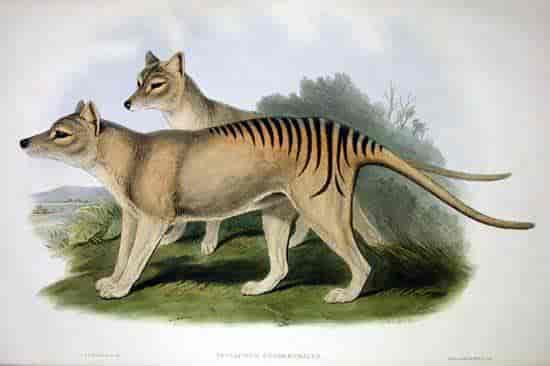
Later that evening the fire finally dies down. The humans have long since moved on with their prizes. But in their wake lie the consequences of their actions. From black widow spiders, to wallabies, to Diprotodons and Procoptodons all manner of life has burnt to a crisp. Not even the mighty Megalania and Quinkana, those two reptiles vying for top predator supremacy, could escape the flames. As fierce as they were, they were ultimately no match for a species who could wield a superweapon like fire. Luckily our Thylacine family managed to survive the fire by seeking refuge in a large and deep burrow. Walking through the burned vegetation and past the bodies, the mother recognises a familiar face. It is the female Thylacoleo. Once a great threat to our Thylacine, the Thylacoleo lies motionless with smoke floating from her burnt skin like a blown out candle. The Thylacine regards her from as close as she has ever managed before. But this time there’s no response, and after a while the Thylacine and her child, as always, are forced to move on to survive. This tragedy is a sign of things to come for the great megafauna of Australia. Even 50,000 years ago species like the Thylacoleo are in decline and within 30,000 years nearly all of the spectacular animals we have encountered on this journey will have disappeared. While the humans’ efficient hunting strategies are a threat the herbivores of Australia are unprepared for, and one the carnivores can’t hope to match, they are not the main reason why the megafauna disappear. By comparing the extinction dates of the Australian megafauna with the arrival of humans it was found that they were actually able to co-exist together for nearly 20,000 years, a piece of information that doesn’t correlate with overhunting. Instead there is another danger, one more devastating than even the humans; the changing climate. Over time Australia becomes even drier and more arid. This results in habitat loss and without their habitat this Ice Age ecosystem will not be able to survive. As for the plucky Thylacines, they will manage to cling on for a while longer. However even they will eventually be unable to adapt to the new human world. After going extinct on mainland Australia 2,000 years ago they were reduced to a small population living exclusively on the island of Tasmania, leading to their more commonly known name of “The Tasmanian Tiger”. However the arrival of Europeans in Tasmania would put them under even greater pressure than before. Their habitat was destroyed to make way for farms, imported disease would strike them down and Europeans would kill them in the mistaken belief that they hunted their sheep and cattle. The last Thylacine, a male that’s often incorrectly thought to have been called Benjamin, passed away on the 7th of September 1936 in Beaumaris Zoo in Hobart Australia. Tragically it is thought that he was a victim of neglect, locked out of his shelter and left out in the bitter cold of the Australian night. It was a truly sad end to a species that was a remnant of a lost world.

pungulv – Store norske leksikon
The Thylacines. The plucky heroes of this safari!
Image Credit: John Gould, https://snl.no/pungulv

*EDIT: This sentence is inaccurate and a mistake on my part! Procoptodon and its relatives, the Sthenurinae Kangaroos, are NOT thought to have hopped like modern Kangaroos do. Instead the currently accepted theory is that they walked on two legs (a bit like humans do). This idea was put forward by a study published in 2014 by Janis, Buttrill & Figueirido and backed up by a 2019 paper by Janis et. al. Links to both papers can be found below in the References/Further Reading section.

References/Further Reading

An article on the National Museum Australia’s website about the extinction of the Thylacine in 1936

National Museum Australia, “Extinction of the Thylacine”, National Museum Australia, www.nma.gov.au, https://www.nma.gov.au/defining-moments/resources/extinction-of-thylacine#:~:text=On%207%20September%201936%20only,the%20time%20of%20European%20settlement.

Rovinsky et. al. 2020. A paper that provides a new size estimate for the Thylacine

Rovinsky Douglass S., Evans Alistair R., Martin Damir G. and Adams Justin W. 2020Did the thylacine violate the costs of carnivory? Body mass and sexual dimorphism of an iconic Australian marsupialProc. R. Soc. B.28720201537, http://doi.org/10.1098/rspb.2020.1537

An interesting web page from the Thylacine Museum section on the Natural Worlds website on Thylacine Reproduction and Development

Natural Worlds, “Biology: Reproduction and Development”, www.naturalworlds.org, http://www.naturalworlds.org/thylacine/biology/reproduction/reproduction_2.htm?fbclid=IwAR13a8Y9GJTCG6vT2vR-GNc8Xv96M7t5aYSE8WsQKjCTaojxQFIZJeju6EM

And another web page from the Thylacine Museum on Thylacine sounds.

Natural Worlds, “Vocalisation”, http://www.naturalworlds.org, http://www.naturalworlds.org/thylacine/biology/behaviour/behaviour_12.htm

• A video by Ben G Thomas (uploaded coincidentally while I was writing this blog article) about the Marsupial Lion, Thylacoleo

An article written by Alice Klein for New Scientist on Thylacoleo

Klein, Alice, “Australia’s ‘marsupial lion’ was a meat-ripping, tree-climbing terror”, New Scientist, www.newscientist.com, 12th December, 2018, https://www.newscientist.com/article/2187990-australias-marsupial-lion-was-a-meat-ripping-tree-climbing-terror/

An article on National Geographic by Laelaps (Riley Black) on the new size estimate of the giant monitor lizard Megalania.

Black, Riley, “Australia’s Giant, Venomous Lizard Gets Downsized”, National Geographic, March 19, 2014, www.nationalgeographic.com, https://www.nationalgeographic.com/science/phenomena/2014/03/19/australias-giant-venomous-lizard-gets-downsized/

Hocknull et. al. 2020: A study that provided evidence that the extinction of Australias megafauna (specifically in the Eastern Sahul region) was mainly due to a changing climate.

Hocknull, S.A., Lewis, R., Arnold, L.J. et al. Extinction of eastern Sahul megafauna coincides with sustained environmental deterioration. Nat Commun 11, 2250 (2020). https://doi.org/10.1038/s41467-020-15785-w

A 2017 article published on The Conversation, written by Gilbert Price, about Diprotodon and it’s seasonal migrations across Ice Age Australia

Price, Gilbert, “Giant marsupials once migrated across an Australian Ice Age landscape”, 27th September, 2017, www.theconversation.com, https://theconversation.com/giant-marsupials-once-migrated-across-an-australian-ice-age-landscape-84762?fbclid=IwAR0G3JDp8KZo-HTLBPIPGIyu2mMKW6yAZ5RlAipREqCL0VZjckZkZhvvGXM

The Australian Museums factfile on Procoptodon. Last updated in 2018 and written by Anne Musser

Musser, Anne, “Procoptodon goliah”, 4th December, 2018, www.australian.museum.com, https://australian.museum/learn/australia-over-time/extinct-animals/procoptodon-goliah/

Janis, Buttrill & Figueirido 2014 paper on Sthenurine (e.g. Procoptodon) locomation

Janis CM, Buttrill K, Figueirido B (2014) Locomotion in Extinct Giant Kangaroos: Were Sthenurines Hop-Less Monsters? PLoS ONE 9(10): e109888. https://doi.org/10.1371/journal.pone.0109888

Janis et. al. 2019 paper that followed up the 2014 study on Sthenurine locomotion by examining the humerus bones of these extinct giant Kangaroos

Janis, C.M., Napoli, J.G., Billingham, C. et al. Proximal Humerus Morphology Indicates Divergent Patterns of Locomotion in Extinct Giant Kangaroos. J Mammal Evol 27, 627–647 (2020). https://doi.org/10.1007/s10914-019-09494-5

Prehistoric Wildlife’s factfile on Genyornis

Prehistoric Wildlife, “Genyornis”, www.prehistoric-wildlife.com, http://www.prehistoric-wildlife.com/species/g/genyornis.html

Aepyornis and the Elephant Birds of Madagascar

File:Aepyornis maximus 01 L.D..jpg
A front view reconstruction of Aepyornis.
Image Credit: Acrocynus, https://it.wikipedia.org/wiki/File:Aepyornis_maximus_01_L.D..jpg

While it seems like I already know a bit about prehistoric life, before each of these blog articles I make sure to do my research on the animal that I aim to talk about, as any blog writer should do regardless of their subject area. During my research I not only broaden my knowledge, but also gain an extra appreciation for the animal in question. In the case of todays subject, Aepyornis (Greek for “high bird”), more commonly known as the “Elephant Bird”, my research showed just how little I actually knew about it. Aepyornis was a much more fascinating animal than I had realised (not just “a big ostrich”), and in this blog I aim to put the spotlight on this underrated animal.

For starters there wasn’t just one “Elephant Bird”; there was a whole family of them! “Elephant Bird” is the common name given to a family of flightless, bipedal, ostrich-like herbivorous birds from Madagascar known as the Aepyornithae. The “Elephant Bird” name originates from tales of the “Roc”; a legendary giant bird spoken of by Arab traders and written about by the famous explorers Marco Polo (13th century) and Ibn Battuta (14th century). It was also one of the monsters that the adventurer Sinbad encountered in “The Arabian Nights” tales (first published in the 18th century). It was said to be so big that it could carry an elephant in its talons. Polo in all likelihood based his Roc description on accounts of large, lemur hunting Malagasy Crowned Eagles that lived on Madagascar until the 16th century. However reports from other travellers of massive eggs, which belonged to Aepyornis, became associated with the Roc, and so the Aepyornithae family became collectively known as “Elephant Birds”. The Aepyornithae belonged to a larger order of birds known as the Ratites. This is the same group that contains ostriches, emus and cassowaries. You may think that since the Elephant Birds lived on Madagascar their closest relatives would be African ostriches since Madagascar lies off the East African coast. However this is not the case. Their closest living relatives are actually kiwis; small flightless birds which have long, thin beaks, reduced eyesight and are also ratites. Kiwis live only on New Zealand, which is 7,000 miles east of Madagascar! So how are these two birds so closely related despite living so far apart? Well the theory is that around 60 million years ago the common ancestor of kiwi’s and Elephant Birds still possessed flight and flew to these two separate islands, establishing colonies. Then, over millions of years, the two islands drifted further apart from each other (out of flying range) and the two separated populations both evolved flightlessness, independently of one another.

Another result of living on an isolated island for much of their evolution, and with no large mammalian herbivores to compete with, is that the Elephant Birds could grow to massive sizes. Aepyornis was no different and was thought to have been the largest bird that ever lived until relatively recently. Originally it was believed that Aepyornis maximus could grow to heights of more than 3 metres and weigh up to 800kg. However a study in 2018 by Hansford & Turney showed that there were enough skeletal differences between these largest specimens and other Aepyornis for these large Aepyornis to be re-classified as a new member of the Aepyornithae family (alongside Aepyornis and another Elephant Bird named Mullerornis). It was given the rather striking name of Vorombe titan, which is a combination of Malagasy and Greek and translates to “big bird” (Vorombe = Malagasy for bird, titan = Greek for big). As a result the size estimates of Aepyornis is now considered to be a more modest 2.5 metres tall and 400-500kg in weight on average, which is still larger than any living bird! Another of Aepyornis’ (and other Elephant Birds’) claims to fame is their humongous eggs. At their biggest they measured 34cm long, had a circumference of a metre and weighed 15 kilos. That’s 150 times bigger than a chicken egg, larger than any dinosaur egg and the largest eggs of any animal ever. Imagine the fried egg you would get from that! It wouldn’t just be enough for your breakfast; it would be enough to feed your entire family for the whole day! Such huge eggs would have meant that Elephant Bird chicks would have been more highly developed compared to other birds and the lack of any large egg thieves (before humans arrived) meant that it would have been safer for Elephant Birds to lay these eggs.

An Aepyornis egg (the large one!) from Museo Capellini in Bologna, Italy.
Image Credit: Ghedoghedo, https://commons.m.wikimedia.org/wiki/File:Aepyornis_egg.JPG

Aepyornis held the ecological niche of “large herbivore” on Madagascar. Its diet consisted of fruit, grasses and leaves and Aepyornis used its strong neck and overall size to reach them, before biting off and swallowing chunks with its beak. Unlike a lot of other large herbivores recent research has suggested that Aepyornis was a mostly nocturnal animal. The evidence comes from another 2018 study (by Torres & Clarke) where Aepyornis braincases were examined with a CT scanner. This produced a 3D model that the researchers could manipulate and examine in detail. Using this they discovered that Aepyornis had enhanced olfactory lobes (the part of the brain that processes smells) and reduced optic lobes (the part of the brain that processes vision). This is a similar, albeit less extreme, version of the brain structure of kiwis; which are nocturnal birds with limited vision and a reliance on smell to sense their environment. Furthermore Torres & Clarke also showed that different Aepyornis species had slightly different sensory lobes. You see there are two recognised species of Aepyornis; Aepyornis maximus (the larger, forest dwelling one) and Aepyornis hildebranti (the smaller, plains dwelling one). In A.maximus the olfactory lobes were proportionally larger, and the optic lobes proportionally smaller, than in A.hildebranti. This is presumably because A.maximus lived in dense rainforests, where eyesight is less useful due to the dense trees, while A.hildebranti lived in the open plains where the lack of dense trees meant they could see greater distances.

Aepyornis shared its Madagascan home with a menagerie of recognisable animals still alive today, such as Ring-tailed lemurs, Fossas and Chameleons. However it also lived alongside some strange animals that are no longer around. These included Archaeoindris, a giant lemur that was the size of a Silverback gorilla, the aforementioned Malagasy crowned eagle which modern lemurs still possess an innate fear of even though it is now extinct, and giant tortoises similar in size and lifestyle to the modern day Galapagos giant tortoise. So once upon a time Madagascar had an even greater diversity of life than it does now. However there are no Elephant Birds, giant lemurs, huge tortoises or giant eagles anymore. This is thought to have been mainly due to change in climate, which lead to changes in food availability. The actions of humans are also commonly linked to the disappearance of many Madagascan animals. However they may not have played as big of a role as previously thought. Yet another 2018 study (2018 should be renamed “Year of the Elephant Bird” due to all the studies carried out that year!) dated Elephant Bird bones that showed distinctive cut marks made by human tools to 10,500 years ago, the end of the Pleistocene period and start of the Holocene period. This was a whole 8,000 years earlier than humans had previously been thought to have reached Madagascar. Since Aepyornis and other Elephant Birds became extinct sometime between the 10th-12th Centuries (though sightings had been reported to as late as the 17th century) this means that humans co-existed with the birds for longer than previously thought. So they couldn’t have quickly hunted them to extinction as had been previously assumed. However this doesn’t mean that Aepyornis wasn’t a target for humans or that human activity wouldn’t have affected their numbers. For one the sheer size of both the animal and especially its eggs (which could be quickly poached from Aepyornis nests) would have been an attractive prospect for human hunters. For another humans were converting the Madagascan forests and plains into farmland, destroying Aepyornis’ habitat, and domesticated chickens and guinea fowl brought to Madagascar may have passed on bird related diseases to Aepyornis, which it had no immunity to.

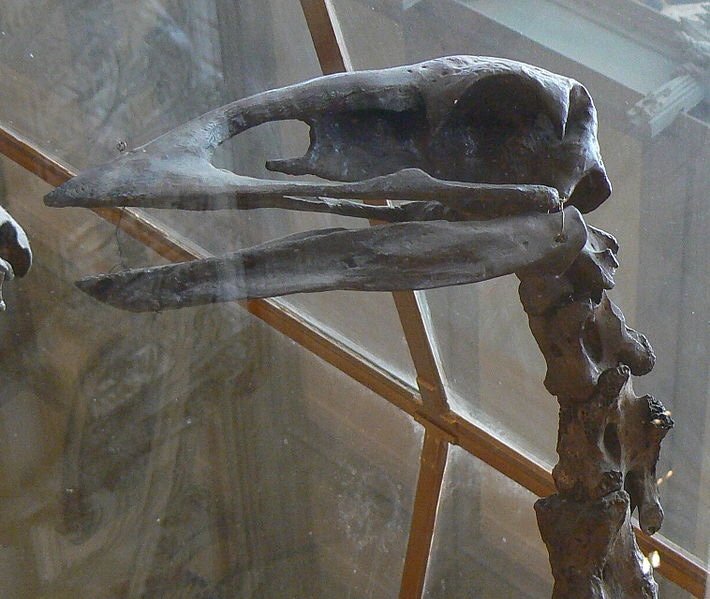
Aepyornis skull from a skeleton at the Muséum national d’Histoire naturelle in Paris, France
Image Credit: LadyofHats, https://zh.m.wikipedia.org/wiki/File:Aepyornis_skull.JPG

So overall, Aepyornis was a truly splendid animal, with a much more varied and detailed history and lifestyle than at first glance. The Elephant Birds are reminiscent of a time 65 million years ago when the close relatives of birds ruled the world. The dinosaurs were long gone, but in this little corner of the world Aepyornis and its family carried on their legacy.

References/Further Reading

Torres & Clarke 2018: a study of the braincases of the Elephant Bird, and what it tells us about their noctournalism

Christopher R. Torres and Julia A. Clarke 2018, Nocturnal giants: evolution of the sensory ecology in elephant birds and other palaeognaths inferred from digital brain reconstructions, Proc. R. Soc. B.28520181540, http://doi.org/10.1098/rspb.2018.1540

Hansford & Turney 2018: a study on the diversity of the Elephant Bird (Aepyornithae) family, showing that the largest Aepyornis were actually a different species of Elephant Bird: Vorombe Titan

James P. Hansford and Samuel T. Turvey 2018, Unexpected diversity within the extinct elephant birds (Aves: Aepyornithidae) and a new identity for the world’s largest bird, R. Soc. open sci.5181295, http://doi.org/10.1098/rsos.181295

Hansford et. al. 2018: a study on Elephant Bird bones with human made cut marks dating from as far back as 10,500 years ago

James Hansford, Patricia C. Wright, Armand Rasoamiaramanana, Ventura R. Pérez, Laurie R. Godfrey, David Errickson, Tim Thompson, Samuel T. Turvey. Early Holocene human presence in Madagascar evidenced by exploitation of avian megafauna. Science Advances, 2018; 4 (9): eaat6925 DOI: 10.1126/sciadv.aat6925

An American Museum of Natural History page about the association of the Roc and Aepyornis, part of their “Mythic Creatures” exhibition

“Strike from the Sky”, Mythic Creatures Exhibition, American Museum of Natural History, https://www.amnh.org/exhibitions/mythic-creatures/air/strike-from-the-sky

A Smithsonian magazine article about the giant eggs of the Elephant Birds

Katz, Bridget, “Giant, Intact Egg of the Extinct Elephant Bird Found in Buffalo Museum”, Smithsonian Magazine, April 23rd, 2018, https://www.smithsonianmag.com/smart-news/giant-intact-egg-extinct-elephant-bird-found-buffalo-museum-180968850/

Bolton, Houston & Monaghan 1992: A study on the link between large eggs and survivability of baby birds

Bolton, M., Houston, D., & Monaghan, P. (1992). Nutritional Constraints on Egg Formation in the Lesser Black-Backed Gull: An Experimental Study. Journal of Animal Ecology, 61(3), 521-532. doi:10.2307/5607