Dakotaraptor: The Thief from Hell Creek

A sketch of Dakotaraptor, complete with gorgeous feathering!
Image Credit: Mariomassone, https://commons.m.wikimedia.org/wiki/File:Dakotaraptor_sketch.jpg

If there was only one place and time that I could take someone new to the topic of dinosaurs, it would undoubtedly be Hell Creek, 65 million years ago. Here, in an environment of lush forests and temperatures similar to Spain today, lived a variety of instantly recognisable dinosaur icons. You could see a Triceratops lumbering through the woods, view a herd of Edmontosaurus browsing the nearby vegetation, hear two Pachycephalosaurus crashing their heads together and ensure to keep us a safe distance from the solid club tail of an Ankylosaurus. To cap it all off you would see the most famous dinosaur of them all, Tyrannosaurus Rex. In one area I could show someone a ceratopsian, a hadrosaur, a pachychephalosaur, an ankylosaur and a tyrannosaur all in one afternoon. Now, thanks to new fossils described only four years ago, you can add a large dromaeosaur (aka, “raptor”) to that list.

This animal has been given the name Dakotaraptor steini (“Stein’s Dakota Thief”), after the State of Dakota where Hell Creek is located and in honour of palaeontologist Walter Stein. It was discovered by a team led by Robert DaPalma, who described some partially articulated fossilised skeletons of a few individuals including arm and leg bones, some tail vertebrae and teeth. There was also a “wishbone” that was thought to belong to Dakotaraptor, however a study by Arbour et al in 2016 showed that this was actually a turtle bone (an honest mistake on the DePalma and his teams part!) These fossils showed that this dinosaur was no chicken! Measuring 5 and a half metres long and 1.8 metres tall it would have been almost exactly the same size as the famous Velociraptors from the film Jurassic Park. However for a large raptor Dakotaraptor was relatively lightweight, partly due to its vertebrae having air spaces within them. Combing this with legs built for long strides and Dakotaraptor would have been able to achieve top speeds of around 30-40 mph, that’s as fast as a greyhound! Just like the Jurassic Park raptors, Dakotaraptor would have been a lethal predator, hunting in packs to take down large herbivorous dinosaurs. To do this Dakotaraptor needed some serious weaponry, luckily that’s just what it had in the form of the raptors signature weapon; the killing claw on its feet. Dakotaraptor’s was especially big, measuring 9 and a half inches, with a serrated hook shaped end. It used to be thought that raptors used their claw in order to violently slash and disembowel prey. However it is now thought that the claws were mainly used to hold onto large struggling prey and to pin down smaller animals, rather like a modern bird of prey.

A illustration of Dakotaraptor showing the position of all the known bones (highlighted in white).
Image Credit: PaleoNeolitic, https://commons.m.wikimedia.org/wiki/File:Dakotaraptor_Skeleton_Reconstruction.jpg

The resemblance to birds doesn’t end there. Dakotaraptor, just like all other raptors, was completely covered in feathers (sorry if I’ve just ruined your childhood memories of scaly raptors!). In fact Dakotaraptor is the first large raptor to have direct evidence of feathers (previously it had been inferred that they had them based on smaller relatives possessing them). On its ulna (one of the arm bones) palaeontologists discovered a series of 15 regular notches running along the bone. These notches are called quill knobs and their purpose is to act as anchor points for long pennaceous feathers to attach to. As a result Dakotaraptor would have sported a small pair of wings! However these wings weren’t strong enough for flight (Dakotaraptor was already lethal enough without needing to fly!) Instead, through flapping and balancing motions it could have helped keep the raptor steady while running or holding on to prey. Wing feathers could also have been for display, with potentially bright colours being used to attract a mate or to show off to rivals (a trait common in modern birds). Feathers could have made the animal look bigger and more intimidating and could even be used to cover its young while nesting. With a full head and body of soft feathers, a feathery tail fan and small wings, you might have mistaken Dakotaraptor (and other raptors for that matter) for a giant grounded eagle or hawk from a distance.

Being discovered at Hell Creek also means that Dakotaraptor, just like Tyrannosaurus and Triceratops, was one of the last of the dinosaurs. It would have lived right up until the end of the Cretaceous period and would have been another victim of the asteroid strike on the Gulf of Mexico 65 million years ago. After the impact and resultant climate change the vegetation that its plant eating prey relied on disappeared. With its prey gone Dakotaraptor would disappear too, and with it the entire line of fast, remarkably bird like dinosaurs known as the dromaeosaurs would be no more.

Size comparison between Dakotaraptor and an adult human. With how close the human is he won’t be waving for long!
Image Credit: Matthew Martyniuk, https://commons.m.wikimedia.org/wiki/File:Dakota_raptor_scale_mmartyniuk.png

Now I’m going to end this blog with the question that I’m sure some people would be asking. Would Tyrannosaurus Rex and Dakotaraptor have clashed? Such confrontations would have certainly been possible as the two dinosaurs lived in the same place at the same time, and might have hunted similar prey at times. However fights may not actually have been that common. Dakotaraptor would have mostly targeted smaller and faster prey than T-Rex. As a result of this it would have occupied a different role (or “niche”) in the Hell Creek environment, that of a medium sized predator. This idea is called “niche partitioning” and we see it happen today on the African savannah, where cheetahs hunt fast gazelles while lions hunt the larger wildebeest, and so don’t compete with each other (except over a carcass). As a result Dakotaraptor might not have directly competed with Tyrannosaurus Rex for food. But for the sake of fun, what if they had come into conflict? Well a single Dakotaraptor would probably have fared against an adult T-Rex about as well as the Velociraptor at the end of Jurassic Park did! However a pack of Dakotaraptors against an adult, or an adolescent T-Rex would have been a different proposition. One could even envision a Dakotaraptor pack chasing a Tyrannosaurus off a kill in exactly the same way as a pack of Hyenas do to Lions on the African Savannah. So that fight between a T-Rex and a raptor at the end of Jurassic Park could have happened, just with a lot more feathers flying around!

UPDATE: A new study (Frederickson, Engel & Cifelli 2020), published in the journal Palaeonon the 3rd of May 2020, has cast doubt on the theory that raptors like Dakotaraptor lived and hunted in packs. The study examined the level of tooth carbon isotopes in juvenile and adult Deinonychus, a smaller and earlier relative of Dakotaraptor. What they found was the carbon isotope levels were rich in juveniles but depleted in adults. This indicates that they were eating different prey and this difference is consistent with animals like crocodiles who don’t live in packs. In pack hunting animals, such as Lions, both young and adult individuals eat the same food as they’re often sharing a kill between members of the group, so have the same or similar tooth carbon isotope level. In short, raptors like Dakotaraptor May have lived a more solitary life.

References/Further Reading

A National Geographic article, written by Ed Yong, on the use of the raptors killing claw

Yong, Ed, “Deinonychus and Velociraptor used their killing claws to pin prey, like eagles and hawks”, National Geographic, Dec 14, 2011, nationalgeographic.com/science/phenomena/2011/12/14/deinonychus-and-velociraptor-used-their-killing-claws-to-pin-prey-like-eagles-and-hawks/

The DePalma et. al. 2015 paper describing the first Dakotaraptor fossils

DePalma, Robert A., Burnham, David A., Martin, Larry D., et. al., The first giant raptor (Theropoda: Dromaeosauridae) from the Hell Creek Formation, Paleontological Institute, Paleontological Contributions;14, (2015), https://doi.org/10.17161/paleo.1808.18764

The Arbour et. al. 2016 paper that pointed out that one of the fossils was actually a turtle

Arbour VM, Zanno LE, Larson DW, Evans DC, Sues H. 2016. The furculae of the dromaeosaurid dinosaur Dakotaraptor steini are trionychid turtle entoplastra. PeerJ 4:e1691 https://doi.org/10.7717/peerj.1691

Another blog, by Brian Switek, talking about possible interactions between Dakotaraptor and T-Rex

Switek, Brian, “Did Dakotaraptor Really Face Off Against Tyrannosaurus?”, goodreads, Nov. 25, 2015, goodreads.com/author/show/3958757.Brian_Switek/blog?page=23

Frederickson, Engel & Cifelli 2020 study that used tooth carbon isotope data to indicate that raptors may not have been pack hunters (EDIT)

J.A. Frederickson et al, Ontogenetic dietary shifts in Deinonychus antirrhopus (Theropoda; Dromaeosauridae): Insights into the ecology and social behavior of raptorial dinosaurs through stable isotope analysis, Palaeogeography, Palaeoclimatology, Palaeoecology (2020). DOI: 10.1016/j.palaeo.2020.109780

Hatzegopteryx: The King of Hațeg Island

The Kings of the Island
Image Credit: Mark Witton, https://commons.m.wikimedia.org/wiki/File:Hatzegopteryx.png

A wildlife safari to the island of Hațeg was going to be perfect they said. Warm sunny beaches, unspoiled wilderness and herbivorous dinosaurs small enough to ride like ponies. What could possibly go wrong!

But now the tourists are running for their lives through the fields of ferns, not daring to stop as the top predators of the island follow closely behind. They had been warned that they were dangerous, but their guide had said that they would be fine, they wouldn’t get too close and he would use his gun if they did. Sadly the guide had been eaten about fifteen minutes ago. The tourists keep going, trying to get as far away from the rasping squawks as they can. One of them is picked up of the ground, disappearing out of sight. Another suffers the same fate. Suddenly the last one trips and rolls forward. Coughing and spluttering he turns around, and sees one of the beasts towering over him. It regards him with its beady eyes before leaning its large head down and grabbing his leg with its beak. The beast leans its head back and with one final gulp the tourist joins his friends. The island once again belongs to its king.

The movie executives look up from the script they’d just read. “Okay who sent this in?”, one asks. “I think it was the same guy who sent in the one about the giant killer centipede, Arthro-something?” the other replied. With a sigh the first executive tosses the script onto a large pile in the corner.

Who needs alien monsters when prehistory keeps giving us animals to make movies about! First there was the giant creepy-crawlies of the Carboniferous, now this!

Hatzegopteryx (meaning “Hațeg basin wing”) was a wonder of the Late Cretaceous. It was first discovered only 17 years ago in 2002, and described from fragmentary remains of skull, humerus and femur. Initially these fossils were thought to belong to a large carnivorous dinosaur. However further study showed that they belonged to a flying reptile – a Pterosaur. Pterosaurs were a group of reptiles that dominated the skies during the Mesozoic era, going extinct sixty five million years ago at the end of the Cretaceous period. They had wings consisting of thin complex structures that stretched from their lower bodies to the end of an elongated fourth finger. Hatzegopteryx in particular belonged to the sub group of pterosaurs known as the azhdarchids. The azhdarchids appeared in the Late Cretaceous and grew to gigantic proportions even by pterosaur standards. They were the largest flying animals to ever live. Hatzegopteryx was no exception, with a wingspan of up to twelve metres long. Despite its large size (and some palaeontologists claiming that they had evolved to be flightless) such a large animal was able to fly because it was surprisingly lightweight. Even the largest azhdarchid pterosaurs have been estimated to weigh only 550 pounds. This is due to a combination of weight saving hollow bones and soft tissue air sacs, which also provided an oxygen reserve for powered flight. In flight azhdarchids such as Hatzegopteryx would have wasted little energy flapping, instead soaring on rising air currents like a modern day vulture. This allowed them to cover great distances, up to 10,000 miles in some estimates. Like almost all pterosaurs Hatzegopteryx would also likely have had a body covering of soft down known as pycnofibres. This down, while feather-like, was different to the feathers of birds and used in insulation rather than for display or flight.

Hatzegopteryx humorous bones from above (A) and from the side (B)
Image Credit: Mark Witton & Michael Habib, http://www.plosone.org/article/info%3Adoi%2F10.1371%2Fjournal.pone.0013982

However despite being able to fly Hatzegopteryx would not have done its hunting whilst airborne. Instead, and rather unusually for a pterosaur, it hunted on the ground. When grounded Hatzegopteryx stood at a height of around five metres, which is as tall as a modern day giraffe! From this high vantage point Hatzegopteryx could survey the landscape, looking for any small dinosaurs it could catch. Able to comfortably stride across the landscape using all four limbs, Hatzegopteryx would pick up and swallow whole any small animals it could find while using its sharp beak to kill any larger individuals. Such a hunting strategy is not too dissimilar to that employed by modern day storks and hornbills, except on a much larger scale. Hatzegopteryx managed this hunting style because of its huge skull. At three metres long and half a metre wide it was the longest skull of any land based animal. This was a powerful beaked weapon that was supported by a relatively short but hugely muscular neck. This short neck is a relatively new discovery and stems from a 2017 paper written by Palaeontologists Mark Witton and Darren Naish. This skull and neck is different to other azhdarchids, such as Quetzelcoatlus and Cryodrakon, which tended to have longer necks and thinner skulls.

A 3 metre long skull of Hatzegopteryx (Top) compared with the 1.5 metre long skulls of Spinosaurus (Bottom right) and Giganotosaurus (bottom left)
Image Credit: Wikimedia Commons, https://commons.m.wikimedia.org/wiki/File:Skulls_length_comparison_of_Hatzegopteryx,_Spinosaurus_and_Giganotosaurus.png. Based on images from Therrien & Henderson 2007 and Buffetaut, Grigorescu & Csiki 2002.

Hatzegopteryx was first discovered in Transylvania in Romania, in the same area that Bran Stokers Dracula lived (though I’m sure Hatzegopteryx would have eaten Dracula for lunch then eyed up Van Helsing as seconds!). 70 million years ago this area was an island, roughly the size of Ireland, known as Hațeg Island. Hațeg was a subtropical environment, consisting of broadleaf forests, open plains and a hot climate. If it were around today it would be heaving with tourists – Hatzegopteryx permitting. What makes the island uniquely interesting were the dinosaurs that lived there. Consisting of a mix of sauropods, hadrosaurs and small theropods, they were of a smaller size compared to their mainland counterparts. For example Magyarosaurus dacus, a species of titanosaur sauropod, had a maximum length of only six metres on Hațeg, compared to fifteen metres on mainland species. This is equivalent to finding an elephant the size of a donkey and is an example of “insular dwarfism”. This is when animals on an isolated island adapt to the limited resources by growing to smaller sizes. Hatzegopteryx on the other hand is an example of “island gigantism”, where in order to fill an empty ecological niche (in this case the role of “top predator” – there were no large carnivorous dinosaurs on Hațeg) an animal grows larger than usual. A modern day counterpart to Hațeg Island would be the Galapagos Islands, where we see similar diverged island evolutionary processes (e.g. the giant tortoise and numerous species of finches). Another example would be New Zealand, where in the absence of large mammals birds such as the Kiwi, the Moa and the Haast Eagle evolving to occupy the major ecological niches (the latter two only going extinct within the last 1000 years).

Hatzegopteryx would have been a marvel to witness flying. An extraordinary and complex achievement of natural aeronautical engineering, there has never been an animal quite like it. If Hatzegopteryx was alive today I’m sure the reptile/stork/giraffe hybrid would generate the same (if not more) fear as another famous blood sucking Transylvanian does.

EDIT: By a weird coincidence 3 days after this blog went up a new paper came out by (Solomon et. al. 2019) about the discovery of a new species from azhdarcid pterosaur from Transylvania! Known from fragments of beak and vertebrae and thought to represent a juvenile this new pterosaur has been named Albadraco tharmisensis. It has been estimated to have been only a little bit smaller than Hatzegopteryx and further illustrates the wide range of life that was present on Hațeg Island 70 million years ago!

References/Further Reading

Solomon et. al. 2019 paper on the new azhdarchid pterosaur Albadraco, which lived at the same place and time as Hatzegopteryx.

Solomon, A. A., et al. (2020). “A new species of large-sized pterosaur from the Maastrichtian of Transylvania (Romania).” Cretaceous Research 110: 104316.

A paper by Darren Naish and Mark Witton (Naish & Witton 2017) on Hatzegopteryx neck length and biomechanics

Naish D, Witton MP. 2017. Neck biomechanics indicate that giant Transylvanian azhdarchid pterosaurs were short-necked arch predators. PeerJ 5:e2908 https://doi.org/10.7717/peerj.2908

A paper, written by a team led by Michael Benton (Benton et. al. 2010), on the dwarf dinosaurs of Haţeg Island.

Benton, M. J., et al. (2010). “Dinosaurs and the island rule: The dwarfed dinosaurs from Haţeg Island.” Palaeogeography, Palaeoclimatology, Palaeoecology 293(3): 438-454.

An article, written by Elizabeth Martin-Silverstone and published on The Conversation website, on Azdarchid Pterosaur flight.

Martin-Silverstone, Elizabeth, “Pterosaurs should have been too big to fly – so how did they manage it?”, The Conversation, Jun. 30, 2016, theconversation.com/pterosaurs-should-have-been-too-big-to-fly-so-how-did-they-manage-it-60892

Another interesting paper, Yang et. al. 2018, on Pterosaur’s feather-like pycnofibres

Yang, Z., Jiang, B., McNamara, M.E. et al. Pterosaur integumentary structures with complex feather-like branching. Nat Ecol Evol 3, 24–30 (2019). https://doi.org/10.1038/s41559-018-0728-7

Megalosaurus: The Original Dinosaur


An Artist reconstruction of Buckland’s great lizard
Image Credit: LadyofHats Mariana Ruiz, https://commons.m.wikimedia.org/wiki/File:Megalosaurus_dinosaur.png

There is no group of extinct life that enthrals the minds of the general public quite like dinosaurs. All palaeontologists both current and aspiring can claim to have at least been partially inspired by reading books and watching documentaries about dinosaurs, and from seeing their fossils and reconstructions in the many museums throughout the globe. Some dinosaurs have received vast amounts of media attention; the great Tyrannosaurus Rex; the three-horned Triceratops; and the long necked Brachiosaurus to name a few. However there is one dinosaur that can claim to be perhaps the most important of them all. Megalosaurus bucklandii is not as well-known as these other dinosaurs, which is quite surprising to me. However this medium-large sized theropod from the mid-Jurassic has every claim to live long in the history books.

Megalosaurus was the first dinosaur to be properly and scientifically described and the first animal to be referred to as a “dinosaur”. The first Megalosaurus fossils were discovered in the village of Stonesfield in Oxfordshire, England in the 18th century. These fossils came from a Mid-Jurassic (170-150 Million years old) deposit known as the “Stonesfield Slate”, a deposit that has also preserved the remains of other dinosaurs, pterosaurs, insects and plants of the time. The Megalosaurus fossils, originally described under the interesting name of Scrotum humanum, which was not formerly accepted by any scientific body, were passed on in 1824 to the geologist William Buckland, who in collaboration with the anatomist Georges Cuvier, identified the animal as a large extinct reptile. This animal was given the name Megalosaurus bucklandii, meaning “Buckland’s great lizard”. It was almost 20 years later in 1842 that Megalosaurus was referred to by Sir Richard Owen as a “dinosaur”. This discovery was quite unlike any living animal and captured the imagination of the Victorian public, with Megalosaurus making an appearance in the Charles Dickens novel Bleak House. This made it one of the first (but certainly not the last!) dinosaurs to appear in mainstream popular media.

A fossilised lower jaw and tooth of Megalosaurus. This jaw is one of the more iconic dinosaur fossils.
Image Credit: Wikimedia Commons, https://he.m.wikipedia.org/wiki/%D7%A7%D7%95%D7%91%D7%A5:Buckland,_Megalosaurus_jaw.jpg

Most of the Megalosaurus specimens that these early Victorian geologists had to go on were incomplete, with the only finds being a lower jaw, upper jaw, some teeth and a few thigh and leg bones. In addition this was really the first time anyone had attempted to reconstruct dinosaurs from their bones. So the Victorian scientists could only make educated guesses as to what this animal was like. While they knew, based on its tooth anatomy, that it was related to reptiles the first reconstructions of Megalosaurus were very different to what we believe today. Basing its design on modern lizards Megalosaurus was reconstructed as a massive, sluggish four legged animal, with its tail dragging along the ground and possessing a big hump on its shoulders. This interpretation can be seen in all its glory at the Crystal Palace Park in London. Unveiled in 1851 it is displayed stalking a group of equally lizard like Iguanodon, also inaccurate as Iguanodon would appear almost 40 million years after Megalosaurus (to name one inaccuracy!). It was only when further theropod remains were found a few decades later that a more accurate picture of Megalosaurus became clear. However during this time the Megalosaurus species was known as a “wastebasket taxon” where any newly discovered large theropod remains were all haphazardly lumped into the Megalosaur group, like somebody chucking different types of cutlery into the same drawer. Also the animal was portrayed, like other bipedal dinosaurs at the time, standing upright like a Kangaroo. This would only change nearly a whole century later, where research in the 1960s and 1970s led to all bipedal dinosaurs’ posture being altered to the more horizontally balanced forms seen today, where the head and body were counterbalanced by a long, lofted tail.

The Megalosaurus model at Crystal Palace park. This model, first revealed in 1851, shows us what Victorian Scientists thought it looked like.
Image Credit: Chris Sampson, https://commons.m.wikimedia.org/wiki/File:Crytsal_Palace_Megalosaurus.jpg

Whilst Megalosaurus has a long and important story about its discovery, and how it changed scientific thinking forever, what was this dinosaur actually like when it was alive? Well, Megalosaurus belonged to a group of theropods known as the Megalosauridae. This group were the main land predators of the early to mid-Jurassic period, dominating the landscape until their numbers declined during the late Jurassic 150 million years ago. Megalosaurus had many of the features that are typical of theropod dinosaurs; big hind legs, saurischian (lizard-like) hips, arms ending in non-pronated wrists, sharp claws and robust jaws filled with razor sharp teeth suitable for cutting and biting into the flesh of its prey. The powerful legs of Megalosaurus would have enabled it to reach speeds of up to 20 miles per hour, equivalent to a modern day Grizzly Bear and easily fast enough to chase down its prey. Once caught Megalosaurus would have attacked its prey with a powerful bite, its skull built for heavy impact by having a framework of slightly loose bones that, through flexing on impact were able to absorb the forces involved in biting and holding large struggling prey. Reaching up to nine metres long, three metres tall and weighing nearly one and a half tonnes it was the undisputed top predator of mid-Jurassic England, hunting large herbivorous dinosaurs, such as the long necked sauropod Cetiosaurus. However it would have needed to be an unfussy eater. During the Mid Jurassic, the UK was broken up into small islands, with Megalosaurus probably swimming from island to island and combing the beaches for any food it could find, including any marine reptiles, crabs and pterosaurs that had been beached. It is also possible, like a lot of other theropods, that Megalosaurus could have been at least partially feathered. Evidence for this comes from another megalosaurid called Sciurumimus. Found in the Late Jurassic of Germany this juvenile megalosaur was found preserved with a filamentous coating of feathers. While this isn’t direct evidence of feathers on Megalosaurus the fact that it is present on a close relative means that it is likely that it too possessed a similar coating, making it look a bit less like a scaly lizard and a bit more like a fluffy carnivorous bird. This new finding, put forward in a 2014 study by Rauhut et. al., would certainly have startled William Buckland, Richard Owen and the other Victorian scientists that first named this remarkable beast a “dinosaur”.

So, just as the 2008 film “Iron Man” was the start of the Marvel Cinematic Universe, and the Benz Patent Motor Car was the origin of today’s cars, the discovery of Megalosaurus was the genesis of dinosaur research. While T-Rex and others get the spotlight nowadays without this first description and reconstruction of this Mid-Jurassic Megalosaur from Oxford, dinosaurs would not have captured the public imagination in quite the way that they have. The field of palaeontology would perhaps have never evolved into the science it is today, and who knows, in that world I may have become an archaeologist!

References/Further Reading

Rauhut et al 2014 paper about feather filaments in the Megalosaur Sciurumimus

Rauhut, O. W. M., et al. (2012). “Exceptionally preserved juvenile megalosauroid theropod dinosaur with filamentous integument from the Late Jurassic of Germany.” Proceedings of the National Academy of Sciences 109(29): 11746-11751.

The Friends of Crystal Palace Dinosaurs page on the Megalosaurus model at Crystal Palace park, including comparisons with how the Victorian scientists thought it looked and behaved compared with modern interpretations

“Megalosaurus”, Friends of Crystal Palace Dinosaurs, cpdinosaurs.org/visit/statue-details/megalosaurus

More Information on Megalosaurus and other animals of the Stonesfield slate from the Oxford University Museum of Natural History website

“The Oxfordshire Dinosaurs”, Oxford University Museum of Natural History, oumnh.ox.ac.uk/megalosaurus-and-oxfordshire-dinosaurs

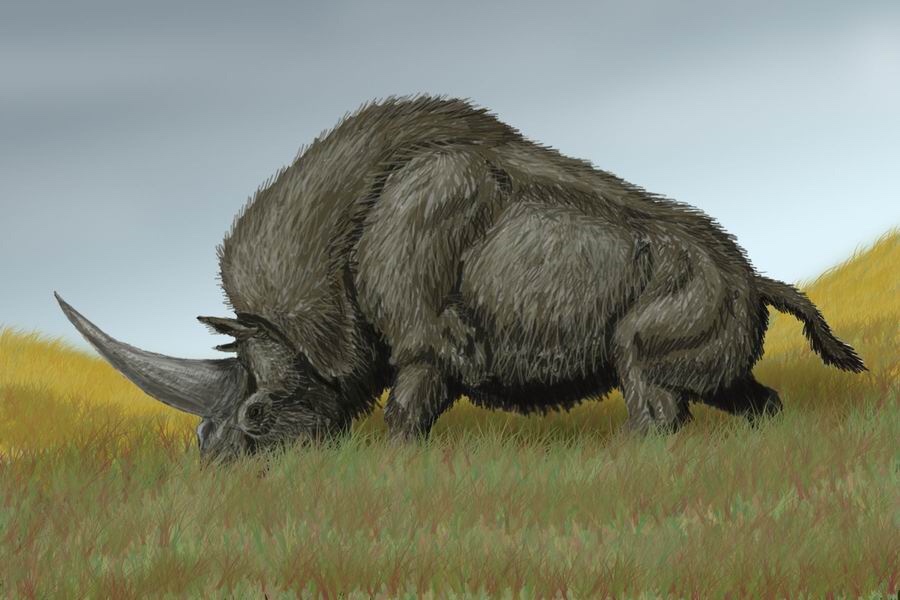
Name: Elasmotherium, Codename: Siberian Unicorn

An artists impression of the Siberian Unicorn
Image Credit: DiBgd, https://fr.m.wikipedia.org/wiki/Fichier:Elasm062.jpg

One evening a man and his wife are looking on the internet for a present for their daughter’s birthday. Their daughters has repeatedly (and loudly) stated that the only thing in the world she wants this year is a real unicorn. The doting father looks for the perfect unicorn toy and after hours of searching he finds one advertised as a “one of a kind Siberian Unicorn!” It is very expensive, however the parents assume that it’s a top of the range item, after all nothing is too much for “their princess!” The day arrives, a large lorry pulls into the driveway. “Here’s your Unicorn” the deliveryman states. The ramp moves down, revealing a strange and unexpected sight; a very large, very furry rhino, possessing one very long horn. The parents look on in shock and confusion; this was definitely not the toy they ordered! Their daughter on the other hand has quite the opposite reaction. “I love him!!” She shouts joyfully as she cuddles the creatures’ thick woolly neck. None of her friends have anything like this.

The “unicorn” in this story is named Elasmotherium (meaning “plated beast”). First described in 1808 by Johann von Waldheim, this animal was a big herbivore measuring 5 metres long, 2 metres tall and weighing up to 4 and a half tonnes in the largest species (Elasmotherium caucasicum). Elasmotherium was related to modern day rhinos and a close cousin to the more famous woolly rhino (Coelodonta antiquitatis) that it coexisted with. Like its cousin, Elasmotherium possessed a thick coat of fur to keep warm in the cold of the ice age. This fur traps a layer of heat around the body, giving a layer of effective insulation. In addition Elasmotherium had a thick layer of subcutaneous fat, similar to modern day polar animals. This fat, stored partly in the animals shoulder hump (like bison) would not only keep Elasmotherium warm but would also act as a store of energy for when food was less plentiful. The most striking feature of Elasmotherium of course is its large nasal horn, which could measure longer than a human is tall. It’s thought to have had multiple uses; clearing away snow in order for Elasmotherium to reach its main food source of grass; display against rivals; and defence against predators such as the cave lion. Despite its stocky appearance it is thought that Elasmotherium could run surprisingly fast, useful for charging anything it perceived as a threat.

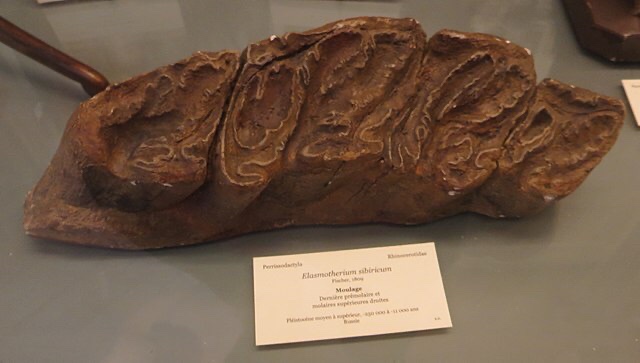
A preserved molar tooth of Elasmotherium, which it used to grind up tough grasses found on the Ice Age steppe.
Image Credit: Ghedo, https://commons.m.wikimedia.org/wiki/File:Elasmotherium_sibiricum_denti_superiori_destri.jpg

Elasmotherium was a widely successful species. Living for around 2 million years its range stretched across Eurasia, from the Ukraine in the west to Siberia in the east. Originally Elasmotherium was thought to have gone extinct around 100,000 years ago. However a study published in 2018, using radiocarbon dating, showed that this animal lived more recently than previously thought, with the new extinction date now being only 39,000 years ago. Around this time modern humans had just reached Europe and Siberia so it is thought that humans could well have come into contact with Elasmotherium. Furthermore it is speculated that this magnificent animal is the original inspiration for the legend of the unicorn. Russian folk tales tell of a great one horned beast, with the body of a bull and head of a horse, known as the Indrik. It is plausible that these stories would’ve spread west into Europe from travellers through word of mouth, evolving over the generations into the story of a one horned horse. There is even a very slight possibility that the Siberian Unicorn could be brought back, or at least a rhino/Elasmotherium hybrid. This is because DNA has been extracted from younger Elasmotherium fossils. Unfortunately, as the DNA is too fragmented to be used for cloning, this is still in the realm of science fiction for now. However this DNA can still give us details on its evolutionary history, showing that Elasmotherium was the last survivor of a lineage that spilt from modern rhinos 43 million years ago.

An Elasmotherium skeleton on display at Azov History, Archaeology & Palaeontology Museum. Note the lack of a horn. This is due to horns not fossilizing. However we can estimate its length from measurements of the attachment point and comparison with other rhinos.
Image Credit: Altes, https://commons.m.wikimedia.org/wiki/File:Elasmotherium_skeleton,Azov_Museum(1).jpg

So Elasmotherium was a spectacular example of the large megafauna that existed at the end of the last ice age. It also proves, if you believe the speculations, that there really were unicorns. They just were bigger, bulkier and more bad tempered than you might think!

UPDATE! (20/11/2021)

New research conducted by Titov, Baigusheva & Uchytel 2021 has shown that the head of Elasmotherium looked very different to what was once thought! From examination of more complete Elasmotherium skulls they have found that section of the skull beneath where the “horn” was was hollow, and would have supported an extended nasal cavity. This delicate structure was protected by a bony structure with a backwards facing top part. This structure was covered in keratin and gave it a horn that looked (at least to me) a bit like an iron. The extended cavity within would’ve given Elasmotherium an enhanced sense of smell, and it’s suggested that it might have enabled it to increase the volume and range of the sounds it made (calls, grunts etc.). Furthermore, this horn was sexually dimorphic (being larger in males than in females, and therefore probably having display and signalling functions) and still could’ve been used to clear away snowfall to reach succulent grasses that were located using smell!

In short, Elasmotherium didn’t have an almost 2 metre long spear on its head. But an iron shaped, all in one grass detector, snow plough, megaphone and advertising board!

References/Further Reading

Kosintsev et. al. 2019 paper on the evolutionary history and extinction of Elasmotherium

Kosintsev, P., Mitchell, K.J., Devièse, T. et al. Evolution and extinction of the giant rhinoceros Elasmotherium sibiricum sheds light on late Quaternary megafaunal extinctions. Nat Ecol Evol 3, 31–38 (2019). https://doi.org/10.1038/s41559-018-0722-0

A Natural History Museum article, written by Josh Davis, on new dating of Elasmotherium, that showed that it may have lived alongside Modern Humans

Davis, Josh, “The Siberian unicorn lived at the same time as modern humans”, Natural History Museum, Nov. 26, 2018, nhm.ac.uk/discover/news/2018/november/the-siberian-unicorn-lived-at-the-same-time-as-modern-humans.html

A ThoughtCo article, written by Bob Strauss, giving information on Elasmotherium’s lifestyle, evolutionary history and links to the mythical unicorn.

Strauss, Bob. “Elasmotherium.” ThoughtCo, Feb. 11, 2020, thoughtco.com/elasmotherium-plated-beast-1093199.

The Legend of the Sea Serpent Mosasaurus

Mosasaurus as it may have looked when it swam in Earth’s seas 70-65 million years ago.
Image Credit: Dmitry Bogdanov, https://commons.m.wikimedia.org/wiki/File:Mosasaurus_beaugei1DB.jpg

The idea of a large, serpentine like animal living in the depths of the ocean and battling heroes of legend has been a favourite tale of a whole host of myths and legends. Since early human history people seem to have been attracted to the idea of such an animal, quite unlike anything that lives today. Even in recent times this is a concept that has people enthralled. Just ask anybody who is convinced that there is a plesiosaur like animal living in Loch Ness. However while a large sea serpent probably doesn’t exist today (not counting real life sea snakes) there was a similar beast that ruled the seas of the Late Cretaceous period 70 million years ago. Its full scientific name, is Mosasaurus hoffmanni (Meaning “Hoffmanns Meuse Lizard”).

Mosasaurus was discovered back in 1764 near the town of Maastricht in the Netherlands. This was a time when the word “dinosaur” hadn’t been spoken yet, and proper scientific research on fossils was in its infancy. The fossil itself was a disarticulated skull, a cast of which is on display in the Sedgwick Museum in Cambridge. This fossil went through an eventful journey before it was first scientifically examined in the early 19th century, which includes being hidden from French occupation and being traded (allegedly) for 600 bottles of wine! Scientists of the time, including the famous French naturalist Georges Cuvier, correctly deduced that this animal was a reptile. Now “Meuse Lizard” may seems like a weird name to give an animal like this, but it was named after the Meuse River which runs through Northern Europe close to Maastricht.

This sea faring animal was very much the top predator of its day, reaching up to 15.2 metres long and weighing 15 tons. While there were other formidable hunters around (one example being Xiphactinus, a 5 metre long predatory fish known for swallowing prey whole!) there was no other marine predator that could rival it. Mosasaurus was an opportunistic hunter, eating almost anything that it could fit its powerful jaws around. This included a whole range of marine animals, from fish to squid, other marine reptiles and even smaller species of Mosasaurs! Mosasaurus was also quite different from other marine reptiles in that its lizard ancestors took to the water at a much later date than other marine reptiles such as Ichthyosaurs and Plesiosaurs. Also, unlike its lizard ancestors Mosasaurus gave birth to live young instead of laying eggs (just like modern day sea snakes). However Mosasaurus, along with the rest of its family, could not survive the asteroid that struck the earth 65 million years ago, dying out alongside the dinosaurs. They are survived by their closest living relatives; monitor lizards and snakes. Which funnily enough makes the sea serpent comparison even more fitting!

The fossilised head of Mosasaurus, showing its frightening battery of teeth!
Image Credit: Tim Evanson, https://www.flickr.com/photos/timevanson/9322551651

In the last couple of years Mosasaurus has been getting attention both in film, where it steals the show in the film Jurassic World, and in the world of paleontological research. This research has changed our understanding of how Mosasaurs both looked and behaved, with the following three studies being particularly insightful:

First. A study carried out by Johan Lindgreen, Hani Kaddumi and Michael Polycin in 2013 discovered a new anatomical feature in Mosasaurs. Previously it had been thought that they powered their long bodies through the water with a broad, straight tail, moving in a undulating manner like a modern day sea snake. However, after examining a fossil Mosasaur, named Prognathodon, from Jordan in Africa the palaeontologists noted that the outline of its skin had been fully preserved. This impression clearly showed a tail fluke like those of sharks or Ichthyosaurs, albeit with the upper fluke being smaller than the lower fluke. This tail, a product of convergent evolution, would have enabled mosasaurs to perform fast, powerful strokes to catch prey by surprise.

Second. A study in 2014, carried out by a team of palaeontologists based at Lund University in Sweden (which also included Lindgreen and Polycin, among others), gave us our first look at the colour of a mosasaur. This was an exciting find as evidence of colour is very rarely preserved in extinct animals and had never before been seen in a marine animal. The study looked at tiny blob like structures on the skin of an 85 million year old fossil mosasaur named Platecarpus tympaniticus. These had previously been thought to be bacteria. However as it turns out these blobs were actually melanosomes, the cells that produce skin colour. The structure of these preserved melanosomes showed that this mosasaur, and by extension other mosasaurs such as Mosasaurus, had what is known as “countershading”. Countershading is a colouration pattern that consists of a dark upper body and a light lower body (an example of this being the colouration of a modern day Killer Whale). This has a few advantages; it provides camouflage against the dark ocean depths (when looked at from above) and against the sunlight lit surface (when looked at from below). The dark upper surface also allows the mosasaur to absorb more heat from the sun when it surfaces for air and gives it protection from UV light when at the surface.

Third. A recent study conducted at the University of California, and only published in September 2019, looked in detail at how Mosasaurs swam. What they found was that Mosasaurs could perform a “breaststroke” like action with their front flippers. In conjunction with powerful beats of their tails, this would have allowed them to achieve great bursts of speed through the water. This is interesting because it was thought that marine animals swim using either their tails or their fins, but not both at the same time. As a result this swimming style is unlike any other known animal and makes mosasaurs even more remarkable.

And so, thanks to studies both old and new, we have a detailed picture of Mosasaurus, and its family, as one of the most unique sea faring animals ever. It further proves that the world of paleontological research is still capable of putting fresh spins on iconic animals of the past!

Mosasaurus enjoying a dinosaur dinner!
Image Credit: Jonagold2000, https://commons.m.wikimedia.org/wiki/File:Mosasaurus_hoffmanni_life.jpg

References/Further Reading

Lindgren, Kaddumi & Polcyn 2013 paper about Mosasaur tail flukes.

Lindgren, J., Kaddumi, H. & Polcyn, M. Soft tissue preservation in a fossil marine lizard with a bilobed tail fin. Nat Commun 4, 2423 (2013). https://doi.org/10.1038/ncomms3423

Lindgren et. al. 2014 paper about Mosasaur coloration. This study also discovered the colour of a 55 million year old turtle (which had the same colour as a modern day leatherback turtle) and a 200 million year old Ichthyosaur (which was a dark colour).

Lindgren, J., Sjövall, P., Carney, R. et al. Skin pigmentation provides evidence of convergent melanism in extinct marine reptiles. Nature 506, 484–488 (2014). https://doi.org/10.1038/nature12899

A paper, written by Kiersten Formoso and published in September 2019 (Formoso 2019), on new theories on Mosasaur swimming motions.

Formoso, Kiersten K., Reassessment of the Mosasaur pectoral girdle and its role in aquatic locomotion, Geological Society of America Abstracts with Programs. Vol. 51, No. 5, (2019), doi: 10.1130/abs/2019AM-333823

Further information, from the FossilEra website, about Mosasaur size, diversity, lifestyle and history of discovery

FossilEra “Mosasaurus & Mosasaurs”, FossilEra, fossilera.com/pages/about-mosasaurs

Arthropleura: The Titan of the Carboniferous

Artists reconstruction of the Carboniferous Titan Arthropleura
Image Credit: Nobu Tamara, http://spinops.blogspot.com/

One day, two executives at Warner Brothers film studio are sitting in their office with their heads in their hands. The last film has massively under-performed at the box office, the writers are struggling for ideas, A-List actors are turning their noses up at working for them and their film sets are so quiet you can hear the crickets chirping. However there is a knock at the door. “Come in!” shouts one of the executives. A nerdy looking man; wearing a shirt with an otter on the front, sport shorts that don’t match his top and sandals of a hideous brown and orange colour, steps in to the room. “Hello Brothers Warner! I have a script I’ve written for a potential film, its a mix of Sci-Fi and horror” he exclaims confidently. One of the executives sighs “alright, lets see it”. “Can’t possibly be worse than what we’ve just put out” the other remarks. The executives flick through the script, reading the tale of an adventurer hacking her way through the lush forest of a strange, almost alien world. The adventurer encounters plenty of dangers; ducking a dragonfly the size of an eagle dive-bombing for her head, narrowly dodging the thrusting stinger of an ambushing scorpion the size of a large house-cat and throughout the film she is pursued by a large, unknown monster. At the films climax the adventurer, remarking that she had seen it all now, stumbles on what seems like a large log. She turns round and watches in horror as the log rises and squirms. The monster is revealed! It is a millipede, which rears up high enough to meet her eyes. It hisses, ready to lunge!

“Wow! This script has serious promise! even if it is a little cheesy” One of the executives gasps. “But where is it set?” The other enquires. “Oh turn to the last page!” The geek squeals excitedly. The executives do so, and see the words that would mark the twist ending to this film.

Earth. 300 Million Years Ago.

It sounds absurd, but believe it or not 300 Million years ago planet earth was home to these enormous arthropods. Meganuera and Pulmonoscorpius, the dragonfly and scorpion in our geek’s story, are both fascinating animals. However the most striking of these arthropods, and the one that I have a personal story of, is our monstrous millipede, which has the scientific name Arthropleura, meaning “jointed ribs”.

First discovered in 1854 by Jordan & Meyer, there are two known species of Arthropleura. While the smaller species was only a quarter of a metre in length the larger species was the biggest terrestrial arthropod of all time. Measuring just over two and a half metres long and nearly half a metre wide it was a size that modern millipedes could only dream of. It had a body plan of 30 jointed segments and each segment was covered by a relatively thin armour plating. Its large size meant that it would have had few natural predators (unless one of the large amphibians of the time got in a lucky shot). Since its discovery the main controversy surrounding Arthropleura was whether it was related to millipedes or centipedes, and as a result whether it was a herbivore or a carnivore. This is due to no mouth-parts having been found as of yet. While remains of giant club mosses had been found in some fossil remains a relatively recent study by Kraus showed that this was actually the shed skin of an Arthropleura that had been deposited on top of these club moss fragments. However despite this the common consensus at the moment is that it is a millipede relative and as such a herbivore, feeding on dead plant matter like modern millipedes do today (although its jaws would have given you a bad bite!). Arthropleura first evolved around 315 million years ago and went extinct 299 million years ago. The main reasons for its extinction being a combination of the disappearance of the coal swamps that it resided in and reduction in oxygen levels.

A fossil of the armour plates of Arthropleura from the Senckenberg Museum of Frankfurt in Germany. Image Credit: Ghedoghedo, https://commons.m.wikimedia.org/wiki/File:Arthropleura_armata.jpg

Unfortunately such an animal really was a product of its time. Arthropleura and other arthropods could only grow to such a size because of the special environment conditions present during the Carboniferous period. The earth had a much higher concentration of oxygen compared to modern times (almost 35%, compared to about 21% today). This suited arthropods in particular as it meant that they could take in more oxygen and therefore have more energy via respiration to use in growth. Arthropods take in oxygen via tiny tubes on the side of their bodies, known as trachea, or even directly through their skin. This system is nowhere near as efficient as true lungs are in terrestrial vertebrates. As a result the lower oxygen levels of today means that arthropods simply can’t get enough energy from respiration to maintain such large sizes. If Arthropleura was alive today it would not be able to survive in such a low oxygen environment. However a large concentration of oxygen isn’t the sole reason for their size, as a lack of competition and predation could also have helped.

Fossilised tracks of Arthropleura such as these are found in places in Scotland (e.g. the Island of Arran) and the USA. Image Credit: Ashley Dace, https://www.geograph.org.uk/photo/1994274

To finish this blog i’m going to share my personal encounter with an Arthropleura! Or rather, its fossilised tracks. When I was around the age of 11, during a family holiday in Scotland, I went to see the Arthropleura tracks at Crail. My young palaeontology mad self loved seeing these tracks, and there is a photo that proves it. So as it turns out this animal is indeed Scottish! (well half-Scottish technically, as fossils and trackways have also been found in the USA, but I like to think its Scottish). Arthropleura tracks are also a famous attraction of the island of Arran in Scotland. Whilst I did go to Arran during the first year of my university degree sadly my group didn’t have time to go see them.

So Arthropleura is yet another example of the weird creatures that evolution has produced, and a true marvel of the distant past. In my humble opinion, it would make a fantastic movie monster!

References/Further Reading

A great blog on Arthropleura written by Hans-Dieter Sues, a Paleontologist based at the National Museum of Natural History in Washington DC. The blog was published on National Geographic

Sues, Hans-Dieter,”Largest Land-Dwelling “Bug” of All Time”, National Geographic, Jan. 15, 2011, blog.nationalgeographic.org/2011/01/15/largest-land-dwelling-bug-of-all-time/

A blog, published on National Geographic, which gives futher background on the Carboniferous Period

National Geographic, “Carboniferous Period”, National Geographic, nationalgeographic.com/science/prehistoric-world/carboniferous/

A paper from 1992, written by Paul Pearson (Pearson 1992) and published in the Scottish Journal of Geology describing Arthropleura tracks (named Diplichnites cuithensis) from Fife, Scotland

Pearson, P. N. (1992). “Walking traces of the giant myriapod Arthropleura from the Strathclyde Group (Lower Carboniferous) of Fife.” Scottish Journal of Geology 28(2): 127-133.

Another paper, written by Ronald Martino & Stephen Greb (Martino & Greb 2009) and published in Journal of Paleontology, describing a set of Arthropleura tracks, this time from Kentucky, USA

Martino, R., & Greb, S. (2009). Walking trails of the giant terrestrial arthropod Arthropleura from the Upper Carboniferous of Kentucky. Journal of Paleontology, 83(1), 140-146. doi:10.1017/S0022336000058200

Smilodon: The Sabre-Tooth (not a) Tiger

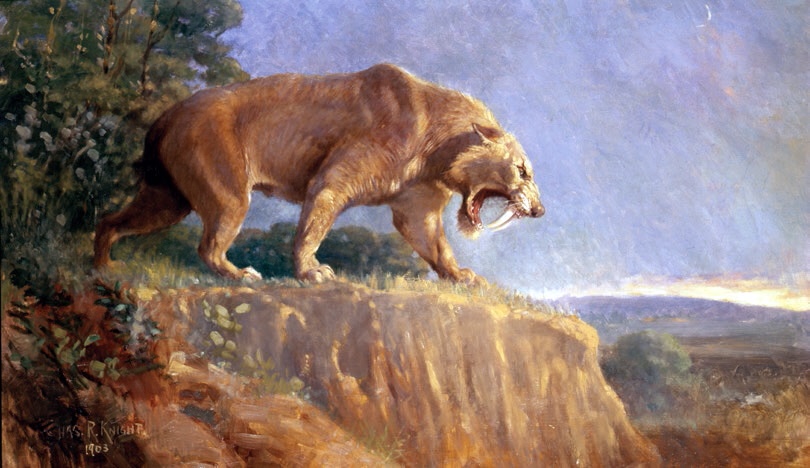
Smilodon looking over his kingdom
Image Credit: Charles R Knight, http://www.charlesrknight.com/dinosaur-artist-charles-r-knight/Knight%20article.pdf

Right, I’m going to start off by clearing up a common misconception. Despite often being called it in popular media Smilodon was NOT a Sabre-Toothed Tiger, or related to tigers at all! It was a Sabre-Tooth Cat (or Machairodontinae if you want to get technical). Also, the term “Sabre-Tooth Cat” refers to the family that Smilodon is a part of rather than just Smilodon itself. Other examples of Sabre-Tooth Cats include; Dinofelis, which lived across Africa, Eurasia and North America during the Pliocene to the Early Pleistocene (5.5-1.5 million years ago) and has a reputation for being a hunter of Australopithecus and other early human ancestors (which it may or may not have done). Another example is Homotherium, a smaller Sabre-Tooth Cat species which lived around the same place and time as Smilodon.

With that out of the way, let’s find out more about this large and rather striking extinct kitty.

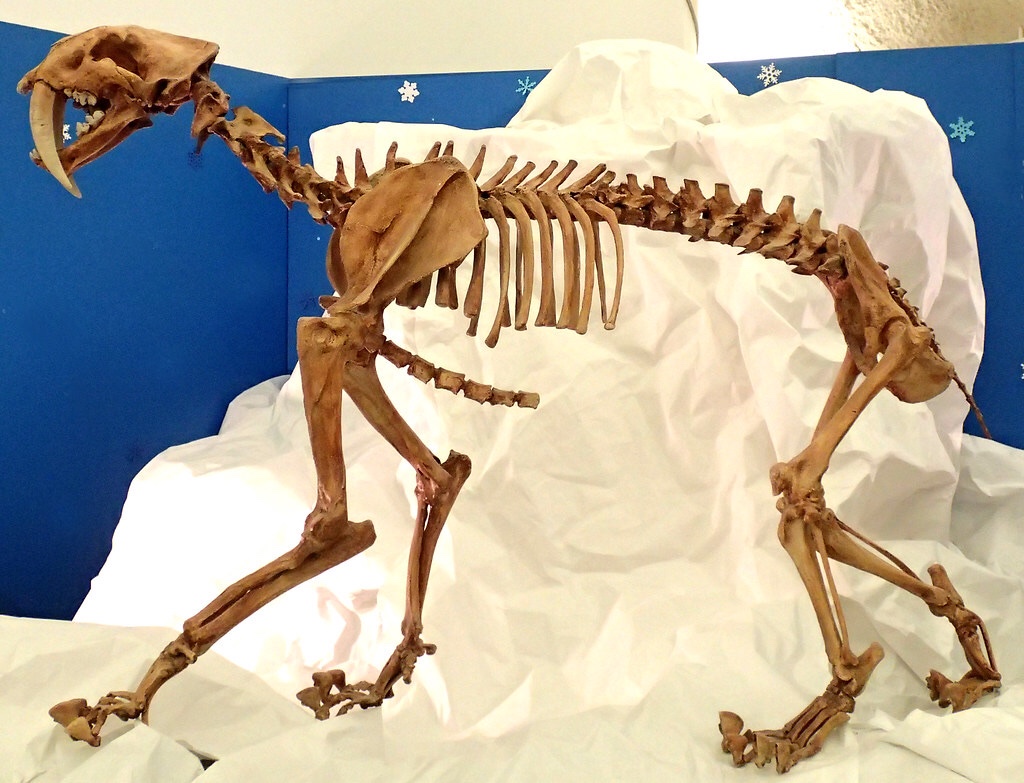
To start with, the first piece of anatomy that everyone notices when looking at Smilodon is its large sabres (which could measure up to 28cm long – almost as long as a school ruler!). Contrary to popular belief Sabre-Tooth Cats like Smilodon were not the first animals to evolve sabre teeth. That title instead goes to animals like the Gorgonopsids, a group of “mammal-like reptiles” that lived in the Late Permian period around 265-250 million years ago. They, and other “mammal-like reptiles” are a fascinating group of animals in their own right which I’m sure I’ll tackle in a later blog. While the sabres in Smilodon look very formidable they were actually surprisingly fragile, and could break easily if used for usual ripping and slashing attacks. Smilodon also had a relatively weak bite, and needed to open its mouth very wide in order to extend the sabres out fully. As a result it is thought that the sabres were used for careful, quick surgical bites to the prey’s neck in order to puncture the neck and ensure a quick end without too much struggle. The iconic positioning of these sabre-teeth is that they’re exposed on the outside. While this continues to be scientific consensus there have been suggestions that Smilodon and other sabre-tooth cats may have had fleshy lips covering them instead.

A reconstructed skeleton of Smilodon fatalis from the Sternberg Museum of Natural History in Hays, Kansas, USA. As you see the sabre-teeth are certainly eye-catching!
Image Credit: James St John, https://www.flickr.com/photos/jsjgeology/15420386216

There are other parts of Smilodons anatomy that also set it apart from modern day big cats. It was larger and more heavily built than a modern lion or tiger, measuring up to 1.5 metres long, a metre high and weighing up to 400 kilograms. Smilodon also possessed thick front leg bones with big muscle attachments. This suggests that Smilodon would not have been a pursuit hunter, but instead an ambush predator, stalking its prey, getting close and then leaping out and pinning them down using their powerful front legs, before then employing the sabres. In terms of behaviour it was a matter of debate as to whether Smilodon lived in prides (like lions) or were solitary like tigers, with reconstructions, paleoart and documentaries switching between the two. However some fossil Smilodon show previous serious injury and not only managed to recover but live to an old age. Also a joint study in 2008 by the Zoological Society of London and the University of California, assessed the large number of Smilodon remains found at Rancho La Brea Tar Pits who had turned up at the tar pits in response to prey distress calls. They compared these with the numbers of modern African predators that turned up to similar distress calls at similar traps. The results showed that the number of Smilodon found compared well to the numbers of pack hunting animals, such as lions and hyenas. Both of these observations indicate that these sabre-toothed cats lived in packs. (On a side note; Rancho La Brea is in my top 5 places to visit in the world!)

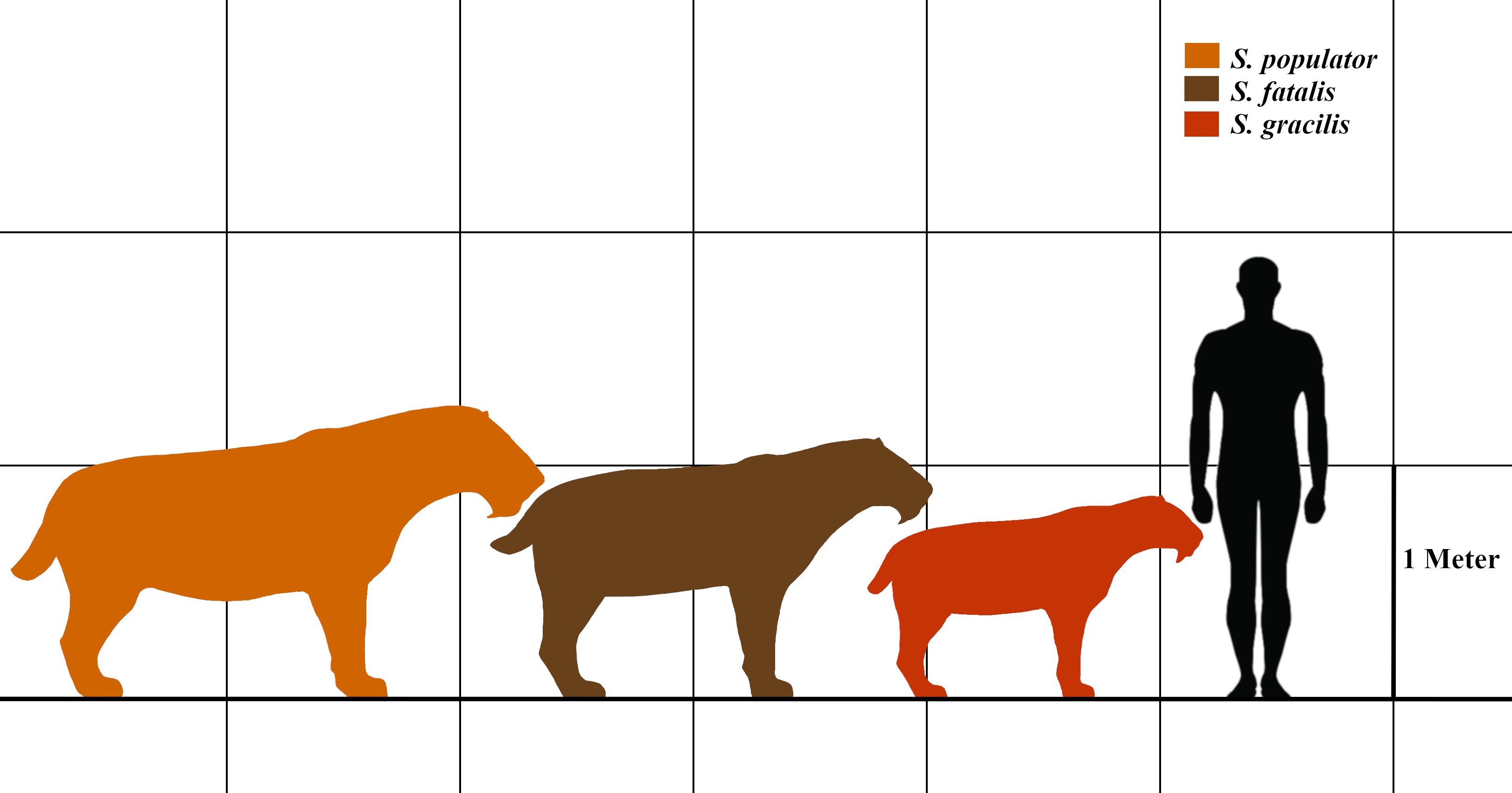
Smilodon fossils have been found across the Americas, having first evolved in North America before migrating to South America via the newly formed Isthmus of Panama land bridge. The first fossils, being of the South American species Smilodon populator, were discovered by Lund in Brazil in 1840. Further species discovered, all mostly based in North America, include; Smilodon fatalis (discovered by Leidy in 1869) and Smilodon gracilis (discovered in 1880 by the legendary Edward Drinker Cope of dinosaur fossil fame). Of these species Smilodon populator was both the youngest, evolving only 1 million years ago, and the largest.

A size comparison between 3 different Smilodon species and an average human. Smilodon populator of South America was the largest, followed by the North American Smilodon fatalis and Smilodon gracilis.
Image Credit: Aledgn, https://commons.m.wikimedia.org/wiki/File:Wiki_Smilodon_Size.png

Such a beautiful cat would be a sight to witness across the American plains. Sadly, like the rest of the megafauna that lived alongside them, they died out during the last Ice Age around 10,000 years ago. A few reasons have been suggested for this; competition with humans for prey being one of them. However it is likely that a changing climate, resulting in habitat reduction, and the loss of the large megafauna that Smilodon preyed on (which could have partly been a result of human hunting) were the main reasons. With large prey gone and with Smilodon not having the endurance to hunt the smaller, swifter mammal herbivores that remained, their numbers dwindled.

Still, Smilodon has gone down in history as one of the most striking extinct animals yet described. Its sabres have repeatedly captured the imagination of generations of people in museums and in popular media. Personally I’m sure of two things about Smilodon:

1. If I had to pick a fossil skull to own, it would be one of these sabre tooth cats, and

2. If one of them could speak it would have the voice of Denis Leary!

EDIT: A small addition to this blog. As well as being found in the USA Smilodon fatalis has also recently been discovered to live as far north as Canada, with the paper describing the new Canadian fossils (Reynolds, Seymour & Evans 2019) only published in January 2019.

References/Further Reading

Carbone et. al. 2008 paper on pack hunting behaviour in Smilodon

Carbone, Chris, Maddox, Tom, Funston, Paul J, et. al., (2008), Parallels between playbacks and Pleistocene tar seeps suggest sociality in an extinct sabretooth cat, Smilodon, Biol. Lett.5, 81–85, https://doi.org/10.1098/rsbl.2008.0526

An interesting blog by Mark Witton, published on his blog site, on exposed teeth in Paleontological reconstructions. Smilodon is one of the animals he talks about.

Witton, Mark, “Exposed teeth in dinosaurs, sabre-tooths and everything else: thoughts for artists”, markwitton.com/blog, Oct. 9, 2016, markwitton-com.blogspot.com/2016/10/exposed-teeth-in-dinosaurs-sabre-tooths.html

Christiansen & Harris 2005 paper, published in Journal of Morphology, on body size estimates of three Smilodon species

Christiansen, P. and Harris, J.M. (2005), Body size of Smilodon (Mammalia: Felidae). J. Morphol., 266: 369-384. doi:10.1002/jmor.10384

Reynolds, Seymour & Evans paper on the Canadian Smilodon fatalis fossils (For the EDIT).

Reynolds, A. R., et al. (2019). “Late Pleistocene records of felids from Medicine Hat, Alberta, including the first Canadian record of the sabre-toothed cat Smilodon fatalis.” Canadian Journal of Earth Sciences 56(10): 1052-1060.

Get the all new Spinosaurus while stocks last!

The skeleton of an ancient river monster!
Image Credit: Mike Bowler, https://commons.m.wikimedia.org/wiki/File:Spinosaurus_swimming.jpg

Let me tell you a story. Three time travellers meet in a bar. They decide that they want to journey back to Mid Cretaceous North Africa, around 95 million years ago. They plan to have a dinosaur safari, just like the safaris that are conducted across the modern day Serengeti. However the area is dangerous as there are plenty of dangerous dinosaurs roaming around, some big enough to take out the jeep faster than the time travelling tourists can say “holy cow is that a dinosaur!” So they come up with a plan. Instead of going by jeep, they will use a river boat. “It’s perfect!” they say, “no dinosaur will be able to reach us as we are on the water and because it’s inland there’s no need to fear any sea faring marine reptiles”. After some time planning the time travellers undertake their boat journey. They marvel at the herds of the huge sauropod Paralititan and see an impressively large Carcharodontosaurus watching the herd hungrily. However as they are distracted by what they are seeing they don’t notice a large object moving in the river. Suddenly one of them hears the sound of rushing water and turns round to see a large sail poking out of the water like Jaws’ fin and heading right towards the boat. In five minutes, the time travellers will have seen their last dinosaur….

The unidentified river monster in this story is not a fish, nor a crocodile. It is instead the largest of all theropod dinosaurs: Spinosaurus aegyptiacus (meaning “Egyptian spine lizard”). The first Spinosaurus fossils were discovered in Egypt by German palaeontologist Ernst Stromer in 1912, however sadly these remains were destroyed during allied bombings raids on Munich during World War Two. Spinosaurus has gained more attention in recent years as new research has shown that this theropod had a lifestyle unlike any other dinosaur. The research suggests that Spinosaurus is the first known aquatic dinosaur.

There are certain anatomical features that support this interpretation. One area is the shape and design of the skull. The teeth were long and conical, well suited for gripping and holding on to slippery prey such as fish. The nostrils were placed high on its snout so it could hold it submerged in water while still being able to breath. It’s also thought that holes at the end of Spinosaurus’ snout contained pressure sensors, similar to those seen in modern crocodiles, which are used to detect disturbances in the water. The water based adaptations don’t stop there; one specimen of a Spinosaurus upper jaw has a barb embedded in it that belonged to a species of giant swordfish called Onchopristis. This suggests that Onchopristis was one of Spinosaurus‘ main sources of food. So taking all these adaptations together it suggests that Spinosaurus had a mostly fish based diet (however it is still possible that it ate meat as well).

An illustration of the head of Spinosaurus. Note the distinctive long, crocodile like jaws, conical teeth and small head crest.
Image Credit: Steveoc 86, https://commons.m.wikimedia.org/wiki/File:Spinosaurus_skull_steveoc.jpg

All these adaptations are well and good, however the biggest evidence for Spinosaurus‘ aquatic lifestyle was detailed in a paper released in 2014, written by a team of palaeontologists led by Spinosaurus expert Nizar Ibrahim. The paper examined and described a new 11.3 metre long specimen (that wasn’t fully grown, Spinosaurus could reach a maximum length of 15 metres) that is the most complete Spinosaurus skeleton ever found. Examination of the hind limb bones and pelvic girdle showed that they were much shorter than previously thought. These hind limbs were so short that Spinosaurus could not have walked on two legs for long periods of time as its legs couldn’t support its massive, front heavy bulk. This meant only one thing, Spinosaurus walked on all fours (at least occasionally). This is certainly very different to the bipedal, T-Rex killing beast that terrorised Alan Grant and the Kirbys in the 2001 film Jurassic Park 3. This new discovery also fits with the theory of a mostly aquatic based Spinosaurus. Short hind legs reduce drag when swimming and diving through water and is something that other aquatic and semi-aquatic animals, such as crocodiles and otters, exhibit today. These hind limbs were also solid and dense, helping with buoyancy control, and it has been speculated that feet would have been webbed to further aid in swimming. This means that Spinosaurus would have been comfortable and manoeuvrable in water, and a somewhat clumsy walker on land!

This reconstruction, which has commonly been dubbed “new Spinosaurus“, has caused quite a stir in the palaeontology community, Not everyone is on board with the idea and a few have even written articles and papers questioning the findings of the Ibrahim et al. 2014 paper. For example palaeontologist Scott Hartman questioned the length measurements of Spinosaurus’ hind limbs and Donald Hendersons 2018 paper questioned its buoyancy. However both these counter papers have their own issues; for example the Henderson paper based their buoyancy calculations on bone density data from other theropods and birds, except Spinosaurs have been shown to have proportionately thicker bones than these animals. The debate is still ongoing to this day, and so it is still not known for certain whether Spinosaurus truly was a quadruped or a biped.

So let us rejoice in the quadrupedal walking, gracefully swimming, humongously sized, sail-backed fish eater that Spinosaurus has become! Proof that during their 170 million year reign there were few habitats that the dinosaurs couldn’t reach.

UPDATE: Spinosaurus reconstructions continue to change with every new paper! A new study was published on the 29th April 2020 in the journal nature. Written by a team led by Nizar Ibrahim, has revealed that Spinosaurus had unusually tall neural spines and elongated chevrons on its tail vertebrae. These special vertebrae supported a flexible, paddle-like tail and it’s theorised that Spinosaurus used it to swim through the water! The image below illustrates what most palaeontologists now think Spinosaurus aegypticus looked like.

The most up to date (as of 29th April 2020) look of the river monster that our time travelling tourists had the misfortune of encountering!
Image Credit: Gustavo Monroy-Becerril, https://en.m.wikipedia.org/wiki/File:Spinosaurus_aegyptiacus_underwater.png

EDIT: One key piece of evidence, that I missed when writing this blog (my apologies!), from the Donald Henderson 2018 paper is that Spinosaurus’ centre of mass was located closer to its hips than to its torso. This is further evidence that Spinosaurus was a biped, walking on its short stubby legs (almost like a duck!). At the time of writing this Nizar Ibrahim has yet to publish his latest research on Spinosaurus so the two legged/four legged debate rages on. But currently the common consensus, at time of writing, is that Spinosaurus was a biped.

References/Further Reading

Ibrahim et al. 2014 paper, published in Nature, describing “New Spinosaurus

Ibrahim, N., et al. (2014). “Semiaquatic adaptations in a giant predatory dinosaur.” Science 345(6204): 1613-1616.

Henderson et. al. 2018 paper countering the Ibrahim et. al. 2014 paper

Henderson DM. 2018. A buoyancy, balance and stability challenge to the hypothesis of a semi-aquatic Spinosaurus Stromer, 1915 (Dinosauria: Theropoda) PeerJ 6:e5409 https://doi.org/10.7717/peerj.5409

Nizar Ibrahim’s response to Scott Hartman, published on Scott Hartman’s Skeletal Drawing.com.

Ibrahim et. al., “Aquatic Spinosaurus – The authors respond”, Scott Hartman’s Skeletal Drawing.com, Sept. 18, 2014, skeletaldrawing.com/home/aquatic-spinosaurus-the-authors-responsd9182014

An article in Smithsonian Magazine on the history of Spinosaurus research

Smithsonianmag.com, “Cracking the Code of Spinosaurus”, Smithsonian Magazine, Apr. 19, 2017, smithsonianmag.com/sponsored/spinosaurus-lost-dinosaur-paleontology-new-discovery-great-courses-plus-180962953/

New Ibrahim et. al. 2020 paper on the structure of Spinosaurus’ tail (USED FOR UPDATE)

Ibrahim, N., Maganuco, S., Dal Sasso, C. et al. Tail-propelled aquatic locomotion in a theropod dinosaur. Nature (2020). https://doi.org/10.1038/s41586-020-2190-3

Is it a shrimp?! Is it a jellyfish?! No its Anomalocaris!

Science is not always static. Like any living species that has, currently or will exist it is constantly changing over time, with scientific theories evolving to fit the best available evidence. This phenomenon is prevalent throughout the scientific world but one area where it can be very clearly seen is in Palaeontology, where there are many instances of reconstructions of extinct life being very different in the past than they are today. One example of this is Megalosaurus, one of the first dinosaurs to be properly described by science. The original Victorian interpretation can be seen in a full scale model at the Crystal Palace in London. It is an impressive sculpture of a big hulking four legged lizard, portrayed as the Victorian scientists interpreted it, however it is nothing like the more graceful reconstruction nowadays. Another example, whose outdated model can be seen in the Sedgwick Museum in Cambridge, is the Carboniferous arthropod Megarachne (“Great Spider”). Once thought to be the largest spider that ever lived new research in 2005 found it to instead be a small to medium sized species of freshwater sea scorpion (though in my opinion this doesn’t make Megarachne any less unsettling to look at!)

However one of the most interesting cases of an extinct animal whose palaeontological reconstruction has changed greatly over time with new discoveries has to be Anomalocaris, whose name means “unusual shrimp”. Anomalocaris lived approximately 505 million years ago during the Early-Mid Cambrian. The Cambrian, from an evolutionary perspective, was prehistories equivalent of the European Renaissance of the 15th century. New body plans and weird evolutionary experiments were emerging during this period of earths history. Some animals from this time became extinct not long after they appeared. Some, like the trilobites, survived for an amazingly long period of time (trilobites appeared 520 million years ago in the Early Cambrian and went extinct during the Late Permian 250 million years ago – a longevity of 250 million years!) While others would eventually evolve and diversify into the main animal groups alive today; including the vertebrates which humans are a part of.

Anomalocaris is one of these weird wonders. It was discovered in 1892 by Joseph Frederick Whiteeves in the Burgess Shale formation, a fossil lagerstätten (which is a site where a high concentration of fossil material is preserved due to special environmental conditions) in Canada. The original fossil, named Anomalocaris canadensis, looked like a shrimp but with no clear headparts, hence its name of “unusual shrimp”. For a long time Anomalocaris was only known from this basic description and while it was definitely strange, its lifestyle was a complete mystery. Nineteen years later in 1911 the palaeontologist Charles Walcott, who is famous for his extensive work on the Burgess Shale, discovered a fossil of what seemed to be a primitive jellyfish. He gave it the name Peytoia nathorsti. Later, in 1928, Laggania cambria was discovered; the name given to a long bodied fossil that was interpreted as a relative of sea cucumbers.

Now you may be wondering “I thought you were going to be talking about Anomalocaris? Why have you wondered off topic to these random animals?” Well this is where the story gets interesting! In the early 1980s, nearly 90 years after Anomalocaris was first named, a palaeontologist working at the University of Cambridge by the name of Harry Whittington, an expert in Cambrian arthropods of the Burgess Shale, saw something that was truly astounding while preparing a fossil from the Burgess Shale. As he chipped away at the rock he saw two Anomalocaris “shrimps” attached to the head of a larger body not too dissimilar to Laggania. Not only that but a Peytoia fossilwas found to be attached to this same head. It soon became clear that Anomalocaris, Peytoia and Laggania were not separate species, but all part of one huge Cambrian animal, which was given the name Anomalocaris as that had been the original fossil part that had been found.

Anomalocaris was the top predator of its day. At around a metre in length it was the largest single animal the earth had ever seen at that point. After identifying its prey using large compound eyes, which gave it excellent eyesight comparable to modern day insects, it then used its prongs, once thought to be shrimps, to grab and hold its prey. Anomalocaris then held the prey close to its mouth-parts, once thought to be Peytonia, so the mouth parts could rip and break through the hard exoskeletons of trilobites and the soft bodies of other Cambrian arthropods that made up its prey. Anomalocaris swam via undulatory movements of their regularly arranged horizontal side flaps in the same manner that modern day soft bodied marine invertebrates do today. Anomalocarids as a group were widely successful, ranging across the globe from Canada to China and living from the Early to Middle Cambrian period. While most Anomalocarids were predators, another species has been described relatively recently in 2014 and named Tamisiocaris borealis (“sieve shrimp”). It had a very different lifestyle to Anomalocaris, possessing bristles on its prongs which it’s thought to have used in filter feeding, behaving rather like the baleen whales of today. This makes Tamisiocaris the earliest example of a large filter feeding animal known to science.

So Anomalocarids, the weird shrimps of the Cambrian, really are a fascinating group of arthropods. Once thought to be multiple separate animals, Anomalocaris and other Anomalocarids have instead been shown to be one of the weirdest of all Cambrian animals, and a true example of the evolutionary variety that has evolved on this planet.

The strange shrimp itself
Image credit: UNE photos, https://www.flickr.com/photos/unephotos/6786859303

EDIT: In this blog I state that Anomalocaris could “rip and break through the hard exoskeletons of trilobites”. This is actually wrong! A study in 2010, led by James Whitey Hagadorn from the the Denver Museum of Nature and Science, used 3-D models of Anomalocaris‘ mouth-parts to show that (a) it couldn’t close its mouth the whole way and (b) its mouth was too delicate to crush hard exoskeletons. As a result Anomalocaris would have fed mostly on soft bodied animals, and maybe even trilobites that had just moulted (and therefore had softer shells).

References/Further Reading

A blog, written by Ed Yong and published in Discover Magazine, about Anomalocaris

Yong, Ed, “The sharp eyes of Anomalocaris, a top predator that lived half a billion years ago”, Discover, Dec. 7, 2011, discovermagazine.com/the-sciences/the-sharp-eyes-of-anomalocaris-a-top-predator-that-lived-half-a-billion-years-ago#.XW6b8S5KjIU

The official Burgess Shale website page about Anomalocaris

“Anomalocaris canadensis”, burgess-shale.rom.on.ca/en/fossil-gallery/view-species.php?id=1

Vinther et. al. 2014 paper, published in the journal Nature, on the filter feeding Anomalocarid Tamisiocaris

Vinther, J., Stein, M., Longrich, N. et al. A suspension-feeding anomalocarid from the Early Cambrian. Nature 507, 496–499 (2014). https://doi.org/10.1038/nature13010

A wired article talking about the Hagadorn 2010 study that showed that Anomalocaris couldn’t eat hard bodied prey (USED FOR THE EDIT)

Mosher, Dave, “Giant Vicious-Looking Ancient Shrimp Was a Disappointing Wimp”, Wired, Mar. 11, 2010, wired.com/2010/11/anomalocaris-trilobite-bite/

Original Hagadorn study: Hagadorn, J. (2010). Putting Anomalocaris on a soft-food diet. 2010 GSA Denver Annual Meeting.

Deinocheirus: The tale of the horrible hands

When I was a young boy who was madly into palaeontology and had significantly less adult responsibilities, I remember walking through the ever popular dinosaur exhibition in the Natural History Museum in London. Among the many displays, which ranged from models of dinosaur nests to the big skeleton of the Triceratops, there was one that always stood out to me. It was a pair of huge arms, complete with hands tipped with large claws. Unlike the proportionately tiny arms of Tyrannosaurus Rex, (I say proportionately as T-Rex arms were still as long as a humans) or the backwards facing stump like arms of Carnotaurus these arms were long with highly developed “hands”, displayed in such a way that it seemed like they could either give you a large hug or grab you and carry you away into the night. These arms, discovered in 1965, belonged to a dinosaur known as Deinocheirus mirificus; meaning “terrible hand which is unusual”. Quite a fitting description for a giant pair of arms! This beast lived in Mongolia 70 million years ago during the Late Cretaceous. At the time I first saw this fossil palaeontologists still didn’t really know what kind of dinosaur it was as no other fossils had been found except for the arms. It was a tricky task, how can you build up the image of an animal from just its arms. Imagine trying to construct what a human looked like, how we behaved, what we ate and what our social lives were like from just our arms. From this incredible looking fossil palaeontologists were able to deduce that it was a species of theropod dinosaur, but apart from that it was only guesswork.

That is, until new fossilised material was discovered in 2009 by a team from South Korea’s Institute of Geoscience and Mineral Resources in Kigam, lead by a palaeontologist named Yuong-Nam Lee. These were not only more giant arms, but also two nearly complete skeletons that finally solved the almost 50 year mystery.

It was much weirder than anything my younger self could have imagined. For starters, it was not a vicious giant carnivore like other large theropods such as Giganotosaurus. Instead it was an omnivore, using its duck-like beak to eat vegetation with a helping of small fish on the side. Deinocheirus was a slow, lumbering giant stretching to eleven metres in length, and weighing up to 6 tonnes. To add to the weirdness, it also possessed back spines that may have formed part of a hump like structure on its back, and it may also have even been covered in feathers. The end of its tail bones were fused together into a pygostyle. This same structure is seen today in modern birds and is used to support long tail feathers, so it’s possible that Deinocheirus also had a feathery tail fan! The large arms were probably used to gather out of reach plants closer to its mouth, rather like a giant panda grabbing bamboo, or as a defence against predators, such as the tyrannosaurid Tarbosaurus whose bite marks are seen on the bones. The fossils did confirm that it was a theropod dinosaur and part of the ornithomimids, a group of dinosaurs which also included Gallimimus of Late Cretaceous North America. However Deinocheirus is very bizarre even when compared to other ornithomimids. Other species were smaller, with slender bodies and legs built for speed (not too dissimilar in lifestyle to the modern day Ostrich).

So as it turns out, Deinocheirus is not the terrifying monster that I thought it was when I saw those fossil arms all those years ago. Instead, in looks and lifestyle, it seems like the result of a group of mad scientists genetically splicing a T-Rex, a duck and an ostrich together to see what they get. However this new depiction, in my view, is just as fascinating and awe inspiring, and shows how diverse dinosaurs really were.

The Horrible hands, along with the rest of Deinocheirus!
Image Credit: Johnson Mortimer, https://commons.m.wikimedia.org/wiki/File:Deinocheirus_by_johnson_mortimer-d9npnef.jpg

References/Further Reading

Lee et al 2014 paper, published in the journal Nature, describing new fossil material of Deinocheirus

Lee, Y., Barsbold, R., Currie, P. et al. Resolving the long-standing enigmas of a giant ornithomimosaur Deinocheirus mirificusNature 515, 257–260 (2014). https://doi.org/10.1038/nature13874

An article on National Geographic, written by Ed Yong, on the 2014 study of Deinocheirus that revealed its true form

Yong, Ed “Deinocheirus Exposed: Meet The Body Behind the Terrible Hand”, National Geographic, Oct. 22, 2014, nationalgeographic.com/science/phenomena/2014/10/22/deinocheirus-exposed-meet-the-body-behind-the-terrible-hand/

An article on NewScientist, written by Jeff Hecht, about the re-discovery of a fossil Deinocheirus‘ head and feet, which had been previously smuggled out of Mongolia!

Hecht, Jeff. “Stolen dinosaur head reveals weird hybrid species” NewScientist, May. 12, 2014, newscientist.com/article/dn25551-stolen-dinosaur-head-reveals-weird-hybrid-species/