Acanthostega: The shape of things to come

File:Acanthostega MLCS.JPG - Wikipedia
Acanthostega wondering what you’re looking at!
Image Credit: Conty, https://en.wikipedia.org/wiki/File:Acanthostega_MLCS.JPG

Throughout earth’s history there have been many major leaps in evolution; the evolution of eyes, the first multicellular animals and (from our point of view) the first time our hominid ancestors walked upright. However one that sticks out in a few people’s minds is when vertebrates first hauled themselves out of the water and started walking on land. To illustrate just how big this step was, imagine an alternate reality where it never happened. This parallel world would contain no reptiles, birds or mammals, and human civilisation would’ve never emerged. The vertebrates in this world are comprised of a wide variety of fish species swimming in seas, lakes and rivers across the world alongside a range of molluscs, crustaceans and corals (to name a few). On land the world is still covered in thousands of plant species but the only animals are invertebrates. Beetles, arachnids, and ants of all possible sizes scuttle along the ground. Dragonflies, wasps and flies buzz and dance through the air and worms bury through the soil keeping the ecosystem together. All in all, it is a world radically different to what we know.

As a result documenting how and why this important moment in life on earth occurred is key to understanding the world around us. One animal that has helped palaeontologists to do this is a 60 cm long stem-tetrapod that swam the rivers of Greenland during the Devonian Period (360 million years ago). Its name was Acanthostega gunnari, meaning “Gunnars spiny roof”.

File:Acanthostega model.jpg
A model of a swimming Acanthostega
Image Credit: Dr. Günter Bechly, https://commons.wikimedia.org/wiki/File:Acanthostega_model.jpg

While fossils of Acanthostega were first discovered in 1933 (and described in 1952 by Gunnar Säve-Söderbergh, who the species is named after, and Erik Jarvik) the majority of what we know about it comes from a magnificent bone bed, part of the Celsius Bjerg Group rock sequence found in East Greenland, that was discovered in 1987 by a team led by Palaeontologist Jenny Clack. These beds contains the remains of multiple Acanthostega buried and preserved with their skeletons almost completely intact. A paper released in 2016 (Sanchez et. al. 2016) detailed another interesting observation about these fossils. Micro CT synchrotron scans of the interior of the arm bones showed that the bones were still reasonably cartilaginous and had yet to fully ossify (i.e. harden into fully formed bones). This ossification happens as animals mature, so it was deduced that all of the 1987 fossils were of juvenile Acanthostega (roughly around 6 years old) who seem to have been living together. The ossification process also seemed to have progressed further in some individuals than in others, suggesting that there was size variation between members of the group, either through genetic variation, sexual dimorphism or even both. Tragically for this ragtag group of youngsters, it seems that they all died together. It is thought that a flash flood might have washed all of them into a small pool of water. This then dried up after the flood receded leaving them stranded and exposed to the elements, away from the water that kept their skin from drying out.

Acanthostega is a great example of a transitional fossil. Its anatomy is comprised of both basal fish-like features (e.g. internal gills, fish-like teeth, fleshy tail fins and a lateral line system) and derived tetrapod-like features (e.g. simple lungs and limbs tipped with digits). Curiously all these features would have made Acanthostega perfectly suited for its river home. It used its fleshy tail to power itself through its river home, snapping at any fish that wondered too close, and to help locate its prey and navigate through its watery environment it used a lateral line system to sense movement and pressure gradient changes. These features (along with its internal gills) meant it stayed underwater for long stretches of time, though its simple lungs enabled it to take breathes of air if required. What surprised palaeontologists the most about Acanthostega was the structure and function of its limbs and the number of digits on each limb. The limbs were not large or robust enough to bear Acanthostega’s weight for long, meaning it would only rarely spend time on land (if at all). Instead the limbs acted as paddles, aiding with swimming and manoeuvring underwater. This is important because it showed that the early tetrapods didn’t evolve limbs when they started walking on land, but instead first evolved them to better aid them underwater. Then later in time they would adapt this pre-existing feature to use for walking on land. The story is the same for its digits. Each of Acanthostega’s limbs were tipped with 8 digits. This showed that the number of digits on stem-tetrapod limbs wasn’t restricted to a set number (originally thought to have been 5). These early digits would have had webbed and made the early limb a more effective paddle. Then later in evolutionary time digits (like limbs) evolved to help bear and spread out the vertebrate’s weight when it was on land.
File:Acanthostega gunnari.jpg - Wikimedia Commons
A skeletal of reconstruction of Acanthostega. Note its 8 digits, flat skull and paddle-tail.
Image Credit: Ryan Somma, https://commons.wikimedia.org/wiki/File:Acanthostega_gunnari.jpg

Looking at all of its features its certain that Acanthostega would have actually spent almost all of its time in water, patrolling the waterways and hunting for small fish and arthropods. Its fish like skull features and relatively weak bite force (adapted more for gripping prey) compared to later tetrapods were perfectly adapted for catching slippery aquatic prey, meaning it didn’t hunt terrestrial animals. Like modern day amphibians Acanthostega would have laid its eggs in water as the eggs lacked a hard watertight casing. Throughout its life Acanthostega would also have had to watch its back! Multiple species of large freshwater fish were alive during the Late Devonian and many of them would have seen Acanthostega as a tasty meal.

So while Acanthostega wouldn’t have been much of a “land lubber”, it was a shape of things to come. This small river dweller helped palaeontologists to figure out the early evolutionary history of the stem-tetrapods and showed that limbs and digits, those features that you use every day, were first developed for underwater use, and only later on evolved for use on land.

All that we know about Acanthostega, the evolution of limbs and digits and how vertebrates first ventured out of the water, couldn’t have been possible without the hard work and dedication of Jenny Clack. Before her work this evolutionary transition period wasn’t particularly well understood. However her meticulous research on every facet of Acanthostega (whose fossils she sometimes gave nicknames to, such as “Boris”, “Rosie” and “Grace”) and its relatives, revolutionised our understanding of this key period of vertebrate evolution. She was one of the world’s leading experts on stem-tetrapods and Acanthostega in particular. This is clear to see as almost every scientific paper released about Acanthostega over the last three decades has carried her name either as a researcher or as a source. Sadly Jenny Clack passed away in March of this year (at time of writing). She will be greatly missed by her friends, family and the wider scientific community. With her passing, the world has lost one of the great palaeontologists.

References/Further Reading

Sanchez et. al. 2016 paper detailing the growth and life history of Acanthostega

Sanchez, S., Tafforeau, P., Clack, J. et al. Life history of the stem tetrapod Acanthostega revealed by synchrotron microtomography. Nature 537, 408–411 (2016). https://doi.org/10.1038/nature19354

Clack 2002 paper on the skull roof of Acanthostega

Clack, J. (2002). The dermal skull roof of Acanthostega gunnari, an early tetrapod from the Late Devonian. Transactions of the Royal Society of Edinburgh: Earth Sciences, 93(1), 17-33. doi:10.1017/S0263593300000304

Neenan et. al. 2014 paper on the feeding biomechanics of Acanthostega

James M. Neenan, Marcello Ruta, Jennifer A. Clack and Emily J. Rayfield (2014) Feeding biomechanics in Acanthostega and across the fish–tetrapod transition, Proc. R. Soc. B.28120132689, https://doi.org/10.1098/rspb.2013.2689

Porro, Rayfield & Clack 2015 paper on a 3d reconstruction of an Acanthostega skull. This allowed the trio to infer how Acanthostega caught prey.

Porro, Laura B et al. (2015) “Descriptive anatomy and three-dimensional reconstruction of the skull of the early tetrapod Acanthostega gunnari Jarvik, 1952.” PloS one vol. 10,3 e0118882, doi:10.1371/journal.pone.0118882

Tree of Life web project section on Acanthostega, written by the Late Jenny Clack

Clack, Jennifer A. 2006. Acanthostega. Acanthostega gunnari. Version 13 June 2006. http://tolweb.org/Acanthostega_gunnari/15016/2006.06.13 in The Tree of Life Web Project, http://tolweb.org/

Another Tree of Life project section written by Jenny Clack on the definition of “Tetrapod” and how it is debated

Clack, Jennifer A. 1997. The Definition of the Taxon Tetrapoda, 1997, http://tolweb.org/accessory/Definition_of_the_Taxon_Tetrapoda?acc_id=471 in The Tree of Life Web Project, http://tolweb.org/

The University of Cambridge Department of Zoology news article on the passing of Professor Jenny Clack

Aucott, Rachael, “Professor Jenny Clack, FRS, 1947-2020”, University of Cambridge, 26th March, 2020, https://www.zoo.cam.ac.uk/news/professor-jenny-clack-frs-1947-2020

A Science Direct web page about lateral line systems

Science Direct, “Lateral Line System”, Science Direct, https://www.sciencedirect.com/topics/medicine-and-dentistry/lateral-line-system

Clack & Neininger 2000 paper on the Celsius Bjerg Group, a rock sequence that Acanthostega fossils have been found in

Clack, J. A. and S. L. Neininger (2000). “Fossils from the Celsius Bjerg Group, Late Devonian sequence, East Greenland; significance and sedimentological distribution.” Geological Society, London, Special Publications 180(1): 557-566.

Yi qi: The Dragon of the Jurassic

The one and only Yi qi fossil. Note the feather covering around its body and head, as well as the styliform on its elongated wrist.
Image Credit: Kumiko, https://www.flickr.com/photos/kmkmks/27011985534/

In a dense forest, full of hissing, rumbling and bellowing noises, a dragon perches on a branch. Using its sharp eyesight it locates its next meal; a large beetle crawling along a tree trunk 50 metres away. The dragon stretches its leathery wings and takes flight, swooping down silently with barely a flap towards its prey. However, just before the dragon can strike the beetle notices and unfurls its own wings in a desperate attempt to escape. But with a couple of quick flaps the dragon adjusts in mid-air and intercepts, snapping it out of the air with its toothy jaws. The beast lands and swallows the meal. But this is only a starter, and the little dragon surveys the forest again before moving on in search of the main course.

Believe it or not this really did occur in the Late Jurassic forests of China. But with one difference. The animal in question was not a mythological dragon, but a dinosaur named Yi qi.

The binomial name Yi qi, meaning “Strange Wing” in Chinese, is the shortest scientific name given to any dinosaur, and one of the shortest names of any animal living or extinct. It belonged to a family of theropod dinosaurs known as the Scansoriopterygidae (a real tongue twister of a name). Yi qi is one of only three known members of this group (the others being Epidexipteryx and Epidendrosaurus/Scansoriopteryx) and as a result relatively little is known about their evolutionary history and general lifestyle. The Scansoriopterygidae were part of a wider theropod order known as the paravians; which includes the dromaeosaurs (i.e. raptors) and all birds (that’s right ALL birds). However the Scansoriopterygidae seem (unless future discoveries say otherwise) to be an example of an evolutionary dead end as they are only known from sites from the Mid-Late Jurassic (and potentially Early Cretaceous) China and nowhere else.

Size comparison between Yi qi and a human being
Image Credit: Matthew Martyniuk, https://commons.m.wikimedia.org/wiki/File:Yi_scale.png

Yi qi was roughly the size of a pigeon with toothed jaws, forward facing eyes, sharp claws, long thick tail feathers and simple filament feathers covering its body, head and upper arms. The fossilised feathers are so well preserved that even the melanosomes (the small organelles that give feathers and other biological structures colour) were clearly preserved. Examination of the shape of these melanosomes, and comparison with melanosomes in living birds, showed that Yi qi had a black/grey body with reds and yellow colours on its arms. This gave it a distinctive contrasting colour scheme with the red/yellow arms perhaps used for signalling or species recognition. So far from this description Yi qi sounds more like a bird than a dragon! However when palaeontologists examined its forearms they made an astonishing discovery. An elongated third finger extended from both its hands and a long rod like bone (known as a styliform) jutted out from its wrist. These supported a skin membrane, known as a patagia, connecting the ends of its elongated fingers to the end of the styliform. It’s theorized that this membrane would also have stretched from the end of the styliform to the body, giving Yi qi “bat-like” wings (though another competing theory is that Yi qi would have had skin membranes like those of a modern gliding tree frog). These unique wings give Yi qi and its close relatives an appearance unlike any dinosaur, bird or pterosaur, one that draws comparisons with a dragon (specifically a “wyvern”). Whether Yi qi would have used these wings for powered flight or gliding (like a flying squirrel) is unclear. However it may have employed a combination of the two; long distance gliding (or as Buzz Lightyear would say “falling with style!”) and powered flapping for initial take off and manoeuvring through the air. Yi qi’s discovery also shows that flight had evolved in dinosaurs on multiple occasions, with the bat winged Yi qi being only one such evolutionary experiment.

All we know about Yi qi so far comes from one remarkable fossil that was discovered in 2007 in the Hebei province of China. It was found in the Mid-Late Jurassic age Tiaojishan formation of rocks. This is important as a large proportion of feathered dinosaurs are known from the Early Cretaceous onwards (20-30 million years after Yi qi). Therefore its discovery shows that feathers were present on dinosaurs far earlier than initially thought, with some palaeontologists suggesting that they originated even earlier than Yi qi. After its discovery the fossil was studied by a team led by the eminent Palaeontologist Xu Xang, who has described and named a whole menagerie of Chinese dinosaurs (e.g. the feathered tyrannosaur Yutyrannus). Yi qi was revealed to the world in a paper released in 2015 and it’s strange, dragon like appearance meant that it, like many dinosaur discoveries from China in the last few decades, made headlines around the world.

Yi qi is one of the most unusual dinosaur discoveries of the last decade. It proves, beyond a shadow of a doubt, that the world of palaeontology continues to unearth astounding discoveries. Discoveries that add more paint to the canvas that is the history of life on earth.

References/Further Reading

The original Xu et. al. 2015 paper describing Yi qi

Xu, X., Zheng, X., Sullivan, C. et al. A bizarre Jurassic maniraptoran theropod with preserved evidence of membranous wings. Nature 521, 70–73 (2015). https://doi.org/10.1038/nature14423

A blog (originally from tetrapod zoology) published in Scientific American by palaeontologist Darren Naish on Yi qi and theories on its lifestyle and features

Naish, Darren “Yi qi Is Neat but Might Not Have Been the Black Screaming Dino-Dragon of Death”. Scientific American, May. 5, 2015, blogs.scientificamerican.com/tetrapod-zoology/yi-qi-is-neat-but-might-not-have-been-the-black-screaming-dino-dragon-of-death/

A blog written by Nick Garland and published in Earth Archives on Yi qi

Garland, Nick “Meet Yi qi, the dinosaur with bat-like wings and feathers”. Earth Archives, 2015, eartharchives.org/articles/meet-yi-qi-the-dinosaur-with-bat-like-wings-and-feathers/

Stegosaurus: A Jurassic Icon

Sophie the Stegosaurus. On display at the Natural History Museum in London, England
Image Credit: Aya Reyad, https://commons.m.wikimedia.org/wiki/File:%D9%85%D8%AA%D8%AD%D9%81_%D8%A7%D9%84%D8%AA%D8%A7%D8%B1%D9%8A%D8%AE_%D8%A7%D9%84%D8%B7%D8%A8%D9%8A%D8%B9%D9%8A_8.jpg

In late 2014 the Natural History Museum revealed a new dinosaur display. It is situated almost immediately after you go through the east entrance, and is different from most fossils in that she has her own identity. Her name is Sophie, and she stands in front of the giant globe that marks the entrance to the Earth Hall as if guarding it. While she is small for her genus she is nevertheless an imposing sight; larger than any living elephant, two rows of plates lining her back and a spiked tail that she raises in defence. Her original home was the coniferous forests and floodplains that would later become the Western United States, and she walked the land 150 million years before humans. She is a special dinosaur, one that is instantly recognisable the world over by dinosaur lovers and casual observers alike. She is power, she is serenity, she is a Stegosaurus.

The first fossils of Stegosaurus (“roofed lizard”) were discovered in the state of Colorado, USA by Marshall Parker Felch in 1876. Felch was a veteran of the American Civil War and was a fossil hunter working with the palaeontologist Othneil Charles Marsh, who subsequently described and named this as a new dinosaur in 1877. The fossils were unearthed from what is known as the Morrison Formation; a 1 million square kilometre Late Jurassic rock sequence that stretches across a large area of the western USA including Arizona, Utah and Wyoming. The very first reconstructions of Stegosaurus was based on the initial assumption that it was an extinct turtle! This resulted in a wildly different animal to what we think today. In this initial reconstruction it reared on two legs, its spines were positioned on its back, its plates were laid flat on its back like roof tiles (hence “roofed lizard”) and it had two brains. That’s right those Victorian palaeontologists though Stegosaurus had TWO brains! A small, walnut sized brain in its head, and a “second brain” located in its hips. The thinking was that its main brain was so small compared to its body size that it needed a second one to help control its hind legs and tail. We know of course that it didn’t really have two brains. The “second brain” is thought to be a body cavity containing glycogen stores to help provide energy, in the form of glucose, to its muscles.

Since those early days many Stegosaurus fossils have been unearthed with Stegosaurus stenops, the species that Sophie belongs to, being the most common (in fact Sophie is the most complete Stegosaurus skeleton ever found). This has allowed palaeontologists to construct a more detailed picture of what this animal was like. It was a relatively slow moving, four legged animal belonging to its own group of ornithischian dinosaurs known as the Stegosaurs. Stegosaurus is the largest and most iconic member of the group, but Stegosaurs have been discovered across the world; such as Kentrosaurus from Africa, Tuojiangosaurus from Asia and Dacentrurus from Europe. Stegosaurus and its relatives were herbivores, using peg-like teeth to strip leaves off low growing ferns, mosses and shrubs. To help digest this, Stegosaurus would intentionally swallowed small stones (called gastroliths) that sat in its stomach and helped to grind up incoming plant matter. This diet may not seem very exciting, but consuming vast quantities of these simple shrubs allowed Stegosaurus to grow to a huge size; up to a maximum of 9 metres long and weighing 7 tons in the largest species (Stegosaurus armatus).

Size comparison between a human and two Stegosaurus species: S.ungulatus and S.stenops (the species Sophie belongs to)
Image Credit: KoprX, https://commons.m.wikimedia.org/wiki/File:Stegosaurus_size_comparison.svg

Stegosaurus is characterised by two eye-catching features. The first is the two rows of alternating pentagon shaped plates that stretch along its back from its neck to near the end of its tail. These plates were covered in a sheath of a horn like material called keratin, the same material that makes up fingernails, horns and antlers. Currently the best explanation for what these huge, lavish structures were used for is that they were multi-functional. The main use is in display and signalling to others. Whether males trying to attract a mate, Stegosaurus’ sizing each other up, ward off predators or to simply recognise each other these plates position on the body and their size would have made them very effective “billboards”. As a bit of fun speculation I wonder if these plates could have been brightly coloured, especially since it’s thought that the plates might have had an outer covering of thin skin. Unique variations in plate colours between different individuals would have acted like a fingerprint, allowing for identification and signalling. Another idea is that Stegosaurus used its plates to help regulate its body temperature. To do this Stegosaurus would have pumped blood into the plates, allowing the heat to be radiated outwards or to be taken in. This was a popular theory for a long time and while the size and positioning of the plates would have allowed them to passively radiate heat, and there are some channels within the plates that could have aided with this, the latest thinking is that the plates weren’t especially adapted for heat radiation or absorption.

The other defining feature of Stegosaurus was the two pairs of long spines that jutted out sideways from the end of its tail. This formed a structure that is referred to as a “Thagomizer”. This term is unique as it originated from a cartoon in the comic “The Far Side”, which had a caveman name the spiny tail after the fictional “late Thag Simmons”. The name has stuck since with palaeontologists accepting it as a valid scientific term. The thagomizer was a deadly weapon that Stegosaurus used by positioning itself sideways or with its tail facing its attacker, giving it room to swing and forming an impenetrable barrier to protect the more vulnerable front end. A thagomizer would have certainly been required as Stegosaurus was prey for the large predators stalking the area at the time. Large theropod dinosaurs such as Torvosaurus and Saurophagonax would have been among these, but by far the most notorious was Allosaurus. Fossil evidence of conflicts between Stegosaurus and Allosaurus have been found frequently, ranging from a damaged piece of Stegosaurus plate to large holes in Allosaurus bones caused by a Stegosaurus thagomizer (including one fossil where a thagomizer went straight through an Allosaurus pelvis, hitting a place where the sun doesn’t shine!). It seems that the two dinosaurs clashed frequently, sharing a rivalry similar to the one between T-Rex and Triceratops 90 million years later. Thagomizers may not have been Stegosaurus’ only method of defence. One theory is that Stegosaurus might have lived in small groups, with the numbers giving mutual protection. Furthermore it’s been speculated that Stegosaurus might also have formed mixed herds (like those seen between Wildebeest, Zebra and Ostrich’s on the African Savannah) with other plant eating dinosaurs such as the smaller Camptosaurus. This arrangement would have provided mutual benefits; Camptosaurus’ keen eye sight would have allowed it to act as a scout, while the Stegosaurus would have been the heavily armoured knights.

A life like model of Stegosaurus
Image Credit: DinoTeam, https://commons.m.wikimedia.org/wiki/File:Stegosaurus_02_DinoPark_Ko%C5%A1ice.jpg

For me personally Stegosaurus has held a fond place in my heart for a long time. It was my favourite dinosaur when I was young, so much so that I still have a toy one amongst my collection. I think I was fond of it it so much because not only did it have an eye catching appearance, quite unlike any animal alive today, but also because I saw it almost like a superhero. Normally it would peacefully munch on ferns and go about its business. But if it or its herd were threatened it wouldn’t hesitate to swing into action, lashing its spiked tail at any predator brave enough to take it on. While many prehistoric animals have left a mark on me over the years, none have done so quite like Stegosaurus, and for that I will always love it.

References/Further Reading

A paper (Carpenter et.al. 2005) on the predator-prey relationship between Allosaurus and Stegosaurus

Carpenter, Kenneth & Sanders, Frank & Mewhinney, Lorrie & Wood, Lowell. (2005). Evidence for Predator- Prey Relationships Examples for Allosaurus and Stegosaurus, The Carnivorous Dinosaurs, Chapter: 17, 325-350

A paper (Farlow, Hayashi & Tattersall 2010) reviewing the possible heat regulatory properties of Stegosaurus plates, using comparisons with Alligator osteoderms

Farlow, J.O., Hayashi, S. & Tattersall, G.J. Internal vascularity of the dermal plates of Stegosaurus (Ornithischia, Thyreophora). Swiss J Geosci 103, 173–185 (2010). https://doi.org/10.1007/s00015-010-0021-5

A blog article, published on Scientific American (originally on Tetrapod Zoology), by renowned palaeontologist Darren Naish on Stegosaurus plates and their research history

Naish, Darren, “The Stegosaurus Plate Controversy”, Scientific American, Jul. 11, 2016, blogs.scientificamerican.com/tetrapod-zoology/the-stegosaurus-plate-controversy/

An article by The Evolution Institute on the geology and fossils of the Morrison Formation

Marano, Michael, “Utah’s Morrison Formation: A Fossil Treasure Chest”, The Evolution Institute, Dec. 13, 2012, evolution-institute.org/utahs-morrison-formation-a-fossil-treasure-chest/

A New Scientist article on the origin of the word “thagomizer”

“The word: Thagomizer”, New Scientist, Jul. 5, 2006, newscientist.com/article/mg19125592-200-the-word-thagomizer/?ignored=irrelevant

A National Geographic article on the history of Stegosaurus reconstructions

Laelaps, “Out With the Old Stegosaurus”. National Geographic, Apr 29, 2013, nationalgeographic.com/science/phenomena/2013/04/29/out-with-the-old-stegosaurus/

Daeodon the Terminator

How the Terminator Pig is thought to have looked like!
Image Credit: Max Bellomio, https://commons.m.wikimedia.org/wiki/File:Daeodon_shoshonensis_.png

Daeodon is an animal that has had a lot of rather intimidating nicknames associated with it over the years. These have ranged from the “Terminator Pig” (which makes me think of a pig wearing sunglasses and travelling through time on a mission to destroy!) to the “Hell Pig” (which suggests a giant boar rising from a fiery pit accompanied by heavy metal!). Even its name “Daeodon” translates as “Dreadful Teeth”, a name that would strike fear into the hearts of dentists everywhere. But what was Daeodon really like? And did it deserve its reputation?

Daeodon belonged to a now extinct branch of the “artiodactyls”, a mammal group that also contains pigs, horses and even whales, known as the Entelodontidae, or “Entelodonts”. In life Entelodonts would have looked superficially pig-like with a long snout, hooved feet, tall shoulder hump, short tail and a round body. The “terminator” and “hell” parts of its nicknames stem from its huge size, Daeodon was the size of a bison, and it’s grotesque looking face which possessed side flanges, bony bumps and fearsome looking teeth. However despite appearances the Entelodonts’ closest relatives are not actually pigs. A study published in 2009 by Michael Spaulding, Maureen O’Leary and John Gatesy found that, whilst studying the ancestry of the artiodactyl group, they were more closely related to the whippomorpha subgroup (which contains hippos, whales and dolphins) than modern pigs. This has changed some reconstructions of entelodonts into a more bulky animal than previously thought, more akin to a land-based hippo than an oversized pig. So maybe the famous nickname of “terminator pig” should now be “terminator hippo”, which is just as horrifying considering how aggressive and dangerous modern hippos are! Entelodonts were a very successful group of mammals. First evolving in Mongolia roughly 40 million years ago during the Eocene they diversified into multiple different species that spread into Europe and North America during the Oligocene and Miocene. Daeodon was in many ways the culmination of this line, being not only the largest entelodont but also one of the last.

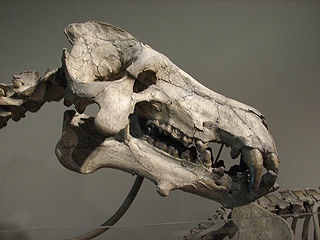
The skull of Daeodon showing its strong build and differentiated teeth.
Image Credit: Matt Celeskey, https://commons.m.wikimedia.org/wiki/File:Daeodon_skull.jpg

Roaming the plains of North America from 25-18 million years ago, Daeodon lived alongside a weird menagerie of life consisting of animals both familiar and unfamiliar. Alongside the ancestors of today’s horses and camels were extinct animals like the Chalicotheres, relatives of horses that walked on their knuckles like gorillas and possessed large claws that they used to pull down vegetation, and Hyaenodonts, mammalian carnivores that belonged to the now extinct Creodont group. Standing 1.8 metres tall and weighing roughly half a tonne Daeodon would have been an imposing animal in this environment. The distinctive flanges on its 3 ft. long head covered large cheek bones and were anchor points for large jaw and neck muscles, giving it a very powerful bite. Despite its fearsome appearance however, Daeodon was an omnivore. It possessed differentiated teeth just like in humans; gripping incisors at the front, large canines in the middle and crushing molars at the back. This enabled it to eat almost anything it came across including roots and tubers, fruit, leaves and meat. It would have been a very effective scavenger as a highly developed sense of smell would allow it to locate a carcass accurately from a distance, tracking the smell in a zig-zagging fashion. Furthermore its large size would have enabled it to drive off other animals from the kill. Make no mistake however, Daeodon would have dabbled with hunting live prey as well. It is thought to have been an ambush hunter, using its large size and powerful jaws to overpower and crunch through prey. But it’s not just other animals that Daeodon would have fought. Puncture marks found on the skulls of other entelodont species have shown that they fought each other, whether for mates, territory or both. So in many ways, given its large size and omnivorous lifestyle, Daeodon might have had a similar lifestyle to a modern day Grizzly Bear. Sadly this magnificent beast isn’t around today to give Grizzly Bears a contest. The last Daeodon went extinct around 18 million years ago. This coincided with the first emergence in North America of the large Bear-Dog Amphicyon (see my Amphicyon blog for more!), which had migrated from Asia. This predator, while smaller, was swifter and most importantly; more intelligent. As a result it seems to have partly out-competed Daeodon. Combining this with a climate which was becoming drier as the Miocene progressed resulted in Daeodon being driven to extinction, leaving only their fossils as remnants of a once widespread group.

Speaking of these fossils, the first Daeodon fossils were discovered in 1879 by the American fossil collector Edward Drinker Cope. Cope is a big name in the field of palaeontology, being responsible for the discovery of many extinct species such as the sauropod dinosaur Camarasaurus and the sail backed stem-mammal Dimetrodon. He is also known for his bitter rivalry with fellow American fossil hunter Othniel Charles Marsh. The two were locked in a race to discover and describe the most new species in a rivalry that has been termed “The Bone Wars”. When Cope examined Daeodon he determined it to be a member of the perissiodactyls, a group of mammals that contain modern day Zebras and Rhinos. It was only in 1909 when it was found that this wasn’t the case and it was actually an artiodactyl. For a long time Daeodon wasn’t the most widely known entelodont, with Dinohyus (meaning “terrible pig”) taking that title. However later it was found that Dinohyus and Daeodon, and another entelodont named Ammodon were actually one and the same animal. Because the rules of species dictate that the first name given to a species is the one that is kept Daeodon was the winner out of the three, with Dinohyus and Ammodon becoming synonyms.

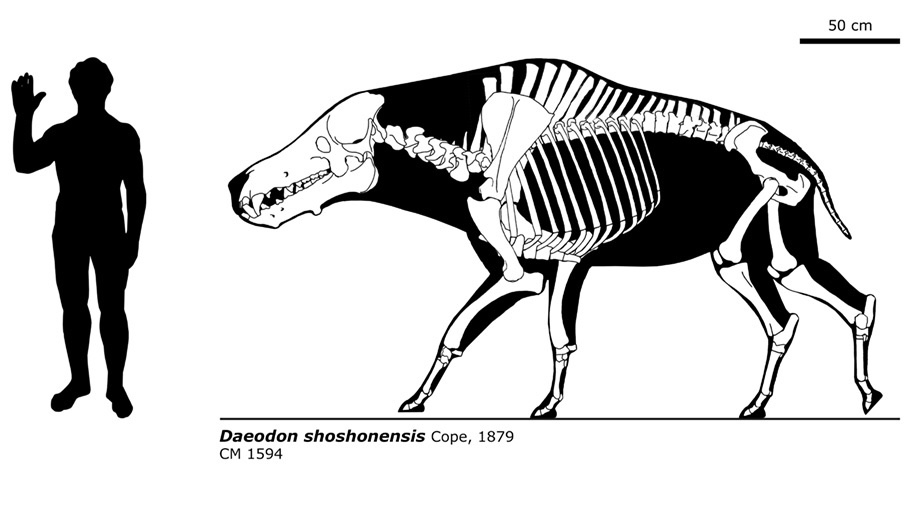
A skeletal of Daeodon, showing how the bones all fit together and how big the animal was compared to a human.
Image Credit: bLAZZE92, https://blazze92.deviantart.com/art/Daeodon-shoshonensis-419367474

Entelodonts were a bizarre group of mammals, with Daeodon being the most eye-catching and iconic of them all. It dominated the North American landscape and while its size and power certainly earns it the “Terminator Pig” nickname (minus the pig part of course) that was only one side to it. As well as being a big and intimidating hunter and fighting for what it wanted, Daeodon would have eaten its greens, rolled happily in the mud and napped peacefully in the sun!

References/Further Reading

Spaulding, O’Leary and Gatesy 2009 paper on the family tree of artiodactyls, including who Entelodonts are most closely related to

Spaulding, Michelle et al. “Relationships of Cetacea (Artiodactyla) among mammals: increased taxon sampling alters interpretations of key fossils and character evolution.” PloS one vol. 4,9 e7062. 23 Sep. 2009, doi:10.1371/journal.pone.0007062

Joeckel 1990 paper on entelodont paleoecology and jaw function

Joeckel, R. (1990). A functional interpretation of the masticatory system and paleoecology of entelodonts. Paleobiology, 16(4), 459-482. doi:10.1017/S0094837300010198

A blog, written by Joe Sawchak and published on the Carnegie Museum of Natural History website, about a life size model of Dinohyus named “hyus”. This model was characterised by the weirdly human eyes!

Sawchak, Joe, “Dinohyus: “Terrible Pig” in more ways than one”, Carnegie Museum of Natural History, carnegiemnh.org/dinohyus-terrible-pig-in-more-ways-than-one/

An article, written by Vasika Udurawane and published on Earth Archives, about the rise of the “Terminator Pigs”

Udurawane, Vasika, “Terminator pigs: Rise of the entelodonts”, Earth Archives, 2016, eartharchives.org/articles/terminator-pigs-rise-of-the-entelodonts/

Yutyrannus: The Feathered Tyrant

Image result for yutyrannus
Reconstruction of Yutyrannus huali, Feathers and all!
Image Credit: Tomopteryx, https://commons.wikimedia.org/wiki/File:Yutyrannus_huali.png

Tyrannosaurs are arguably the most famous members of the great dinosaur pantheon. Their traditional look has been set in stone in the public eye for decades, being immortalised in various media, of a giant scaly lizard with tiny arms and a massive head full of sharp, banana shaped teeth. However what if I were to tell you that this picture isn’t completely accurate, and that at least some tyrannosaurs were in fact a lot more on the soft and fluffy side! While it’s still being debated to this day whether the mighty Tyrannosaurus Rex had feathers (a story for another blog!), there was another tyrannosaur that not only possessed feathers, but was completely covered in them! Revealed to the world in 2012 Yutyrannus huali (meaning “Beautiful Feathered Tyrant” in a mix of Mandarin and Latin) shaked pre-existing ideas about Tyrannosaurs to the core.

Yutyrannus was discovered in the Yixian formation, in the Liaoning Province of China by a Chinese palaeontologist named professor Xing Xu. This particular corner of the world is extremely rich in dinosaur fossils, mostly dating to the Early Cretaceous period (125 million years ago). A large majority of the feathered dinosaur finds in the last few decades originated from this area. Xu is a big name in the world of contemporary palaeontology as described and named a lot of these feathered dinos, such as the “four winged” Microraptor and another feathered tyrannosaur called Dilong. The Yutyrannus fossils discovered by Xu and his team consisted of an adult and two juveniles, all of them almost complete. This is remarkable as tyrannosaurs are often only known from incomplete fossils. So in this case we have a vividly detailed picture of this particular animal.

One of the most surprising observations about Yutyrannus is not only that it had feathers, but that this was a big animal. Previously other known feathered tyrannosaurs, such as Dilong and Guanlong (both also discovered in China), were relatively small; ranging around the sizes as modern big cats. However Yutyrannus bucked this trend by growing up to 9 metres long, 3 metres tall and weighing up to 1 and a half tonnes. This makes Yutyrannus the largest animal with direct definitive evidence of feathers ever discovered. While other dinosaurs like Therizinosaurus and Gigantoraptor are likely to have had feathers, there’s been no direct evidence found yet, so Yutyrannus keeps the crown for now. Unlike other large tyrannosaurs Yutyrannus shares many features with other early tyrannosaurs, such as possessing three fingers instead of two and a lack of a specialised weight-bearing middle toe (used by later tyrannosaurs to support their weight). By comparing its anatomy with other tyrannosaurs it was also deduced that Yutyrannus was not a direct ancestor to T-Rex, but instead belonged to a family of tyrannosaurs that split off during the Early Cretaceous, meaning that Yutyrannus was essentially T-Rexs great great uncle. Unlike later Tyrannosaurs Yutyrannus also possessed a small, midline crest at the end of its snout. This could have been used to attract a mate or to signal other individuals, saying for example “I’m the biggest and baddest of the Yutyrannus! Keep away!”. As the fossils were of an adult and two juveniles this could potentially be a family group. It has been theorised that tyrannosaurs may have lived in groups, so perhaps this find represents the sad end of a mum or dad raising its offspring.

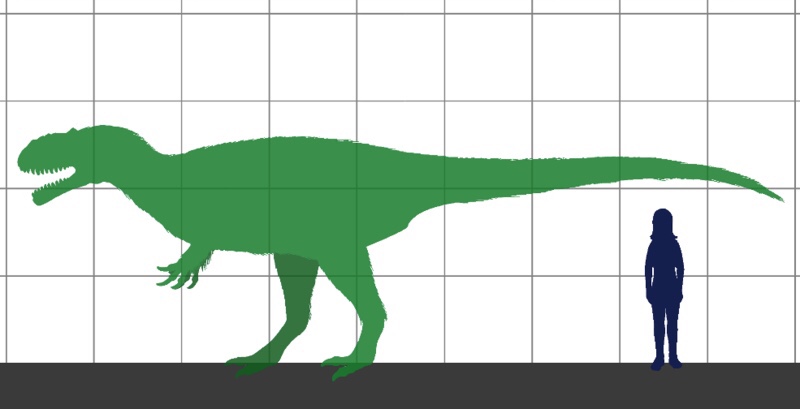
Size comparison between a full grown Yutyrannus and a fully grown human. As you can see this was certainly a large feathered animal!
Image Credit: Conty, https://en.m.wikipedia.org/wiki/File:Yutyrannus_SIZE.png

The feathers themselves have been found preserved in patches across the whole body of all 3 fossils. In life they were relatively simple “proto-feathers”, consisting of long simple filament like structures. These filaments would have intertwined to produce a fluffy down; somewhere between the down on a baby chicken and the longer, fibrous feathers of an emu. The primary function is likely to have been to keep Yutyrannus warm. A study by Amiot et. al. in 2011 looked at oxygen isotope compositions found in reptile fossils from East Asia. These seem to indicate that at the place and time where Yutyrannus lived was a relatively cold, compared to the hothouse that was the rest of the Mesozoic, so a feathery coat would have helped to keep an active hunter like Yutyrannus at the right temperature. Other possible usages of this coat of feathers could have been to assist with attracting mates, as has been speculated to have been the case in other feathered dinosaurs (e.g. Caudipteryx), and any shed feathers could have been used to line their nests, as it is employed by modern birds. It has even been suggested that the colour of the feathered coat would have helped Yutyrannus camouflage itself against its surroundings, a trick that is employed by most predators today. Some reconstructions have given Yutyrannus a fully white coat to blend in with a snowy background (like a polar bear). While this is a neat bit of speculation, it can’t be proven until any melanosomes that may be preserved are examined. If so then palaeontologists would be able to discover the colour of a tyrannosaur for the first time!

An illustration showing a group of Yutyrannus hunting a juvenile Dongbeititan
Image Credit: PaleoEquii, https://commons.m.wikimedia.org/wiki/File:Dongbeititan_and_Yutyrannus.jpg

A lot of criticism of these feathered dinosaurs, and particularly with ideas about feathers existing on dinosaurs that were previously thought to be scaly, is that it makes dinosaurs “less cool looking” and more like giant turkeys. However I think that Yutyrannus is an excellent example of how feathers can enhance the interest in dinosaurs, providing another side to how we see these great lizards. An animal like this would certainly make a cute pet when it’s young. However, like pet owners who buy young tiger cubs, it’ll grow up over the years into a giant unmanageable carnivore, leaving the owner thinking “I REALLY didn’t think this through!”

References/Further Reading

Xu et. al. 2012 paper describing the 3 complete skeletons of Yutyrannus, including the description of its feathers

Xu, X., Wang, K., Zhang, K. et al. A gigantic feathered dinosaur from the Lower Cretaceous of China. Nature 484, 92–95 (2012). https://doi.org/10.1038/nature10906

American Museum of Natural History blog on getting to know Yutyrannus

AMNH, “Get to Know a Dino: Yutyrannus huali”, American Museum of Natural History, Apr. 11, 2016, amnh.org/explore/news-blogs/on-exhibit-posts/get-to-know-a-dino-yutyrannus-huali

Amiot et. al. 2011 paper on oxygen isotope compositions in fossils from the Early Cretaceous East Asia

Amiot, Romain et al. “Oxygen isotopes of East Asian dinosaurs reveal exceptionally cold Early Cretaceous climates.” Proceedings of the National Academy of Sciences of the United States of America vol. 108,13 (2011): 5179-83. doi:10.1073/pnas.1011369108

A National Geographic article, written by Cliff Tarpy, about the fossils of Liaoning

Tarpy, Cliff, “Liaoning Province—China’s Extraordinary Fossil Site”, National Geographic, nationalgeographic.com/science/prehistoric-world/china-fossils/

Pentecopterus: The oldest Sea Scorpion yet

File:Eurypterids Pentecopterus Horizontal.jpg
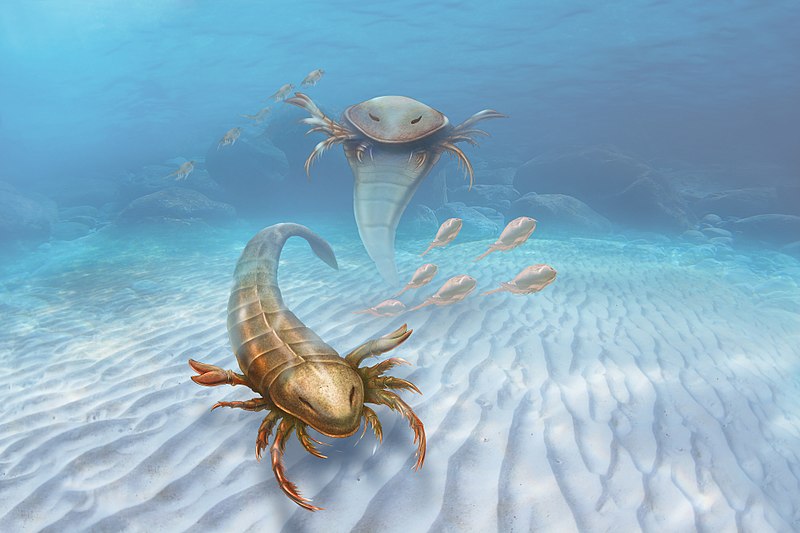
A pair of Pentecopterus exploring together
Image Credit: Patrick Lynch, https://commons.wikimedia.org/wiki/File:Eurypterids_Pentecopterus_Horizontal.jpg

In the heart of London a famous food critic, sporting a sharp suit and meticulously polished shoes, sits down at a table. He’s about to review a wildly popular new restaurant, where the signature dish is “The Sea-Food Surprise“. After a disappointing starter that he could only describe as “tasting of old, dried rock” the Surprise arrives. To the critics astonishment the dish is absolutely splendid! Cooked to perfection in a piquant sauce and with a texture and taste reminiscent of the best lobster ever! The next day he returns to the restaurant, demanding to be be shown the “lobster” he had had last night. “I’ll get the chef” the waiter replies. Eventually the chef emerges from the kitchen and asks the food critic to follow him. The critic passes a tank with a pair of North Atlantic Lobsters silently observing him with their beady stalked eyes. However the chef continues on past them. “If they aren’t the lobster then what is?” The critic wonders to himself. He is taken through the kitchen and down a set of stairs. “Surely you don’t keep lobster in the wine cellar?!” the critic joked. “You’re right, we don’t” the chef replies, opening a hatch in the wine cellar that leads to second, hidden cellar. In this cellar is a giant pool, and in this pool is a group of the “lobster” he had eaten the night They are huge, as long as a man and possessed a flat tail, smooth semi-circular head, spines sticking out all over the place and large claws which they were using to tear into the fish that were being used to feed them. It truly was unlike any seafood he had ever seen. “What in the world is that?!” The critic exclaimed! “The Sea-Food Surprise” The chef replied. “Pentecopterus, a Sea-Scorpion”.

An illustration of a Pentecopterus swimming between vegetation.
Image Credit: Apokryltaros, https://commons.m.wikimedia.org/wiki/File:Pentecopterus_decorahensis.JPG

While a story like this could only be from the realm of science fiction, Pentecopterus decorahensis (Greek for “Decorah’s Penteconter Wing”) was a very real animal. It belonged to an order known as the Eurypterids, although they’re more commonly known as “Sea-Scorpions”. While it is another example of a cool paleontological nickname, “Sea Scorpion” is misleading. While most (but not all) members of this order did live in the sea they were not scorpions, but instead were part of a completely separate group. That being said modern scorpions and other arachnids such as spiders, along with horseshoe crabs, are the Sea Scorpions closest living relatives. This is unsurprising as Sea Scorpions looked like what would happen if a scorpion and a crab decided that they wanted to settle down and start a family! Sea Scorpions were a highly successful order of animals during the Palaeozoic era, having a timespan from 467 Million Years ago (during the Mid-Ordovician period) to 252 Million Years ago, succumbing to extinction during the “great dying” at the end of the Permian period. This means that Sea Scorpions were alive for longer than the dinosaurs!

What makes Pentecopterus special among this already interesting group is that it is the oldest species of Sea Scorpion discovered so far. Their fossils are estimated to be about 467 Million Years Old. These fossils were first formally described in 2015 by a team led by James C Lamsdell, who named the animal after the penteconter, an Ancient Greek galley ship that, like the animal, possessed a sleek shape. The original fossils were discovered in 2010 in the Winneshiek Lagerstätte near Decorah in Iowa, USA (Hence its full name). Winneshiek is an interesting place as it is located within the remnants of an old meteorite crater! When Pentecopterus was alive this 5 km wide meteorite crater was filled with sea water, creating a unique shallow marine environment. The relatively still waters and lack of oxygen on the crater floor resulted in the perfect conditions for fossilisation, and the relatively low salinity of the water meant that marine animals typical of the Ordovician oceans couldn’t live here, creating a unique ecosystem for its time. As a result of these conditions multiple Pentecopterus individuals (ranging from juveniles up to fully grown adults) were perfectly preserved, so perfectly in fact that the outline of the tiny sensory hairs can be seen.

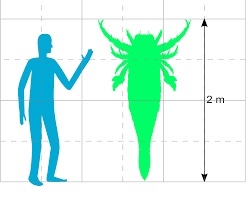
As you can see in this comparison, a Pentecopterus was one large arthropod!
Image Credit: Slate Weasel, https://commons.m.wikimedia.org/wiki/File:Pentecopterus_Size.svg

So what exactly did Pentecopterus look like and how would it have behaved? Pentecopterus, like all arthropods (a group of invertebrates containing all insects and arachnids), would have had an exoskeleton divided into a series of distinct segments. At the front was a round, smooth and sleek head with two pairs of eyes; (one pair of compound-eyes at the front and a pair of smaller eyes at the top). Its body had 3 pairs of legs attached to it, that it used for walking on the sea floor (and maybe occasionally on land), and behind them a pair of broad paddles (that were uniquely shaped to this Sea Scorpion) used to help it swim and turn in the water. Finally at the back end there was a long, broad tail (known as a telson) that it used to power itself through the water. Pentecopterus also possessed a pair of vicious claws at the front of its body that it used to grab prey, (consisting of early jawless fish species and other arthropods). Pentecopterus belonged to a larger family of Sea Scorpions known as the Megalograptids. These are characterised by possessing many more spines on their legs compared to other Sea Scorpions, giving Pentecopterus a very spiny look. This would have been an unnervingly large animal to look at, growing as long as a human is tall (1.8 metres). However there were later Sea Scorpions that could grow even larger than this, with the largest being the 2.5 metre long Jaekelopterus!

Such a magnificent animal would have certainly been very eye catching and, if modern day crabs and lobsters are anything to go by, would potentially have made for a unique sea food delicacy, as the food critic in our story found out!

References/Extra Reading

Lamsdell et. al. 2015 paper describing Pentecopterus

Lamsdell, J.C., Briggs, D.E.G., Liu, H.P. et al. The oldest described eurypterid: a giant Middle Ordovician (Darriwilian) megalograptid from the Winneshiek Lagerstätte of Iowa. BMC Evol Biol 15, 169 (2015). https://doi.org/10.1186/s12862-015-0443-9

Briggs et. al. 2018 paper reviewing the Winneshiek biota, home to Pentecopterus and other animals

Derek E.G. Briggs, Huaibao P. Liu, Robert M. McKay, Brian J. Witzke; The Winneshiek biota: exceptionally well-preserved fossils in a Middle Ordovician impact crater. Journal of the Geological Society ; 175 (6): 865–874. doi: https://doi.org/10.1144/jgs2018-101

A blog written by Palaeontologist Dave Marshall, and published in BMC Series blog, about the discovery of Pentecopterus and its significance

Marshall, Dave, “The oldest and the scariest sea scorpion: a giant discovery”, BMC Series blog, Sep. 1, 2015, blogs.biomedcentral.com/bmcseriesblog/2015/09/01/oldest-scariest-sea-scorpion-giant-discovery/

Another blog, written by Jim Shelton and published in YaleNews, on the discovery of Pentecopterus

Shelton, Jim, “Meet the newest ‘sea scorpion’: Pentecopterus, a predator from prehistoric seas”, YaleNews, Aug. 31, 2015, news.yale.edu/2015/08/31/meet-pentecopterus-new-predator-prehistoric-seas

Plateosaurus: A dinosaur that laid foundations

Image result for plateosaurus
Two Plateosaurus greeting each other, whether its friendly or not is debateable!
Image Credit: Nobu Tamara, http://spinops.blogspot.com/

The Triassic period was a time when the age of dinosaurs was just starting. The Permian/Triassic Extinction event of 250 million years ago (mya) had killed off almost 90% of all life, making it the biggest mass extinction event of all time. In the millions of years after this, the world was recovering. Life that survived this catastrophe expanded to fill in the many niches that had been left behind. This resulted in a weird menagerie of animals, dominated mostly by the reptiles. One group of reptiles known as the dinosaurs (you may have heard of them!) first evolved roughly 240 million years ago, and for the first 30 million years of their existence they competed with other reptile groups (e.g. rauisuchians, dicynodonts and cynodonts to name a few) for the inheritance of the earth. However by the Later Triassic, roughly 210 mya, dinosaurs were starting to gain the upper hand, and with the extinction of competing reptile groups were able to diversify into a variety of different shapes and sizes. This included their first evolutionary exploration into becoming giants. Whilst the true giants of the dinosaur world, the sauropods, had yet to appear on the scene their distant ancestors (and fellow members of the Sauropodomorpha sub-order) were already taking these first steps. These were the prosauropods. This group of dinosaurs were iconic members of the Late Triassic ecosystem and group members included some of the oldest dinosaurs yet discovered. The most famous member of this family would have been a common sight across the European edge of Pangea (a massive landmass consisting of all of the continents put together) 214-204 mya. Its name was Plateosaurus; meaning “flat lizard” (not because it was shaped like a pancake but because its fossils were noted to be much flatter than others discovered).

The first Plateosaurus fossils were discovered in 1834 by German Palaeontologist Johann Friedrich Engelhardt, and one Plateosaurus species (Plateosaurus engelhardti) was even named after him. This means that it was discovered just before Richard Owen coined the term “dinosaur”. However Plateosaurus wasn’t included as one of Richard Owen’s examples of dinosaurs because it was known only from fragmentary remains, which meant that it was poorly understood at the time. However this has changed, with multiple fossils of this animal having since been discovered (mostly in Germany but with some in Greenland and Norway too). One area which has produced multiple Plateosaurus fossils is a site near the village of Trossingen in the Black Forest, Germany. Here multiple Plateosaurus individuals have been unearthed, buried here over a period of time. One theory as to why this is the case is that the area contained thick sticky mud, in which the dinosaurs got stuck, before eventually collapsing and dying from exhaustion as they desperately tried to wiggle free (which is not a way to go!). However the large number of fossils means that Plateosaurus is now one of the best understood dinosaurs, with multiple papers being published about it, something I noticed when researching for this blog! These papers detail its anatomy and lifestyle, from studies of its skull, locomotion, its vertebrae and even its growth. As such Plateosaurus is one of the best known Triassic dinosaurs.

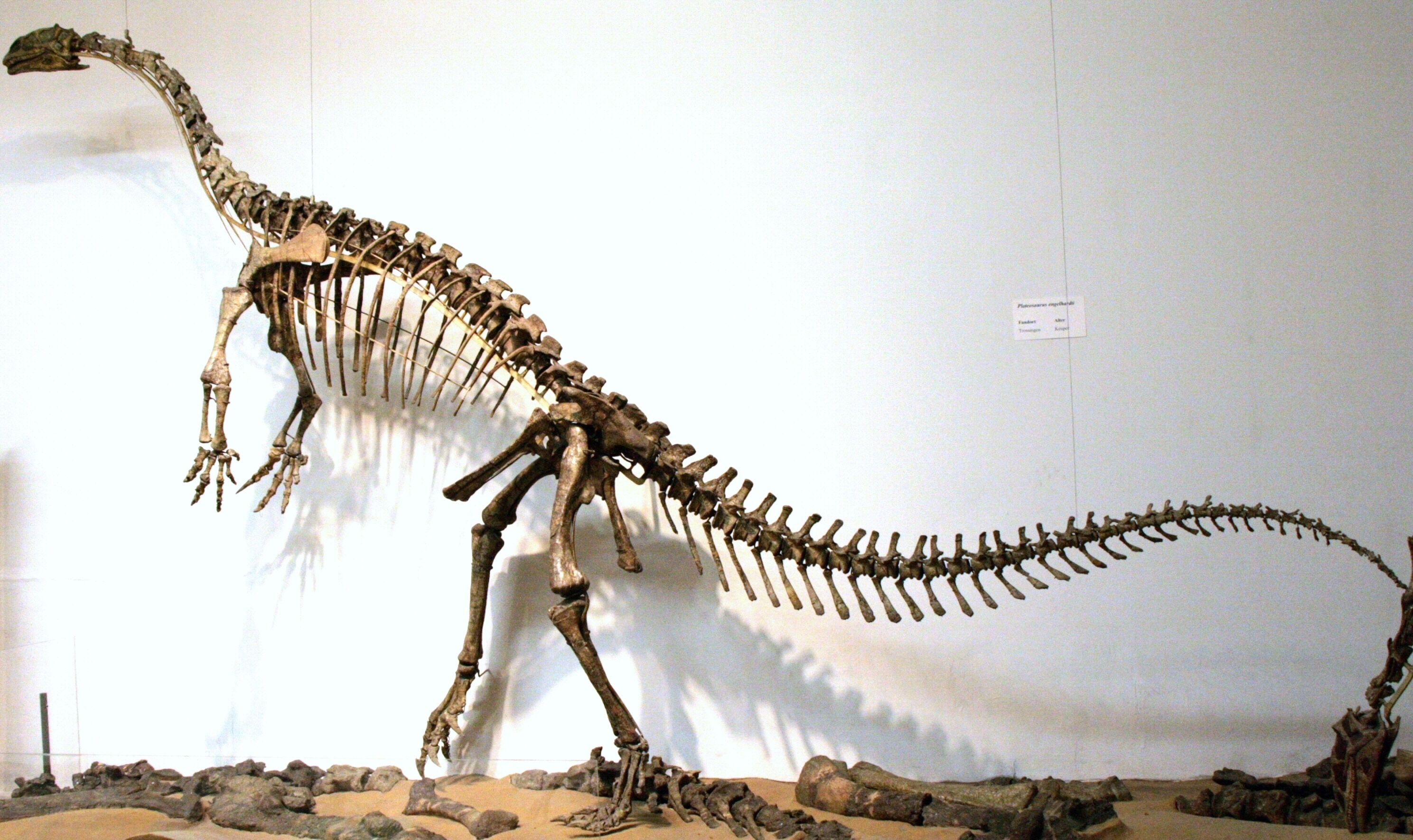
A reconstructed skeleton (known as “Skelett 2”) of Plateosaurus engelhardti in the Institute of Geosciences of the Eberhard-Karls University in Tübingen, Germany. This reconstruction is based on two individuals found at Trossingen.
Image Credit: FunkMonk, https://commons.m.wikimedia.org/wiki/File:Plateosaurus_Skelett_2.jpg

Due to the large concentration of fossils it is thought that Plateosaurus travelled in large herds. These herds would have stripped the landscape of almost any vegetation that they came across, the leaves of ferns and cycads being their favourite meal (though an estimated faster jaw closure speed than later sauropods, and different types of teeth, suggest that they might have eaten meat occasionally). To access this vegetation they would have used their long necks to reach leaves that were too high up for other herbivores. They also had claws to hook around and pull down plants and sharp crushing teeth to rip off leaves before swallowing them whole. Plateosaurus could also reach these heights because they walked around on two legs, with their long tail balancing out their long neck. This is a new discovery; previously it was thought they walked on all fours like their sauropod descendants. This theory is based on two main observations; firstly their front arms couldn’t pronate, meaning that they couldn’t lie their hands flat on the ground to support their weight; and secondly their centre of gravity was located over the hips, meaning that the hind limbs supported all of the weight. Further studies have also revealed another side to Plateosaurus. Deep depressions found in its dorsal vertebrae suggest that it possessed a bird like respiratory system with air sacs. This is surprising, as birds evolved from small, nimble theropod dinosaurs; not large long necked sauropods! One possible explanation is that bird like characteristics evolved much earlier in dinosaurs than previously thought, before they had diversified into their key groups. The other is that this system evolved convergently (i.e. it evolved separately in two different groups). These air sacs would have allowed Plateosaurus to carry around their large bulk more efficiently, and would have enabled them to process enough oxygen to have a more active, almost warm-blooded lifestyle. Plateosaurus is best envisaged as the Elephant of its day, approaching 10 metres long and 4 tons in weight. However not all adults would have reached this size. This is because Plateosaurus is one of only a few dinosaurs that is known to show “developmental plasticity”. In simple terms this is variation in growth between different Plateosaurus individuals, resulting in different adult sizes (in this case an adult range of 5-10 metres long and 0.6-4 tons). This is seen on a smaller scale in humans, with adults ranging from approximately 5”0 to as tall as 6”8. Being relatively large, a fully grown Plateosaurus would have been a tough proposition for most predators. Two exceptions however were the simply named Smok (meaning dragon in Polish), a 6 metre long archosaur reptile related to dinosaurs, and Liliensternus, a 5.2 metre long theropod dinosaur belonging to a family known as the Coelophysidae. Like the pro-sauropods this group were also dinosaurs that were characteristic of the Triassic, and fights between Liliensternus and Plateosaurus would be a subject for a segment in any nature documentary about life in the Triassic.

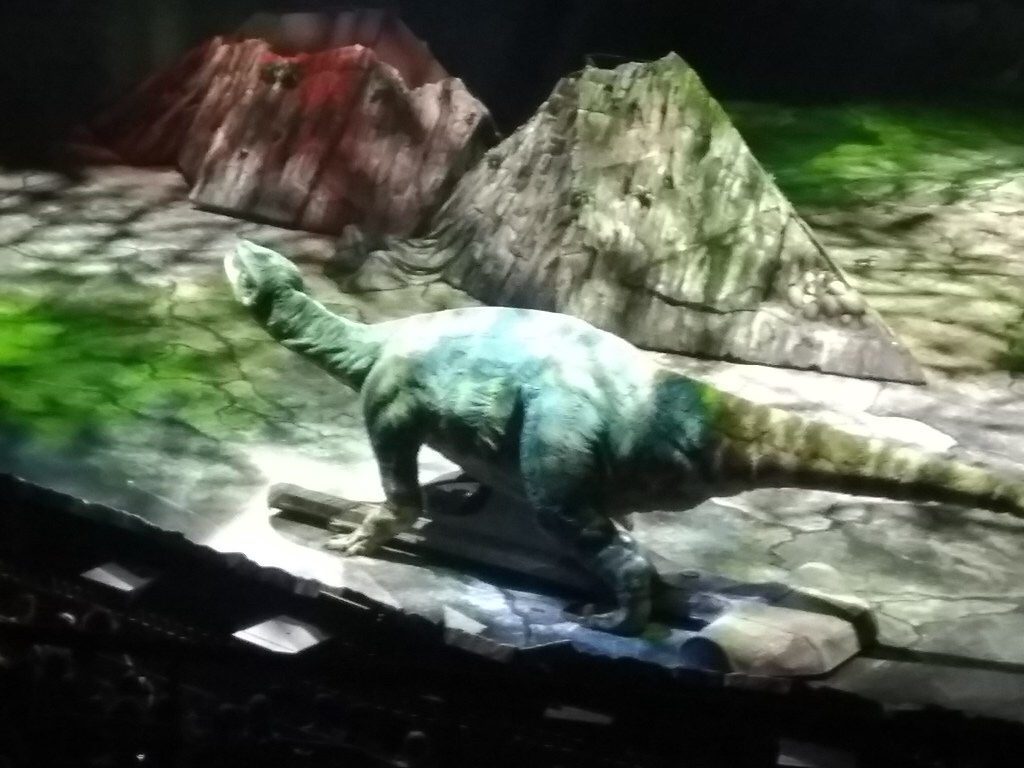
Plateosaurus has even appeared on the stage! This is from the Walking with Dinosaurs live show
Image Credit: Dark Dwarf, https://www.flickr.com/photos/darkdwarf/42887589745

Plateosaurus is undoubtedly one of the most famous dinosaurs of their earliest days. Its large size, plentiful fossils and connection to the later sauropods makes it a talisman among dinosaur enthusiasts. I think Walking with Dinosaurs summed up Plateosaurus the best, stating “This is the shape of things to come”.

EDIT: Based on studies of related pro-sauropods such as Massospondylus and Mussaurus (e.g. Otero et. al. 2019) it is thought that while Plateosaurus was a biped when fully grown, they were actually quadrupeds when they were juveniles. This theory is based on evidence such as observed changes in the centre of mass from the mid-thorax (in juveniles) to the pelvis (in adults), and in changes in body mass over time (e.g. Mussaurus grew from 60g when hatched, to 7kg at 1 years old, to over 1000kg when adults).

References/Extra Reading

Hofmann & Sander 2014 paper on the study of juvenile Plateosaurus fossils and developmental plasticity in Plateosaurus

Hofmann, Rebecca, and P Martin Sander. “The first juvenile specimens of Plateosaurus engelhardti from Frick, Switzerland: isolated neural arches and their implications for developmental plasticity in a basal sauropodomorph.” PeerJ vol. 2 e458. 3 Jul. 2014, doi:10.7717/peerj.458

Gunga et al 2007 paper estimating body mass and volume in Plateosaurus

Gunga, H., Suthau, T., Bellmann, A. et al. Body mass estimations for Plateosaurus engelhardti using laser scanning and 3D reconstruction methods. Naturwissenschaften 94, 623–630 (2007). https://doi.org/10.1007/s00114-007-0234-2

Mallison 2010 paper accessing range of motion of Plateosaurus legs and vertebrae, proving, among other results, that Plateosaurus walked on two legs only

Mallison, H. (2010). “The Digital Plateosaurus II: An Assessment of the Range of Motion of the Limbs and Vertebral Column and of Previous Reconstructions using a Digital Skeletal Mount.” Acta Palaeontologica Polonica 55(3): 433-458, 426.

Button, Barrett & Rayfield 2016 paper comparing the jaws of Plateosaurus with the Late Jurassic sauropod Camarasaurus

Button, D, Barrett, P, Rayfield, E. Comparative cranial myology and biomechanics of Plateosaurus and Camarasaurus and evolution of the sauropod feeding apparatus. Palaeontology, Vol 59, Iss 6, 887-913 (2016), https://doi.org/10.1111/pala.12266

Otero 2019 paper on the grow changes in Mussaurus, a close relative, that show a shift in locomotion from a quadruped to a biped

Otero, A., Cuff, A.R., Allen, V. et al. Ontogenetic changes in the body plan of the sauropodomorph dinosaur Mussaurus patagonicus reveal shifts of locomotor stance during growth. Sci Rep 9, 7614 (2019). https://doi.org/10.1038/s41598-019-44037-1

Bear + Dog = Amphicyon

Image result for amphicyon
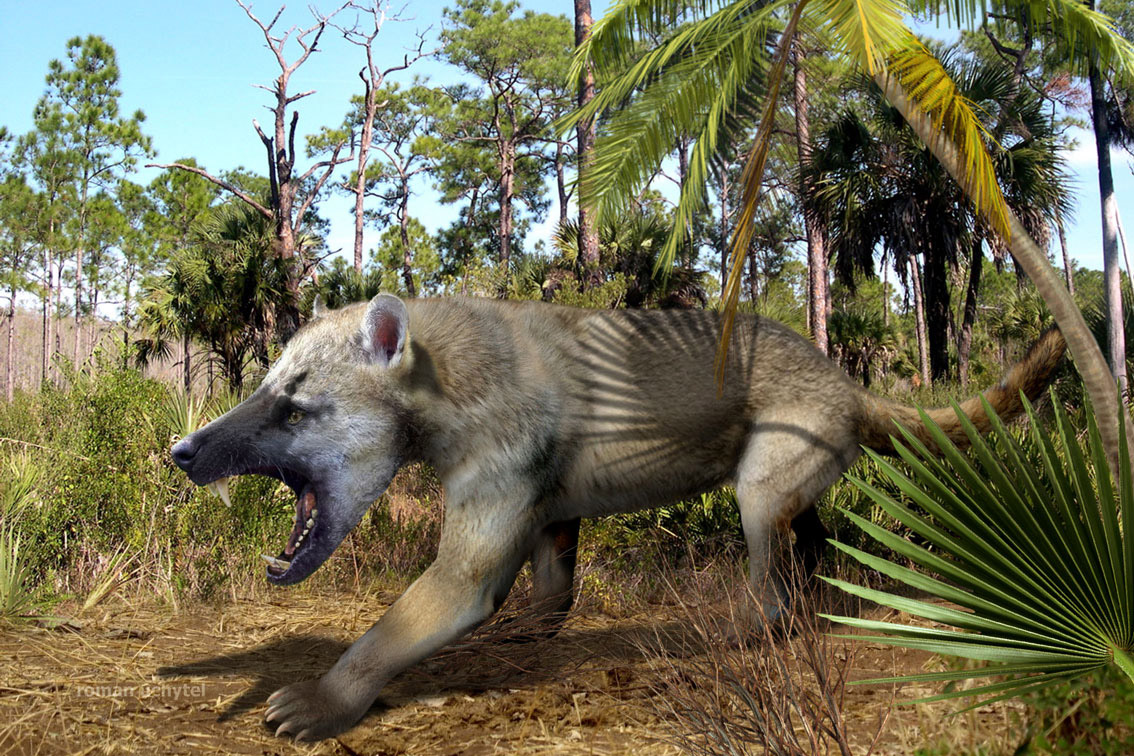
Reconstruction of Amphicyon ingens: The largest of the Bear-Dogs
Image Credit: roman uchytel, https://ru.wikipedia.org/wiki/%D0%A4%D0%B0%D0%B9%D0%BB:Amphicyon-ingens_reconstruction.jpg

16-18 million years ago, a fierce predator roamed the North American landscape. It had a long snout and a long tail like a modern day wolf, but it also had a stocky build, powerful forelimbs, plantigrade feet (i.e. it walked with its paws flat on the ground) and grew up to 2.5 metres long and 1.5 metres tall. These latter characteristics are much more like a modern bear. This was a weird mix of features. Anybody seeing this animal today, not knowing what it was, would think to themselves; “Is that a mutated bear?” “Or is it a new dog breed?”. This animal has the scientific name Amphicyon, meaning “Ambiguous dog”, however its common nickname is “Bear-Dog”. This is fitting because Amphicyon looks like an animal that would be the result of bizarre genetic cross-breeding of a Labrador and a Grizzly Bear! So the question that I will ask in this blog is, what in the world was it?

The genus Amphicyon (genus being a group of species, i.e. like the big cat group) was a very successful animal in its time, with multiple species stretching across the globe from North America to Europe to Africa. These species included Amphicyon longirams, which stalked what is now Florida, and Amphicyon Ingens; which reached a size comparable to the largest terrestrial carnivore alive today – the Polar Bear. In 2016 there was even a Chinese species discovered which was named Amphicyon zhanxiangi. Amphicyon first evolved in Europe and Asia, before migrating into North America during the mid-Miocene period 18 Million years ago. From this period they out-competed the resident mammalian carnivores such as the Hyaenodonts (large mammalian predators with shearing teeth), the Entelodonts (who have the awesome nickname of “Terminator Pigs”) and other Bear-Dogs to become the top dog (pun intended) of the Miocene landscape.

A map showing the geographical range of Amphicyon. As you can see Europe, Asia, North America and Africa all had their own Amphicyon species!
Image Credit: Noles1984, https://en.m.wikipedia.org/wiki/File:Amphicyon_range.png

Bear-Dogs as a whole are thought to have had a variety of hunting strategies that varied between species. Amphicyon, being larger and more stocky in build, would have hunted somewhat like a bear; surprising their prey and pursuing it for a short distance before using their muscular forelimbs and large body size to pin it down before biting at the neck and body to finish it off. Being an ambush hunter it wouldn’t have regularly partaken in long chases, though it was able to pursue prey for longer than other ambush predators. Their size would have allowed them to hunt larger mammalian herbivores, which would have included early rhinos. We know this from a fossil unearthed from Portugal of the lower jaw of the extinct rhino Iberotherium. This jaw has clear puncture marks in it made by the teeth of a large carnivore. A study, conducted by Antunes, Balbino and Ginsberg in 2006, concluded that the culprit was Amphicyon giganteus as it was the only known carnivore from the same time and place large enough to inflict these type of wounds (though whether it did so when hunting or scavenging this Iberotherium is unknown). Meanwhile other species of Bear-Dogs, such as Borocyon, had longer legs and more slender bodies. This suggests that they hunted more like modern day wolves; pursuing their prey over long distances. While Amphicyons diet would have mostly consisted of meat it is thought that other Bear-Dogs might also have been omnivorous to a degree, eating plant matter and berries to supplement their diet. It is also thought that they, along with other Bear-Dogs, exhibited denning behaviour, digging out burrows in which they could raise their young and take shelter. Like all mammals they would have exhibited high levels of parental care, raising pups until they were old enough to fend for themselves. Amphicyon also exhibited sexual dimorphism, just like bears, with the males being substantially larger than the females.

A mural depicting a scene from the 16-13 million year old Mascall assemblage in Oregon, USA, showing an Amphicyon hunting a Miolabis.
Image Credit: National Park Service, https://www.nps.gov/joda/learn/nature/mascall.htm

So to answer the question posed at the beginning of this blog, what exactly was Amphicyon? A bear or a dog? Well the answer is in fact neither. Amphicyon belonged to a family known as the Amphicyonidae, which included it and all other species of Bear-Dogs. This family belonged to an order known as the Caniformia, which also contains the dog and bear families as well as foxes and sea lions. As a result Amphicyon and its kin were actually close cousins of bears and dogs, separating from them in the evolutionary tree around 40 million years ago during the Eocene period. The Bear-Dogs evolved into a wide range of shapes and sizes, filling a variety of niches. However, despite its success, Amphicyon and its kin would sadly go extinct around 7.2 million years ago. The main cause of this was the changing environment at the end of the Miocene. The climate became dryer, which resulted in the emergence of more open plains. This meant that the slower, bulkier Amphicyon could not find the cover it needed to ambush its prey. This meant that they struggled to find enough food to support their large size. Also (rather ironically) another factor was the emergence and success of the dogs and bears. Dogs were more specialised in the endurance hunting style that is effective on open plains, and some had jaws that could crush bone, something Amphicyon couldn’t do despite its impressive appearance! (In fact one group of dogs, named the Borophaginae, are commonly referred to as the “bone-crushing dogs”!) Bears meanwhile had a more omnivorous diet than Amphicyon, giving them access to a wider range of food. Dogs and Bears were also generally smaller, so didn’t require as much food to keep them alive. In addition at about this time the first Sabre-Tooth Cats were evolving, bringing yet more competition. These three groups together took over all the niches that had previously been occupied by Amphicyon and its relatives. As a result this magnificent group of animals were squeezed out and confined to the pages of pre-history.

It’s a shame too, as a pet Amphicyon would have been not only a cute puppy but also grown to be an effective “guard dog”. It would certainly draw more than a few glances when you took it for a walk!

References/Further Reading

Antunes, Balbino & Ginsberg 2006 paper on Iberotherium jaw fossil showing bite marks made by Amphicyon

Antunes, Miguel. Telles, Balbino, Ausenda C., Ginsberg, Léonard. Ichnological evidence of a Miocene rhinoceros bitten by a bear-dog (Amphicyon giganteus), Annales de Paléontologie, Volume 92, Issue 1, 2006, Pages 31-39,

Florida Museum information page on Amphicyon longirams

Morse, Paul E. “Amphicyon longiramus” Florida Museum, Oct. 5, 2012, floridamuseum.ufl.edu/florida-vertebrate-fossils/species/amphicyon-longiramus/

Sorkin 2006 paper on Amphicyon and Ischyrocyon diet and hunting behaviour

Sorkin, Boris. (2006). Ecomorphology of the giant bear-dogs Amphicyon and Ischyrocyon. Historical Biology. 18. 10.1080/08912960600618073.

Jiangzuo et. al. 2016 paper describing the Amphicyon zhanxiangi

Qigao Jiangzuo, Chunxiao Li, Shiqi Wang & Danhui Sun (2018) Amphicyon zhanxiangi, sp. nov., a new amphicyonid (Mammalia, Carnivora) from northern China, Journal of Vertebrate Paleontology, 38:6, DOI: 10.1080/02724634.2018.1539857

Leaellynasaura: A dinosaur that called the South Pole home

A drawing of the South Poles resident dinosaur Leaellynasaura
Image Credit: El fosilmaníaco, https://commons.m.wikimedia.org/wiki/User:El_fosilman%C3%ADaco

It’s hard to imagine any land based animal living at the South Pole. The frozen wastes, completely prevents any significant plant growth, complete darkness covers the area for about half the year, and temperatures are nearly always well below freezing. This results in an environment where the largest life-form is no more than microscopic. However for a sizeable chunk of earth’s history there was no permanent ice cap at the South Pole. Instead temperate forests covered the continents that were located there. During the Early to Mid-Cretaceous period, (around 105-110 million years ago), a landmass that would eventually break up to become Antarctica and Australia was present at the south pole of our planet. If you trekked through this land, often with only the southern lights illuminating the landscape, you might be able hear the chirps of a small, unassuming little dinosaur piercing the otherwise silent frozen forest. These sounds belonged to an ornithopod known as Leaellynasaura amicagraphca (Latin for “Leaellyn’s lizard”, with “amicagraphica” referring to the friends of Museum Victoria who helped with the research).

When a prehistoric animal is given its scientific name, the usual procedure is to either; 1. Name it because of a distinguishing feature; 2. Name it after the area it was discovered in; or 3. Give it an eye catching name that involves the words “terror” or “massive” or “weird”. However Leaellynasaura bucks this trend by instead being named after Leaellyn Rich, the young daughter of Palaeontologists Thomas and Patricia Rich, who first discovered Leaellynasaura in 1989 (a great present for any person!). The fossils were found at a place known as Dinosaur Cove, which is located just outside of Melbourne, Australia. This site, and others in Australia, have shown that Leaellynasaura lived alongside a wide range of other animals. This included other dinosaurs, such as the large vegetarian iguanodontid Muttaburrasaurus and the mid-sized hunting theropod Australovenator, as well as a giant 5 metre long amphibian named Koolasuchus. Fans of the hit BBC documentary “Walking with Dinosaurs” might recognise some of the names I’ve just mentioned. This is because the fifth episode, titled “Spirits of the Ice Forest”, is actually based on this fossil assemblage.

A selection of Leaellynasaura amicographica fossils.
Image Credit: Kumiko, https://www.flickr.com/photos/kmkmks/8086848566/

Leaellynasaura itself was a small dinosaur, with estimates varying between 1-3 metres. It is unclear what specific group of Ornithopod Dinosaurs it belonged to, however it is similar in anatomy to the Hypsilophodontids (try saying that five times fast!). These dinosaurs are characteristically small, bipedal, nimble herbivores, using their beaks to browse vegetation, all whilst scampering between larger herbivores (the best modern analogue might be modern day Gazelles). When you look at the skeleton of Leaellynasaura a few features stand out. Firstly it had large eye sockets relative to its skull. Combined with a large optic lobes in its brain cavity this suggests that Leaellynasaura had excellent eyesight, allowing it to spot predators and locate juicy plants to eat. Secondly its tail was very long, nearly 3/4 of its entire length! This tail contained over 70 vertebrae and lacked many of the ossified tendons involved in stiffening and strengthening the tail of other dinosaurs. This means that Leaellynasaura probably possessed a remarkably flexible tail, capable of a wide variety of movement (maybe even curling round up and around its body). The function of this long tail is unclear at the moment, though it has been theorised that it was involved in display, especially when combined with any feather covering that it likely possessed.

Size comparison between Leaellynasaura amicagraphica and an adult human. Note Leaellynasaura’s proportionally long tail that takes up 2/3rds of its total length!
Image Credit: Slate Weasel, https://en.m.wikipedia.org/wiki/File:Leaellynasaura_Size.svg

The biggest challenge that Leaellynasaura would have faced would have certainly been surviving the elements. As Dinosaur Cove was located well within the Antarctic Circle it would have endured the same seasonal variations that Antarctica does today; 6 months of near permanent sunshine followed by 6 months of near permanent darkness. So how could a dinosaur possibly have coped with these long periods of darkness, where temperatures would’ve regularly dropped well below freezing? This is where its key distinguishing features come into play. Its large eyes would have allowed it to see well in the dim light, key for spotting what little edible plant matter could be found in the frozen ground. Its long flexible tail could potentially have been wrapped round itself when the animal rested in order to keep itself warm (rather like your pet cat does when it is taking a nap!). Another strategy to protect itself against the cold could have been taking shelter in burrows. Fossil burrows have been found at Dinosaur Cove and it has been suggested they could have been made by Leaellynasaura. Support for this theory comes from fossils in Montana of a close cousin, named Oryctodromeus. Fossilised remains have been found preserved in the burrows that they lived in. Also because of fossil evidence from ancestral relatives (such as Tianyulong) it has been suggested that Leaellynasaura was covered in feathers. Speculations range from simple velvety fuzz to a multi-layered fluffy coat according to different reconstructions. The feathered coat makes sense considering the cold climate, certainly allowing it a much greater degree of insulation than traditional reptilian scales.

It may not be the biggest, or possess giant claws, bone clubs or spines, but Leaellynasaura in its own way was just as remarkable a dinosaur as any that have ever existed, perfectly adapted to an environment that was previously thought to be impossible for a reptile to live in. Also, especially if we assume it did possess a thick fluffy coating of feathers with its big eyes and long tail, Leaellynasaura would have certainly been a contender for the cutest dinosaur to ever exist! If it were alive today dog grooming shows would have serious competition from Leaellynasaura grooming shows!

References/Further Reading

Article on Australian Dinosaurs (including Leaellynasaura) and Dinosaur Cove

Udurawane, Vasika, “Dinosaurs down under”, Earth Archives, 2016, eartharchives.org/articles/dinosaurs-down-under/

A 2017 study by Sharp et al. which put a Leaellynasaura fossil through a CT scanner

Sharp, Alana & Regalado Fernandez, Omar & Siu, Karen & Rich, Tom. (2017). Revealing the skeleton of the polar dinosaur Leaellynasaura amicagraphica using synchrotron computed tomography, Society of Vertebrate Paleontology (SVP) 77th Annual Meeting.

The Western Australian Museum’s article about Leaellynasaura, talking about its anatomy, size and growth.

“Leaellynasaura”, Western Australian Museum, 2014, museum.wa.gov.au/explore/dinosaur-discovery/leaellynasaura

“Take your stinking paws off me, you damned dirty Gigantopithecus!”

Gigantopithecus as it may have appeared in life
Image Credit: Concavenator, https://commons.m.wikimedia.org/wiki/File:Gigantopithecus.png

If there is one creature that is frequently recycled in pop culture it is the giant ape. They recur over the decades because writers and directors can make them human enough that people can relate, but also fearsome enough to differentiate itself and be a scary threat. The most notorious example of this is King Kong, who first starred in a film in 1933 and has been reinvented on screen a staggering 3 times. He is one of the most famous large movie monsters of all time, tying only with Godzilla (whom Kong will battle on the silver screen in 2020). As well as seeing them in movies some people are convinced that large “ape-men” still exist in the wild. Sightings of animals such as Bigfoot and the Yeti, as well as “evidence” of hair and skin samples, have been reported for centuries. However the fossil record tells us that there were once indeed giant apes roaming the earth, as recently as 100,000 years ago!

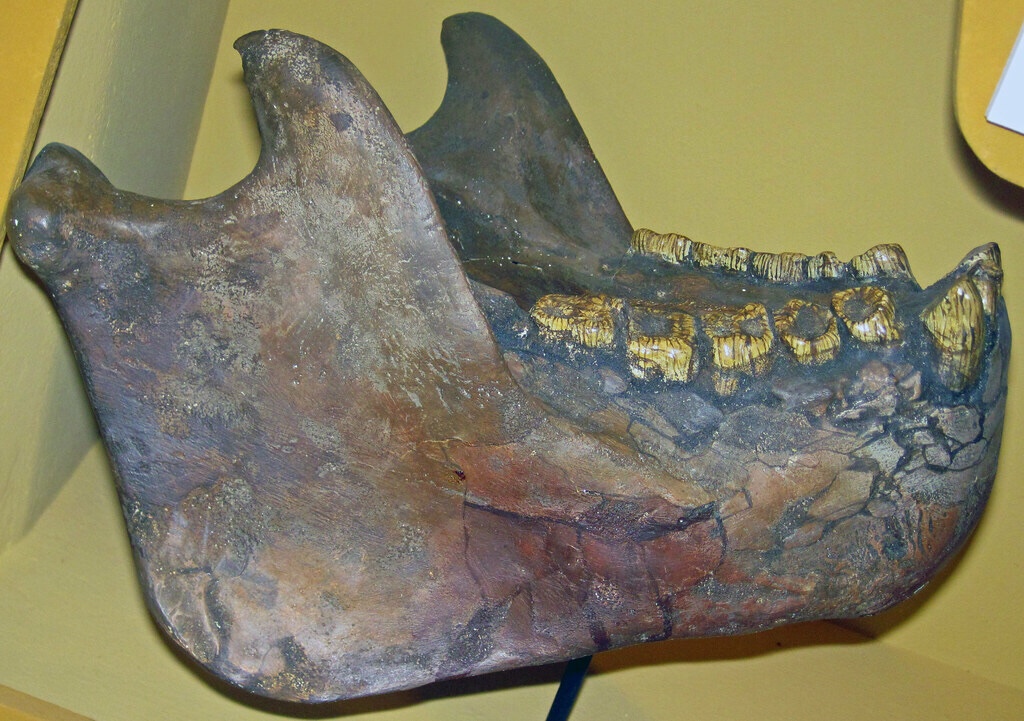
The first fossils of this mysterious animal were discovered not during an excavation or stored in a museum, but in a market in Hong Kong. In 1935 A German palaeontologist named Ralph von Koenigswald was wandering through a Chinese market looking for weird curiosities such as “dragon bones”. Suddenly his eye was drawn to a molar tooth in one of the pharmacies. Von Koenigswald deduced that this tooth belonged to a species of primate, however this tooth was much bigger than any tooth belonging to a modern primate! Tracing the source of the tooth to a cave in Guangxi, South China, Von Koenigswald found more teeth and a jaw fragment. He named this giant ape Gigantopithecus blacki, (Greek for “Black’s giant ape”) after a colleague of his called Davidson Black. Since then surprisingly few further remains of Gigantopithecus have been found, with only a few more teeth and fragments of lower jaw collected from China, Vietnam and India. This could be due to the poor preservation potential of the areas that this animal lived in. This problem affects other prehistoric animals, and explains why we know some animals from very fragmented remains only. They have to be reconstructed based on what little we can infer from the remains, information from close relatives and more than a fair bit of educated guesswork!

A Cast of a Gigantopithecus lower jaw on display at the Cleveland Museum of Natural History in Cleveland, Ohio, USA. Jaws and teeth like these make up pretty much all of the known fossils of this giant ape.
Image Credit: James St. John, https://www.flickr.com/photos/jsjgeology/32409712905

However, despite the mysteriousness surrounding this animal, palaeontologists have been able to estimate that Gigantopithecus blacki stood 3 metres tall and weighed around half a ton; meaning that it would easily tower over a person and would have been the largest and most physically powerful primate that has ever lived. This size varied between genders, with males being much larger than females (this is known as “sexual dimorphism”). Like Orangutans Gigantopithecus is thought to have sported a long red/ginger coloured coat of hair, which together with its size would have made it a distinguishable sight in the tropical forests of South East Asia. At first glance this description may sound eerily similar to the popular depiction of “The Abominable Snowman”. However before anybody gets any ideas, Gigantopithecus would not explain the myth of the Yeti! For one thing it probably was not a bipedal walker, instead walking on its knuckles like a gorilla. Also its geographical range didn’t stretch to the Himalayas, where most yeti sightings have traditionally been located. That being said, it is plausible that fossil remains of Gigantopithecus collected over the centuries by locals may have been mistaken for remains of a Yeti. Despite its large size and ferocious canines, it is thought that Gigantopithecus would have had a diet consisting of fruit, leaves, roots and even bamboo, using its large molars to crunch through the plant matter. Its size would have given it protection against the main predators that inhabited the forests it lived in, such as tigers and alligators. The similarities to Orangutans isn’t just superficial however. A study published in November 2019 (by Welker et. al.) has shown that modern Orangutans and Gigantopithecus share a close common ancestor. By extracting and studying small fragments of protein from fossils of Gigantopithecus teeth the researchers showed that the two species split from a common ancestor around 10-12 million years ago. This was at a time when the great apes were undergoing an increase in diversity, evolving into the precursors of species alive today (including the early ape-like ancestors of humans).

A size comparison between Gigantopithecus blacki (left), the smaller Gigantopithecus giganteus (right) and an adult human (centre)
Image Credit: Discott, https://commons.m.wikimedia.org/wiki/File:Gigantopithecus_v_human_v1.svg

Gigantopithecus evolved around 6 million years ago and was a highly successful species in its time. However despite its longevity it would eventually succumb to extinction, the last Gigantopithecus dying out 100,000 years ago. One reason for its extinction is thought to have been the loss of its tropical forest habitat due to global cooling. With the reduction of forest went the loss of it’s mainly fruit diet. As a result Gigantopithecus could not find enough food to support its huge size. However before it disappeared Gigantopithecus did manage to come into contact with our early human ancestors, in particular the early hominid Homo erectus, who had just spread into Asia at the time. Whether these early human ancestors would have hunted Gigantopithecus is a matter of debate, however a 3 metre tall bad tempered great ape would have certainly posed a massive threat to any human ancestor brave enough to take it on!

So Gigantopithecus managed to inspire awe in our early human ancestors, as giant apes do in ourselves today. To finish I’ll leave you with one more fun fact about this ape. The character of King Louie in the 2016 live action film “The Jungle Book” is a self-confessed Gigantopithecus!

References/Further Reading

Welker et. al. 2019 paper on Gigantopithecus ancestry

Welker, F., Ramos-Madrigal, J., Kuhlwilm, M. et al. Enamel proteome shows that Gigantopithecus was an early diverging pongine. Nature 576, 262–265 (2019). https://doi.org/10.1038/s41586-019-1728-8

Bocherens et. al. 2017 paper on how Gigantopithecus’ size may have contributed to its extinction

Bocherens, H., et al. (2017). “Flexibility of diet and habitat in Pleistocene South Asian mammals: Implications for the fate of the giant fossil ape Gigantopithecus.” Quaternary International 434: 148-155.

Another paper, Zhang & Harrison 2017, revisiting Gigantopithecus

Zhang, Y., Harrison, T., Gigantopithecus blacki: a giant ape from the Pleistocene of Asia revisited. American journal of physical anthropology, 162 Suppl 63, 153-177 (2017). doi: 10.1002/ajpa.23150.