The Woolly Mammoth: The great wonder of the Ice Age

File:Hunting Woolly Mammoth.jpg
Despite their size Woolly Mammoths were not invulnerable to attack from predators like these human species.
Image Credit: Wikimedia Commons, https://en.wikipedia.org/wiki/File:Hunting_Woolly_Mammoth.jpg

“Alright, so what’s the next animal decided by the voters?”

[See’s that it’s the Woolly Mammoth].

“…..oh boy”.

Woolly Mammoths are HUGE. Not just in size but also with regards to public interest and our knowledge of these mammals. There are dozens upon dozens of scientific papers, journal articles, blog articles, TV documentaries and YouTube videos covering almost every aspect of mammoth biology, behaviour, extinction, evolutionary history and even whether they can be brought back from the dead (more on that later). As a result there is a lot to talk about! There’s so much that I can’t cover everything in just one blog article. So in this article we shall address one basic question; what exactly was a Woolly Mammoth? Furthermore I shall include some facts and stories about Woolly Mammoths that I’ve personally found awesome, interesting, inspiring and thought provoking.

Mammoths have a very long history of discovery, longer than almost any other prehistoric animal. Written records of mammoth fossil finds date back to the 17th century, with one find being recorded from Belgium in 1643. At that time palaeontology wasn’t a recognised field of study and the people who unearthed them thought that they had found the bones of mythical giants. Further remains were brought to the naturalist Sir Hans Sloane in 1728, who studied the remains and published his findings in the “Philosophical Transactions of the Royal Society”. This means that Woolly Mammoths were the first prehistoric animals to be studied scientifically! The finds presented to Hans Sloane consisted of tusks and teeth. But they were enough to convince him that they belonged to a type of elephant. However why were elephant bones being found as far north and in as cold a climate as Siberia? It wouldn’t be until the late 18th century when it was deduced that these bones belonged to a new extinct elephant relative; a Mammoth. Some of the earliest Mammoth reconstructions from the 18th century were truly bizarre. One such reconstruction can only be described as a short, round pig with tusks coming out of its narrow snout! This is a far cry from the elephant-like reconstructions of today. Modern day reconstructions of Mammoth species, and the science surrounding them, are put together from evidence not only from fossil bones but also from one of the most exceptionally preserved remains possible in nature; frozen carcasses. These frozen bodies are the result of the poor Mammoths becoming trapped in thick mud. This mud fills the Mammoth’s mouth, nose and throat and combined with the fatigue from the trying to escape the Mammoth perishes. It is then buried under the thick mud and he combination of the cold temperatures (slowing down respiration of decaying bacteria) and the thick, oxygen deficient frozen mud slows down decomposition to a crawl. Therefore when the bodies are unearthed tens of thousands of years later they still have fur, skin, muscle tissue (which is so fresh that it is still edible!) and even internal organs. Some famous examples of frozen Mammoth carcasses include a 2013 specimen (of a 50-60 year old female) from the Stathsky Islands in Siberia that still had blood within it. Another example is a “Golden Mammoth”; a 22,000-50,000 year old “pygmy” Mammoth species (scientifically named “Mammuthus exilis”), only 2 metres tall, discovered in Kotelny Island in Siberia in 2018 that possesses golden strawberry blonde fur. A third example is the Jarkov Mammoth; a 20,000-18,000 year old bull male mammoth discovered in 1997 which is encased in a 23 tonne cube shaped block of ice, except for its tusks sticking out the front. This particular find gained significant internet fame as it is the basis for the “Mammoth Cube” meme. These frozen carcasses are spectacular and each one has its own story to tell regarding their discovery and the life of the Mammoth in question. These stories are so rich and detailed that I have only barely scratched the surface about them in this blog article!

Frozen Mammoth carcasses like this one (The 42,000 year old “Lyuba Mammoth”) are a fantastic way for palaeontologists to study these immense mammals!
Image Credit: James St John, https://www.flickr.com/photos/jsjgeology/34834312015/

The basic body shape of a Woolly Mammoth (known scientifically as “Mammuthus primigenius”) is similar in a few key features with modern elephants, especially Asian Elephants who are the Mammoths closest living relatives. They are four legged herbivores with a domed head, slightly sloped back and a pair of specialised incisor teeth known as tusks. Furthermore they had a mostly grass based diet which they grinded down with a battery of thick, ridged molar teeth. Like elephants, Mammoths possessed a long, flexible trunk that was used for a number of different tasks; from grabbing and pulling vegetation (mainly grasses and flowering plants) towards their mouths, to sensing their environment through smell or touch, to sucking up water to drink and more. However Mammoths differed from elephants in a number of key ways. The most obvious of these was their thick, furry coats, which would grow even thicker and furrier in winter before shedding in summer. This feature was obviously beneficial in keeping them warm in the cold of Ice Age Europe, Asia and North America. Furthermore we know from the discovery of frozen mammoth bodies (and from fascinating cave art made by early humans!) that this coat came in a range of colours from dark brown, to light brown to reddish brown. But it wasn’t just the fur coat that kept them warm. Mammoths also possessed smaller ears and tails compared to modern elephants (to reduce heat loss) and a thick layer of fat that surrounded the entire animal and helped insulated it against the cold by trapping heat inside the animal. These features are typical of large animals living in very cold climates and can sometimes make these animals larger than their warm weather counterparts. This is true of Woolly Mammoths, with their average size coming in at 3-3.5 metres tall and weights of 5-6 tons, which is actually roughly around the same size as a large African Elephant. Woolly Mammoths were by no means the largest Mammoths around though. The Steppe Mammoth (a possible direct ancestor whose fossils have been discovered in the UK) lived up to about 750,000 years ago and could grow even bigger to around 4.5 metres tall and roughly 10.5-14 tonnes in weight. This means that when the Steppe Mammoth evolved into the Woolly Mammoth it actually shrunk to a smaller size! This is probably because of climate change resulting in less available vegetation to support the larger sizes.

Despite their size, weaponry and safety in numbers Woolly Mammoths were by no means impervious to attack. Cave Lions, Wolves, our close cousins the Neanderthals and our own ancestors would have definitely targeted a young or sick Mammoth that was struggling to keep pace with the herd. That being said even a weakened Woolly Mammoth would have been a tough nut to crack. It’s large size and massive tusks would have done considerable damage to these would be predators (even the co-operating, tool using human species). We know that both Neanderthals and Humans hunted Mammoths due to depictions in cave paintings, discoveries of Mammoth bones and tusks that have been altered, and even jewellery and huts made by humans from mammoth bones and tusks. These finds emphasize just how big a part Mammoths were in the lives of these humans, not only as food but also in a cultural and maybe even religious way. Even today Mammoths have marched their way into people’s imaginations through discoveries of their fossil remains and the subsequent reconstructions. Woolly Mammoths are particularly popular in pop culture for a prehistoric animal, being portrayed in numerous books, TV documentaries and even movies (looking at you “Ice Age” and “10,000 years BC”). With how popular they are, it is no wonder that people get excited by the potential of cloning Woolly Mammoths from DNA extracted from their frozen carcasses. This is theoretically possible due to the excellent preservation of the frozen mammoths. Hair from two specimens dating to 20,000-60,000 years old has preserved enough DNA to sequence half of the complete genome of a Woolly Mammoth. It’s perfectly understandable why people are excited, Imagine being able to see such an iconic animal brought back to life for everyone to see again! Even if the animal would only be a hybrid of a Mammoth and an Asian Elephant, made of half, or part of a Mammoth. I’m sure seeing a Woolly Mammoth again will give people the world over the same sense of awe and wonder that their distant ancestors must have felt when they saw Mammoths at their peak. But bringing back an extinct animal opens a whole can of worms when it comes to the ethics surrounding it. If scientists can bring Mammoths back from the dead like this, should it be for a more scientifically valid reason than just “because it would be cool”? Should the purpose instead be to learn more and confirm aspects about Mammoth biology, appearance and behaviour that is impossible with just fossils (e.g. specific herd behaviour, sounds etc.). Furthermore at the end of the day you’re bringing a large extinct mammal into the modern world where it may be difficult for it to live in. Is there a habitat in the world large enough and with the right conditions for a population of de-extinct Mammoths? Or would this small population spend all of their lives in zoos or safari parks across the world? Regardless of whether we can or will resurrect Woolly Mammoths, sequencing their genome has already told us much about their evolutionary history and life appearance. For example we know from their DNA that Mammoths are more closely related to Asian Elephants than to African Elephants and that Mammoths and Asian Elephants diverged away from each other around 5-4 million years ago. Furthermore, DNA evidence has told us that while Mammoths had a range of coat colours some were more prevalent than others, with the Dark Brown colouration being the most common. This is similar to how some human hair and eye colours are more common than others. What’s certain is that the more Mammoth DNA is sequenced, the more discoveries will be made!

An excellent painting of a small herd of Woolly Mammoths!
Image Credit: Kira Sokolovskaia, https://commons.wikimedia.org/wiki/File:A_Herd_of_Mammoths_-_Kira_Sokolovskaia.jpg

Put all these aspects of biology and lifestyle together, and what you get is an incredibly successful herbivore. For roughly 400,000-450,000 years large Woolly Mammoth herds, consisting of mainly females, their young and led by a matriarch, would have been a common sight across Western Europe (including the UK, France and Spain), to Eastern Europe and Siberia, to Western North America. But sadly, no species lasts forever, and this was true of the Woolly Mammoths. The last surviving population, a pygmy subspecies living on Wrangel Island in Northern Siberia, became extinct as recently as 4,000 years ago. Humans have been blamed for the extinction of the Woolly Mammoths, with the theory being that extensive overhunting was too much for the dwindling Mammoth population to recover from. However while human hunting would have affected their numbers it is unlikely that humans were the sole, number one reason for their extinction. Instead it is believed that extensive climate change caused a reduction in the huge Mammoth steppe grassland that they relied on. This were replaced by forested environments, a habitat that was not as suitable for a large herbivore who was predominantly a grazer. As a result the Mammoth populations was in a steady decline leading up to their extinction, and genetic studies show that there was a reduction in genetic diversity up to the end of the last glacial period 10,000 years ago.

So there you have it. That is what a Woolly Mammoth was. A remarkably successful prehistoric animal that managed not only to adapt to, but to thrive in the freezing cold conditions of the Ice Age. They may be gone from this world (for now perhaps) but they have left a rich legacy through fossils and a deep mark in many people’s imaginations. There is no denying that Woolly Mammoths have cemented themselves as one of the most well-known and famous prehistoric animal of all time!
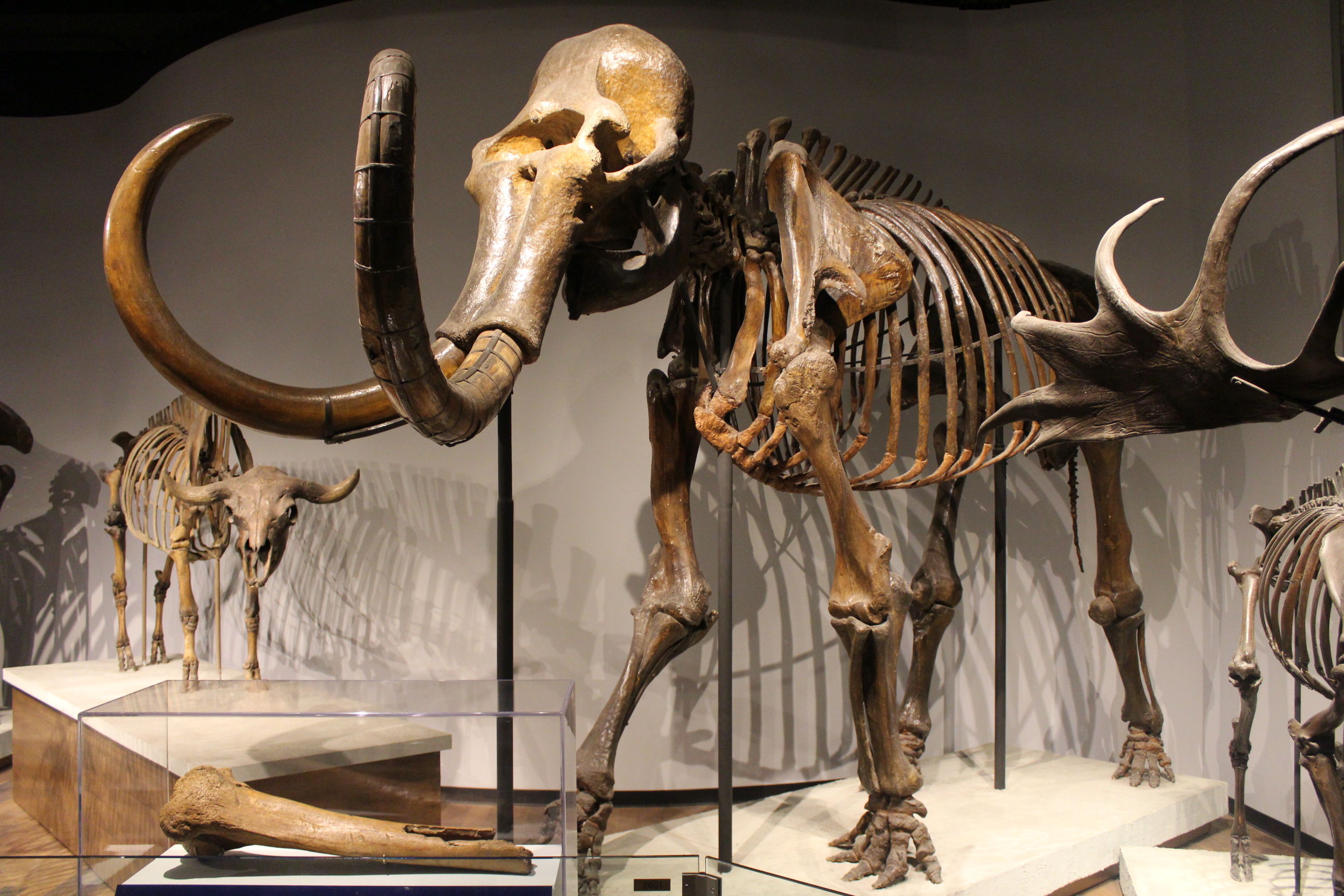
A Woolly Mammoth skeleton on display at the Field Museum of Natural History in Chicago, Illinois, USA
Image Credit: Jonathan Chen, https://commons.wikimedia.org/wiki/File:Woolly_Mammoth-Field_Museum.jpg

References/Further Reading

•An article from the Washington post, written by Henry Nicholls, detailing the evolutionary history of the Woolly Mammoth

https://www.washingtonpost.com/national/science/frozen-remains-help-explain-the-life-and-eventual-extinction-of-the-woolly-mammoth/2011/03/29/AFOPWeMD_story.html

Nicholls, Henry, “Frozen remains help explain the life and eventual extinction of the woolly mammoth”, Washington Post, www.washingtonpost.com, https://www.washingtonpost.com/national/science/frozen-remains-help-explain-the-life-and-eventual-extinction-of-the-woolly-mammoth/2011/03/29/AFOPWeMD_story.html

• An article written by David Robson for NewScientist detailing the sequencing of half of a Woolly Mammoth genome in 2008.

https://www.newscientist.com/article/dn16081-frozen-hair-gives-up-first-mammoth-genome/?ignored=irrelevant

Robson, David, “Frozen hair gives up first mammoth genome”, NewScientist, www.newscientist.com, https://www.newscientist.com/article/dn16081-frozen-hair-gives-up-first-mammoth-genome/?ignored=irrelevant

• A video by the excellent Ben G Thomas YouTube channel that details 5 frozen carcasses. One of the carcasses covered is the Jarkov Mammoth (aka the “Mammoth Cube”) with the others consisting of frozen Cave Lions and the recently discovered frozen Cave Bear

• A fact file from the Prehistoric Wildlife page on Woolly Mammoth. Prehistoric Wildlife is a fantastic resource for information on prehistoric animals and I’ve used it as a resource for a lot of my blog articles.

http://www.prehistoric-wildlife.com/species/m/mammuthus-primigenius-woolly-mammoth.html

Prehistoric Wildlife, “Mammuthus primigenius

(Woolly mammoth)”, www.prehistoric-wildlife.com,

http://www.prehistoric-wildlife.com/species/m/mammuthus-primigenius-woolly-mammoth.html

• A Siberian Times article about the “Golden Mammoth”; a frozen pygmy Mammoth with golden/strawberry blonde fur

https://siberiantimes.com/other/others/news/scientists-discover-unique-carcass-of-extinct-pygmy-woolly-mammoth-on-island-off-siberian-coast/

Siberian Times, “Scientists discover unique carcass of extinct ‘pygmy’ woolly mammoth on island off Siberian coast”, www.siberiantimes.com, 12th August, 2018, https://siberiantimes.com/other/others/news/scientists-discover-unique-carcass-of-extinct-pygmy-woolly-mammoth-on-island-off-siberian-coast/

• A National Geographic article, written by Tom Mueller in May 2009, about the “Ice Baby”, including history of its discovery and how it became preserved in the thick frozen mud.

https://www.nationalgeographic.com/magazine/2009/05/mammoths/

Mueller, Tom, “Ice Baby”, National Geographic, http://www.nationalgeographic.com, May, 2009, https://www.nationalgeographic.com/magazine/2009/05/mammoths/

Prestosuchus and the Rauisuchians: The Pangean top predators

File:Prestosuchus-chiniquensis (2).jpg - Wikimedia Commons
An artists impression of Prestosuchus chiniquensis. AKA “Prestes Crocodile”
Image Credit: Dmitry Bogdanov, https://commons.wikimedia.org/wiki/File:Prestosuchus-chiniquensis_(2).jpg

The Mesozoic era is usually associated with one group of animals. You may have heard of them already, but if you haven’t, I’ll give you a clue; the name starts with D! However, during the first third of the Mesozoic era, a time known as the Triassic period, that famous group were only just beginning to establish themselves and radiate into their early sub groups. During this time the Triassic was instead dominated by other animal groups. These included Dicynodonts; large reptilian pig-looking herbivores who were part of a larger group known as “stem-mammals” (the lineage that would give rise to true mammals) and Cynodonts; small omnivorous stem mammals that often lived in burrows. However the animal I will be talking about here belonged to an altogether different reptile group. This animal is Prestosuchus; a huge four legged carnivore that belonged to a line of reptiles known as the Pseudosuchians (the same group that modern crocodiles would descend from). Despite being part of the same lineage, and possessing similar morphological features, Prestosuchus wasn’t a crocodile. Instead it belonged to the now extinct sister group known as the Rauisuchians. This important group of carnivores I think don’t get the attention they deserve, something that I shall now try rectify!

The first fossils of Prestosuchus (from a species eventually named Prestosuchus chiniquensis) were discovered in Brazil during the war torn year of 1942 by a German Palaeontologist named Friedrich von Huene. However, while he is credited as the discoverer of the fossil he was only able to do it with the help of his colleague; Vicentino Prestes de Almeida. A local self-taught Brazilian palaeontologist Vicentino is who Prestosuchus is named after, (the name translates to “Prestes Crocodile”), while the “chiniquensis” part refers to Vicentino’s birthplace of Chiniquá in Brazil. The two men found these first fossils in a rock formation known as the “Santa Maria formation”. Back when Prestosuchus was alive, Santa Maria was the site of a vast watering hole where animals of all kinds would gather to take a much needed drink. For a predator like Prestosuchus this provided regular hunting opportunities and one could imagine that the area around this watering hole was Prestosuchus’ home, with little need to move far from such fine real estate! (unless it became so hot that the watering hole dried up of course). Since this first discovery, two other Prestosuchus species have been identified; Prestosuchus nyassicus (originally thought to be a different, though closely related, Pseudosuchian named Stagonosuchus nyassicus) and an as yet unnamed species, which sadly will probably not have a naming competition any time soon!

Prestosuchus lived during the early to mid-Triassic period (roughly 241-236 million years ago). During this time all the continents of the world were joined together into one great landmass known as Pangea. Pangea would have been a hot holiday destination, with the dry climate resulting in an arid central region. However towards the coast and away from the equator the climate was a lot milder allowing the growth of wet and dry seasonal forests battered by regular monsoons. It was in these places where Prestosuchus was found and at 6.5 metres long (based on measurements of a specimen discovered in 2010) and a ton in weight it would’ve been hard to miss! As I mentioned earlier, Prestosuchus shares many similarities with its relatives the crocodiles and alligators. These include regular tooth replacement, strong jaws, a thick muscular body and, most notably, a row of hard scaly scutes that ran along its neck, back and down its tail. These hard scutes would’ve given protection from prey violently defending themselves or indeed from other Prestosuchus’ looking to pick a fight. It is also possible (and this is speculation on my part) that like crocodiles these scutes may have had a thermoregulatory function, keeping the carnivore cool by releasing excess heat through them. However these scutes did have one drawback; their weight would have slowed Prestosuchus down, meaning that it probably couldn’t run very fast. However this might not have been that much of a problem for two reasons. Firstly, Prestosuchus is thought to have been an ambush predator. Having targeted its prey using the binocular vision provided by its forward facing eyes (a key predator trait) Prestosuchus would’ve burst out of an ambush site and used its strong jaw muscles (attached at the back of its wide skull) to powerfully crush small animals and inflict massive wounds on any animal large enough to survive the first attack. Secondly the Dicynodonts that were its main food source (e.g. Dinodontosaurus & Stahleckeria) were not very fast themselves. So Prestosuchus could keep up with them just fine. Besides when you have powerful jaws and a heavy body that can overpower anything in your way who needs speed!

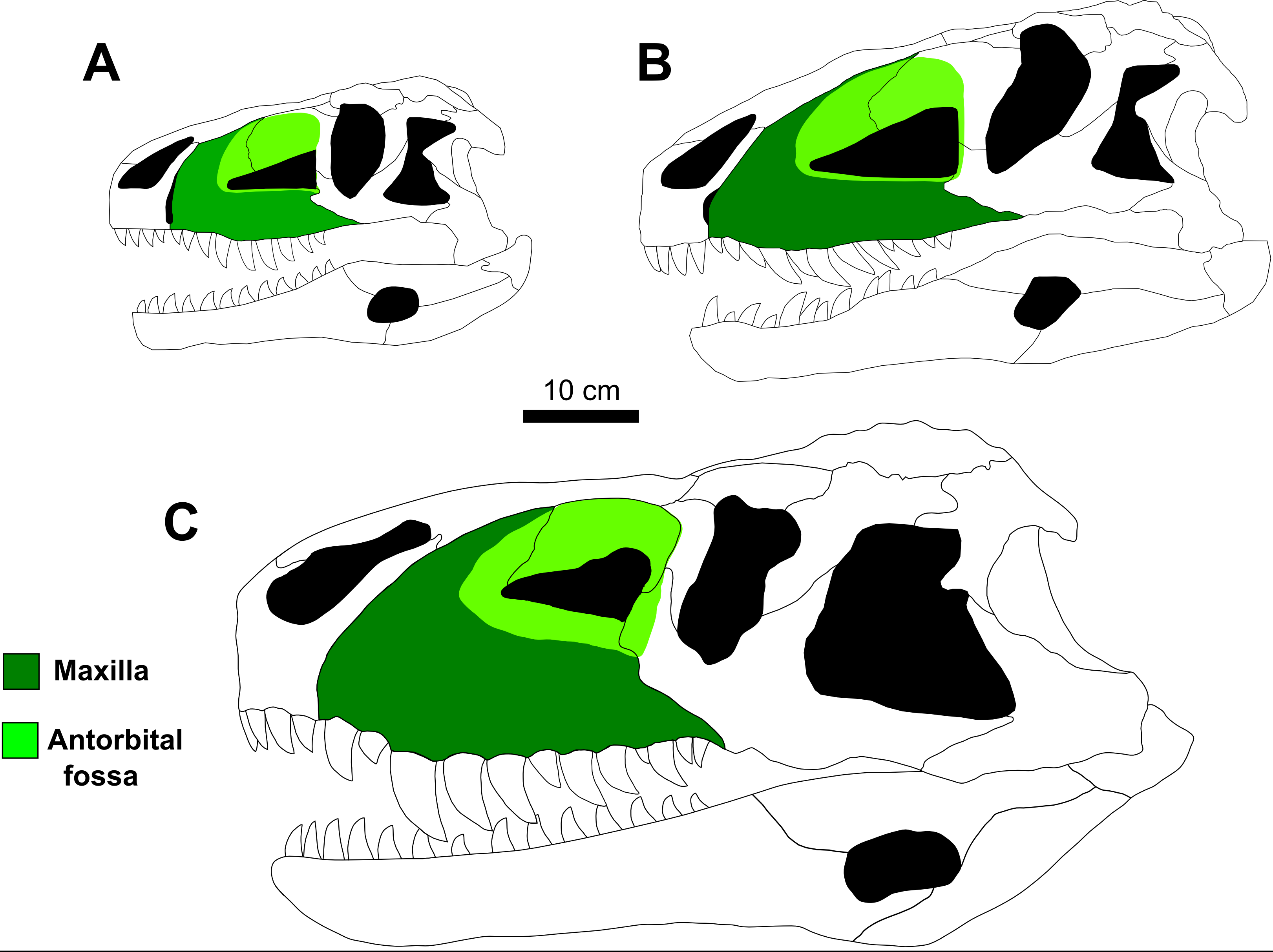
File:Prestosuchus skull diagrams.png - Wikimedia Commons
Skull diagrams of Prestosuchus. Note how wide the back of the skull is. This anchored large muscle that gave Prestosuchus its fearsome bite!
Image Credit: Lacerda et. al. 2016, https://peerj.com/articles/1622/

The Rauisuchians were the top predators of the Triassic. They ruled over nearly all the Pangean supercontinent, ranging from only a metre long to the 9 metre long Saurosuchus (who was very closely related to Prestosuchus). Nearly all of them were covered in characteristic heavy scutes and they were nearly all quadrupeds (walked on four legs). However some Rauisuchians did occasionally break the mold, such as the North American Postosuchus; which possessed reduced forelimbs and is thought to have walked on two legs. The Rauisuchians were so successful that the early theropod dinosaurs, which actually co-existed with them, spend the majority of the Triassic in their shadow. However this wasn’t to last. While Prestosuchus itself went extinct around 235 million years ago the Rauisuchians managed to cling on until the end of the Triassic (around 201 million years ago). At this time the world was going through a massive extinction event that was caused by massive volcanic eruptions that split Pangea apart and fuelled a runaway global warming event and acidification of the oceans. This event is so big that it is classed as one of the “big 5” extinction events, alongside the K/T (65 million years ago) and end-Permian (250 million years ago) events to name two. The Rauisuchians were one of many animal groups that didn’t survive the end Triassic, dying out alongside other Triassic defining groups like the Dicynodonts, Rynchosaurs and other Pseudosuchian groups. Why these groups didn’t survive whilst the dinosaurs did is a mystery. Dinosaurs were not a “superior” species as previous narratives have stated. In fact studies (such as one published in 2008 and led by Dr Steve Brusatte) have found that Pseudosuchians contained more species and more variety between species during the Triassic period than the dinosaurs. Furthermore dinosaurs and Pseudosuchians were so similar to each other that even palaeontologists have classified an animal as part of one of these groups only to find out they were the other!. It is a real mystery and the answer may simply be just chance, with dinosaurs only just managing to fare better in the chaos. If the end Triassic extinction event hadn’t happened it’s possible that the Pseudosuchians would’ve been the dominant animals of the entire Mesozoic instead of the dinosaurs, with animals like Prestosuchus being as successful and iconic as theropod dinosaurs like T-Rex and Allosaurus.

So Prestosuchus and the Rauisuchians as a whole are truly fascinating reptiles and I’m happy that I finally got to talk about them in this blog article. I hope that in the future I will be able to introduce you to other fascinating crocodile relatives, as the crocodile family tree, as shown by Prestosuchus, is a truly rich, varied and colourful lineage!

File:Saurosuchus and hyperodapedon.jpg
Rauisuchians were the “top dogs” in Pangea. This piece of paleoart depicts the 9 metre long Saurosuchus, with Hyperodapedon the animals looking to get away from it!
Image Credit: ABelov2014, https://www.deviantart.com/abelov2014/art/Saurosuchus-Hyperodapedon-753703812

References/Further Reading

Desojo et. al. 2020 study on the anatomy, taxonomy and phylogenetic relationships of Prestosuchus chiniquensis

Desojo, Julia Brenda, von Baczko, María Belén, and Rauhut, Oliver W.M. 2020. Anatomy, taxonomy and phylogenetic relationships of Prestosuchus chiniquensis (Archosauria: Pseudosuchia) from the original collection of von Huene, Middle-Late Triassic of southern Brazil. Palaeontologia Electronica, 23(1):a04. https://doi.org/10.26879/1026

• A blog article reporting on the 2010 discovery of a specimen of Prestosuchus. This fossil is important as it showed that Prestosuchus was much larger than previously thought

Mike, “Most Complete Fossil of a Crocodylotarsian found in Brazil”, Everything Dinosaur, www.blog.everythingdinosaur.co.uk, https://blog.everythingdinosaur.co.uk/blog/_archives/2010/05/12/4528166.html

• Another blog article, also from everything dinosaur, that provides more background on Prestosuchus while also previewing a model of it

Mike, “Preparing for Prestosuchus”, Everything Dinosaur, www.blog.everythingdinosaur.co.uk, https://blog.everythingdinosaur.co.uk/blog/_archives/2018/11/07/preparing-for-prestosuchus.html

• “The Rise and Fall of the Dinosaurs” by Steve Brusatte. Chapters 2 and 3 (“Dinosaurs rise up” and “Dinosaurs become dominant”) details what dinosaurs were like in the Late Triassic, the Pseudosuchians that co-existed with them and the end Triassic extinction event.

Brusatte et. al. 2008 paper discussing the evolutionary radiation of dinosaurs and Pseudosuchians

Brusatte, S. L., et al. (2008). “Superiority, Competition, and Opportunism in the Evolutionary Radiation of Dinosaurs.” Science 321(5895): 1485-1488.

Lacerda et. al. paper analysing the 1942 fossils of Prestosuchus chiniquensis

Lacerda MB, Mastrantonio BM, Fortier DC, Schultz CL. 2016. New insights on Prestosuchus chiniquensis Huene, 1942 (Pseudosuchia, Loricata) based on new specimens from the “Tree Sanga” Outcrop, Chiniquá Region, Rio Grande do Sul, Brazil. PeerJ 4:e1622 https://doi.org/10.7717/peerj.1622

Paleo Safaris: Dinosaur Island

File:Wessex Formation dinosaurs.jpg
A selection of dinosaurs that once lived on the Isle of Wight. Dinosaurs pictured include Iguanodon (middle left), Eotyrannus (bottom right), Neovenator (top right) and Hypsilophodon (bottom left). One thing to bear in mind is that a number of palaeontologists now think that Eotyrannus, Hypsilophodon and the Ornithomimosaurs (middle right) would have been more extensively feathered than shown here.
Image Credit: ABelov2014, https://www.deviantart.com/abelov2014/art/Barremian-fauna-660152146

The Isle of Wight, 127 Million Years Ago.

The sun rises over the horizon as another day dawns on Dinosaur Island. Light dapples through the coniferous trees, illuminating the forest in a hazy yellow glow. As the morning continues the forest begins to waken, with the buzzing of insects, the crashing sounds of distant dinosaurs and the calls of the crow sized pterosaur Vectidraco echoing through the trees and creating a Cretaceous era symphony. Making the most of this early start are the Hypsilophodons. These small feathery dinosaurs chirp and bound among the gaps between the trees, nipping away at ferns that grow as far as the eye can see. As the group feeds one Hypsilophodon notices a bright yellow flower blooming among the green ferns. Flowering plants are a new phenomenon on Planet Earth at this time, having only appeared a few million years before this Hypsilophodon was born. Their appearance adds a dash of colour to the otherwise brown and green landscape of the Cretaceous period, and plants like these will continue to grow and evolve across the planet, watching millions of other species come and go and be a staple of the earth’s ecosystem right up to the modern day. The young Hypsilophodon curiously sniffs at the flower for a moment, taking in its distinctive smell, before taking a bite out of it and moving on to the next tasty plant!

Exiting the coniferous forest onto the wide open plains a loud bellowing sound reverberates in the distance. If we follow this noise we come across a large herd of Iguanodon travelling along the banks of a large river. They walk along on all four of their limbs but when they need to run or reach higher branches they rock back and balance themselves on just two legs. This also frees them up to swing their deadly “thumb spikes”. Their hands are like multipurpose Swiss army knives. The little fingers are incredibly dexterous and are used to manipulate and hold branches steady for their beaked jaws to reach. Their thumbs in contrast have evolved into spikes that act as effective stabbing weapons that give them protection against attack from the hungry predators on the island. However two male Iguanodon are currently using their thumb spikes against each other! Luckily for both of them no serious harm occurs this time and the victor of the dispute wanders towards the female he’d just won the right to court. These herbivorous ornithischian dinosaurs are a common sight on the island with their vast herds reminiscent of the large Wildebeest herds in the Serengeti and Masai Mara of modern day Africa. Amongst the large adult Iguanodons are what initially appear to be adolescents. However these are actually not Iguanodon but a close relative named Mantellisaurus. Inter species mixing like this can be seen in modern day, where Wildebeest and Zebra sometimes form huge herds together. So it’s no surprise to see these dinosaurs exhibiting this behaviour too. Lumbering along the outskirts of the herd is another, very different species of plant eating dinosaur. This is a Polacanthus, a 4 metre long four legged dinosaur that boasts a heavy casing of hard armour plating (known as osteoderms) on its back and a battery of sharp spikes lining its back down to its tail that it uses to protect itself. To complete this spectacular gathering of plant eaters are humongous Brachiosaurs; sauropod dinosaurs that tower over the rest of the herd. Palaeontologists currently do not have a formal scientific name for these particular Brachiosaurs yet, but what is abundantly clear is that these were by far the largest animals on Dinosaur Island. They feed on vegetation at the tops of the coniferous trees far above the reach of the other dinosaurs. As a consequence they can co-exist with the other herbivores as they do not compete for the same food.

A restoration of Polacanthus. Their bony osteoderms and spines would have made them tough proposition for any carnivore!
Image Credit: FunkMonk (Michael B. H.), hip armour by Franz Nopcsa von Felső-Szilvás, https://commons.wikimedia.org/wiki/File:Polacanthus_foxii.jpg

As the sun moves higher in the sky some of the herd notice a bipedal, sharp toothed dinosaur crossing the path ahead. They watch each other for a moment, the herd wary of the sharp teeth and heavy claws of a predator! Luckily, this Baryonyx is not interested in them and instead makes her way towards the river bank. Her lunch today is not of the land living variety. Standing on the riverbank the Baryonyx places her long, crocodile-like snout in the water. Concentrating intently, she uses small sensors on her snout to detect movement in the water, and in combination with her forward facing eyes uses it to locate her prey. Suddenly, sensing a flash of movement close to her, she lunges forward, snapping her jaws around a large fish. She drags it to shore and, held securely by her strong foot, tucks into her hard earned prize. This is the first of many catches that the Baryonyx will need to make today in order to fuel her one and a half ton, 9 metre long frame. This fish eating lifestyle has allowed her kind to carve out a unique niche for itself on the island, one that is characteristic of the spinosaurid order of dinosaurs that Baryonyx is a part of. Later spinosaurids will take this lifestyle even further, evolving shorter hind limbs and paddle like tails to aid swimming. However Baryonyx still possess the stereotypical body plan of a theropod dinosaur (except for its long skull) and whilst they spend a lot of time fishing in the rivers and lakes of the island they’re not totally reliant on them and can hunt on land if they need to. Whilst this Baryonyx left the herd alone earlier in the day she may turn her attention to them at a later date if the fish stocks dry up.

File:Baryonyx life restoration.jpg
A Baryonyx patrolling the banks of a river.
Image Credit: Андрей Белов, https://commons.wikimedia.org/wiki/File:Baryonyx_life_restoration.jpg, (Original Image: https://www.deviantart.com/abelov2014/art/Spinosauridae-773270478)

It is now evening, and as the sun sets the herd begins to move on to other feeding grounds. However just 300 metres downwind the Isle of Wight’s top predator is watching them intently with hungry eyes. He is a Neovenator, a 7.5 metre long theropod dinosaur that is a relative of the mighty Allosaurus, which dominated the Late Jurassic just 25 million years earlier. He edges closer to the herd, keeping as silent as he can and staying downwind to conceal his scent as best he can from the Iguanodons. He needs to stalk his prey precisely to be successful. If he’s too far away he’ll run out of steam before he can catch his prey. If he’s too close the herd will spot him and his cover will be blown. The Neovenator picks his spot and identifies his target; an older Iguanodon struggling to keep up with the rest of the herd. The Neovenator strikes! As he charges towards his target the Iguanodon sound the alarm, making loud calls and sprinting away on their powerful hind legs. But it’s too little, too late, and the great carnivore reaches on his target, tearing into it with his blade like teeth and claws. The blood loss and shock is too much for the Iguanodon and the Neovenator finishes proceedings with a final bite to the neck. It’s brutal and it’s messy, but today it has proven effective. The Neovenator picks up his prize and drags it away to a secluded spot so he can eat in peace.

But the Neovenator will not get that peace today. As he tucks into his meal a small group of Eotyrannus approaches the giant. At only 4 metres a single one of these small feather coated carnivores isn’t going to trouble the Neovenator. But if they work together they pose a much greater threat. They hound the great carnivore like Hyenas do to Lions on the African Savannah today, surrounding and harrying the giant carnivore, using their speed to dodge his aggressive lunges. Eventually the Neovenator begrudgingly surrenders his kill to the group. This is a shape of things to come. In time the descendants of Eotyrannus will evolve larger body sizes, complete with bone crushing bites, and they will take over the role of top predators from the likes of Neovenator. But for now these relatively small, early tyrannosaurs are content with their place in the pecking order.

Today the Isle of Wight is still an island (hence the name). One thing is for certain is that it is a lot colder now than it was 127 million years ago! The dinosaurs that once roamed the island are now found preserved as fossils, and have been unearthed at locations such as Compton Bay, Yaverland and Shanklin. Fossils have been discovered at such sites like these on the Isle of Wight for centuries and new species are still being found today. In August of this year, partial remains of a new theropod dinosaur named Vectaerovenator inopinatus, which lived roughly 12 million years after the dinosaurs we’ve seen on this particular safari, were discovered in the rocks of Knock Cliff, Shanklin, on the east side of the island. Some of the many amazing dinosaur fossils are now on display in the Dinosaur Isle museum located in the town of Sandown, a place that showcases the lost world of Dinosaur Island for all to see. It’s amazing to think that a thriving ecosystem, containing miniature insects, flying pterosaurs and magnificent dinosaurs, once existed right here in the UK. The Isle of Wight is absolutely, unquestionably, the “Dinosaur Capital of the UK”!

File:Dinosaur Hall-Dinosaurisle.jpg
Some of the Isle of Wight dinosaurs on display in the Dinosaur Isle Museum in Shanklin on the Isle of Wight.
Image Credit: N.Cayla, https://commons.wikimedia.org/wiki/File:Dinosaur_Hall-Dinosaurisle.jpg

References/Further Reading

A page on UK Fossils website detailing the main fossil sites on the Isle of Wight

UK fossils, “Category: Isle of Wight”, ukfossils.co.uk, https://ukfossils.co.uk/category/isle-of-wight/

A website, named Dino Wight, detailing the dinosaurs and other prehistoric animals discovered on the Isle of Wight

Dino Wight, “The Dinosaurs of the Isle of Wight”, Dinowight.co.uk, http://www.dinowight.co.uk/

The website of the Dinosaur Isle Museum

Titanoboa: The Supersized Snake

File:Titanoboa 1 (7684792594).jpg
A life sized model of Titanoboa, in the process of gorging on a crocodilian, from the Smithsonian Museum of Natural History.
Image Credit: Ryan Quick, https://www.flickr.com/photos/order_in_chaos/7684792594/

It’s a giant snake.

That’s what most people think when it comes to Titanoboa cerrejonensis, meaning “Giant Boa from the Cerrejón”. It looks like something straight out of a straight to video B-list horror movie; an animal that is very familiar but scaled up to gargantuan proportions. The giant extinct shark Megalodon has this same problem and I think just labelling animal like these two as “just an oversized [insert animal here]” doesn’t tell the whole story. In this blog article I shall look at the truth about this giant snake, and find out just what kind of animal it really was.

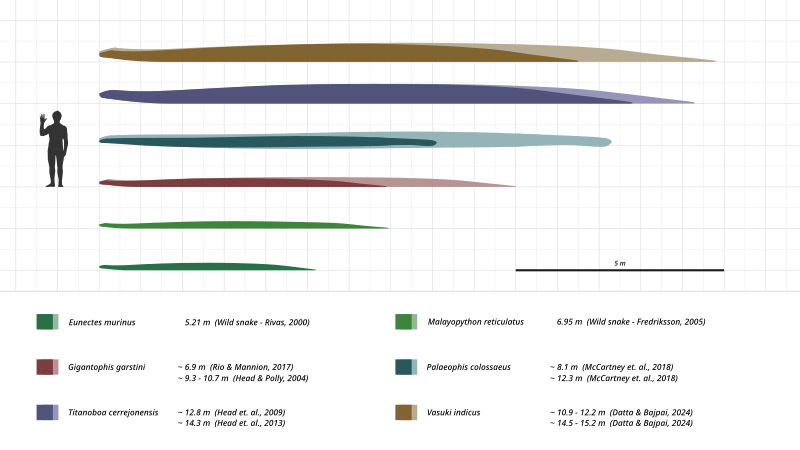
Now the first thing that documentaries and any paleo-obsessed person will tell you about Titanoboa is that it was very big. They are not exaggerating! The study (published in 2009) that first described Titanoboa estimated that it grew up to 13 metres long; almost double the length of The Reticulated Python, the largest living snake. If that wasn’t enough other palaeontologists argue that Titanoboa could have grown even larger, to lengths approaching 14.5 metres! For comparison that’s longer than a bus (as most extinct animal books will boldly state) and a Titanoboa would have no problem rearing up to tower over a human if it had ever encountered one. Titanoboa lived 60-58 million years ago during a time known as the Palaeocene period. Its size gives Titanoboa the record as the largest land animal that we know of from this time, and also the title of the largest land predator since the demise of the non-avian dinosaurs, which only happened 7 million years before Titanoboa existed.

The first fossil that was identified as belonging to a Titanoboa was a single vertebrae unearthed from a coal mine in the Cerrejón region in Northern Colombia in 2007. This wasn’t actually the first fossil ever found of it, but was the first that was recognised as belonging to a new animal. The snake identification was made due to the fossil vertebrae’s similarities to modern snake vertebrae. From just this one bone, palaeontologists were able to deduce several key bits of information about Titanoboa. Firstly, the vertebrae was very similar to those found in modern day boa constrictors and Anacondas, suggesting that these snakes are Titanoboa’s closest living relatives (and that is reason for the “boa” part of Titanoboa!). Secondly the vertebrae was massive, almost twice the size of an Anacondas, and by scaling with measurements from them the authors of the 2009 study were able to obtain their 13 metre length estimate. After this find, further fossil expeditions to the Cerrejón have unearthed further remains including up to 100 further vertebrae and a partially complete skull. The skull is particularly exciting as snake skulls are delicate and don’t usually preserve well in the fossil record.

File:Titanoboa vertebra 1.jpg
A cast of a fossil vertebrae from a Titanoboa, on display at the Museo Geológico José Royo y Gómez, Bogotá, Colombia.
Image Credit: Rextron, https://commons.wikimedia.org/wiki/File:Titanoboa_vertebra_1.jpg

So how would this supersized snake have lived? Well the answer is that it would have had a similar lifestyle to that of modern Anacondas, just on a larger scale. Like all Boas, Titanoboa would not have possessed venom. Instead it would have hunted in the same way as modern day Boa Constrictor snakes; wrapping its body quickly and tightly around its prey and using its large body muscles to squeeze it hard. This action would break bones and cause suffocation as the prey’s windpipe and chest cavity were constricted. Once its prey had been subdued Titanoboa would then open its dislocatable jaws very wide and swallow it whole, sometimes taking hours to do so. Animals on Titanoboa’s menu included the numerous species of crocodilians and turtles that also inhabited the Cerrejón region. Like modern day Anacondas Titanoboa would’ve spent a lot of its time in water, swimming around the lakes and rivers of its very hot, very humid rainforest home. In these rivers lived another major source of food for the snake; fish. The skull of Titanoboa was found to contain more teeth than those of a modern boa, and the the teeth themselves were more loosely attached to the skull. This would’ve allowed the snake to more easily grab and hold onto wriggly, slippery prey. Furthermore fossils have been unearthed from the Cerrejón dirt of lungfish that grew up to 3 metres long! This large fish would have certainly provided a filling meal for a Titanoboa.

File:Eunectes-murinus -Broghammerus-reticulatus- -Titanoboa-2.svg
A size comparison between Titanoboa (grey), Gigantophis (another prehistoric snake – Red), a Reticulated Python (light green), an Anaconda (dark green) and a human.
Image Credit: Gamma 124, https://commons.wikimedia.org/wiki/File:Eunectes-murinus_-Broghammerus-reticulatus-_-Titanoboa-2.svg

To be honest what fascinates me about Titanoboa is not just the snake itself, but the ecosystem that it was a part of. 58 million years ago the Cerrejón was a unique place because it was dominated by reptiles. Indeed journey back only 7 million years and this statement would still be true! But these reptiles weren’t like the non-avian dinosaurs. Instead they belonged to more familiar families. For example living alongside the supersized snake that was Titanoboa was Carbonemys; a prehistoric turtle that could grow as large as a small car! There were also multiple species of dyrosaurs; a now extinct group of crocodilians (the reptile group that contains modern day crocodiles and alligators) which could grow up to 6 metres long in large species like Acherontisuchus. The long standing theory as to why these reptiles could grow as large as they did is that in the Palaeocene period the world was going through what is known as a “thermal maximum”. This is a global warming event that resulted in the worlds average surface temperature was much higher than today, and this heat, combined with 50% higher Carbon Dioxide levels, created a warm and very humid world that was so hot that there were no polar ice caps! To get an idea as to what the Cerrejón region was like imagine the Amazon Rainforest but even hotter, more humid and more waterlogged. These were favourable conditions for reptiles, who could absorb the highly abundant heat and use it to keep themselves active and fuel their internal biochemistry for longer periods at a time. This heat also meant they could generate more energy for growing larger sizes. In fact Titanoboas size has been used by a team of palaeontologists led by Jason Head (Head et. al. 2009) to estimate that the average yearly temperature of the Cerrejón 58 million years ago was between 30-34 Degrees Celsius. This was definitely a place where packing some suntan lotion, loose clothing and insect repellent would have been necessary! But its not just temperature that produced these giant reptiles. After the K/T extinction event (which took place 65 million years ago and wiped out 70% of all life on earth – casualties included the non-avian dinosaurs, pterosaurs and marine reptiles), many ecosystems were left vacant and open for the survivors to claim them. Furthermore mammals at this time had, in general, yet to grow large enough to fill the large animal niches available. As a result other groups were able to claim these open niches for themselves. In some parts of the world these were birds, with some growing taller than a man, and in the Cerrejón it was the reptiles, with Titanoboa taking the job of top predator.

The Palaeocene was undoubtedly a unique and weird period in earth’s history, and Titanoboa is a prime example of what can happen when an extinction event and favourable conditions creates evolutionary openings. While some people will be glad that this snake isn’t around anymore (and it certainly wouldn’t help cure anybody’s ophidiophobia!) I personally wish it were possible to see a living, breathing Titanoboa. It is a paleontological icon for a reason; it’s not just a giant snake, it’s THE giant snake.

References/Further Reading

Head et. al. 2009 paper about Titanoboa and what it can tell us about the hot conditions of the Cerrejón region

Head, J., Bloch, J., Hastings, A. et al. Giant boid snake from the Palaeocene neotropics reveals hotter past equatorial temperatures. Nature 457, 715–717 (2009). https://doi.org/10.1038/nature07671

NOTE: This paper has had its critics, with a few other papers being published (e.g. Sniderman 2009, Denny, Lockwood & Somero 2009) offering arguments that dispute the claim that the large size of Titanoboa can be used to estimate the temperature of the Cerrejón region 58 million years ago

An article written by Guy Gugliotta for the Smithsonian magazine about Titanoboa

Gugliotta, Guy, “How Titanoboa, the 40-Foot-Long Snake, Was Found”, Smithsonian, www.Smithsonianmag.com, https://www.smithsonianmag.com/science-nature/how-titanoboa-the-40-foot-long-snake-was-found-115791429/

A factfile on Titanoboa written by Jonathan Bloch, one of the people who first described Titanoboa, for the Florida Museum.

Bloch, Jonathan, “Titanoboa”, Florida Museum, www.floridamuseum.ufl.edu, https://www.floridamuseum.ufl.edu/100years/titanoboa/

A YouTube video from the excellent PBS Eons on Titanoboa and the world it lived in

Akmonistion: The Bearsden Shark

“Through shoal and shining flock and froth and freath and freaky frisky flashers, like a liner, The Bearsden shark coasts casually, kinglily, killingly casual, casing the scales, lazily pacing and chasing, lord of the place, of the plaice, lordly diner.”

The Bearsden Shark, Edwin Morgan.

Glasgow was a very different place 330 million years ago. What is now the largest city in Scotland, covered in sandstone buildings frequently splattered by rain, was once a warm shallow sea teeming with marine life. This ranged from molluscs, corals and fish to now extinct creatures such as straight coned Belemnites (ancient relatives of squids) and Sea Scorpions (which could grow bigger than a human!). Just like in today seas, sharks were a key part of this ancient ecosystem. At this point in their history, sharks and their close relatives were still in their early evolutionary days and, just like any teenagers, were going through “a phase”. They were experimenting with different body types and features not found in modern sharks. One of the weirdest shark-like creatures from this time was unearthed in the Bearsden area of Glasgow in 1982 by a local fossil collector named Stan Wood. This shark is known scientifically as Akmonistion zangerli (meaning “Zangerles anvil sail”) but it is more commonly referred to as “The Bearsden Shark”.

The 1982 Bearsden Shark fossil was quite an astonishing find. The cartilaginous fishes (a group that contains Sharks, Rays and Chimera fish), despite having existed on Planet Earth for over 400 million years, actually have a poor fossil record. This is because their skeletons are almost entirely made up of cartilage instead of bone. Cartilage is relatively soft and doesn’t fossilise well at all. So as a result an ancient shark’s body is almost always lost to time. The only exception is their teeth which due to being hard and resilient, and the sharks shedding and replacing them frequently, are more commonly preserved. In fact much of what we know about a number of extinct sharks (including the famous Megalodon) only comes from fossilised teeth. This limits what we can discern about the rest of their anatomy. But the Bearsden Shark was different. The fossil that Stan Wood found in 1982 preserved not just the teeth but the entire body. This happened because, by a stroke of luck, the Bearsden Shark was buried by thick mud very quickly after it died. This protected the carcass from being broken down by scavengers, decay and/or the surrounding environment. The preservation was so good that palaeontologists were able to identify muscles, blood vessels and even its last meal! It’s truly a unique fossil, and if you want to see it for yourself it’s on display at Glasgow University’s Huntarian Museum.

The Bearsden Shark belonged to a group of extinct relatives of sharks known as the Stethacanthidae. This group is known as the “Ironing Board Sharks” due to their most iconic feature; a large ironing-board like structure attached to their back. This board extends outwards into a wide, flat surface covered in small spines and is often described as being like an upturned ironing board or an anvil in shape (hence Akmonistion’s name meaning “anvil sail”). This structure is known scientifically as a “Spine Brush Complex” and only appears in male Ironing Board Sharks. So from this we can already deduce that the Bearsden Shark was male. What could possibly have been the purpose of this bizarre ironing board/brush structure? Palaeontologists still don’t know for sure! The fact that this structure only appears in males could indicate that they were display structures. The male with the largest board would be “more impressive” to the females and more intimidating to rival males. As a result over millions of years this board could evolve to become larger and more extravagant. Another suggestion is that the spines on the board could somehow have allowed males to attach themselves to a female during mating. Outside of this structure the Bearsden Shark (and its relatives) also possessed a patch of spines on the top their head (again only in males) and long thin strips trailing from their front fins (which palaeontologists also don’t know the function of!). Put this all together and you get a unique looking animal that would have been distinctly recognisable if you were out scuba diving in the Carboniferous seas. These features would also have affected the Bearsden Shark’s lifestyle outside of courtship. They meant that it wasn’t as streamlined and hydrodynamic as other sharks. Therefore it wouldn’t have been a fast swimmer and instead it would have cruised the sea floor, snapping at any small fish that wandered too close.

Akmonistion has not only influenced the field of palaeontology (by increasing our understanding of early sharks and their relatives) but has also been an influence on the local community of Bearsden. In 2016 a cairn and plaque were placed on the site of its discovery to simultaneously commemorate it and inform people about it. The Bearsden Shark is even the subject of a poem by Edwin Morgan, which I quoted at the beginning of this blog article. It’s a fun read and I’ve provided a link to it in the “References and Further Reading” below. Not many prehistoric animals can say that they have a poem in their honour!

The Bearsden Shark is an astonishing animal of earths’ past, and a great example of how diverse and wonderful sharks and their relatives both were and are. The week this blog article is coming out is the same week as “Shark Week”, a week-long event that is supposed to celebrate and educate people about sharks. While some places promote incorrect, negative ideas and stereotypes about sharks I hope that through the story of the Bearsden Shark you can catch a glimpse at their rich history, and why they absolutely should NOT be seen as simply monsters.

File:Akmonistion NT small.jpg - Wikipedia
The Bearsden Shark itself!
Image Credit: Nobu Tamura, http://paleoexhibit.blogspot.com/

References/Further Reading

Coates & Sequeira 2001 paper that fully described the Bearsden Shark fossil

M. I. Coates & S. E. K. Sequeira (2001) A new stethacanthid chondrichthyan from the lower Carboniferous of Bearsden, Scotland, Journal of Vertebrate Paleontology, 21:3, 438-459, DOI: 10.1671/0272-4634(2001)021[0438:ANSCFT]2.0.CO;2

The full Bearsden Shark poem by Edwin Morgan

A BBC news article about the plaque and cairn commenerating the Bearsden Shark

BBC News, “Shark ‘fossil wonder’ find commemorated at Bearsden site”, Glasgow & West, BBC News, https://www.bbc.co.uk/news/uk-scotland-glasgow-west-35092689

Enhydriodon: The Bear Otter

Enhydriodon, the bear-otter : Naturewasmetal
An Enhydriodon surprising an unlucky Aepyceros
Image Credit: Joschua Knüppe, https://www.deviantart.com/hyrotrioskjan

Well it was coming eventually! After 24 blog articles on this humble little site, it’s time that an article on Prehistoric Otter was actually about a Prehistoric Otter! There were a few candidates for the otter of choice for this momentous occasion, but ultimately I decided that Enhydriodon shall be the one in the spotlight. So sit back, grab some snacks, and let’s learn about the life and times of the “Bear Otter”.

Enhydriodon lived in East Africa and India from 5 to 2 million years ago during the Pliocene period of the Cenozoic era. As previously stated Enhydriodon was an otter and like all otters it belonged to a larger mammalian group known as the Mustelids, whose members also include Wolverines (the animal not the superhero!), Ferrets and Badgers. The earliest otters evolved around 23 million years ago with the first “modern” otters arriving on the scene 7 million years ago; a full 2 million years before Enhydriodon. Otters evolved from land based ancestors who became semi aquatic partly due to the exciting food resources available (e.g. fish, crustaceans and shellfish) and partly to help escape larger, scarier predators. Modern Sea Otters take this concept to the extreme and have become fully aquatic marine animals but the majority of todays otters still maintain a tie to the land. Otters took to their watery home with gusto and over millions of years they evolved webbed feet and a snazzy waterproof fur coat. This coat is so snazzy that unfortunately humans would hunt otters specifically for it, or even just for sport, to use the fur in the fashion business. Once these adaptations were in place the otters diversified and spread across the globe producing a wide variety of species. Along the way many species came and went, and Enhydriodon was one of them.

The first Enhydriodon fossils were discovered way back in the early 19th century, with the first known species, Enhydriodon sivalensis from the Sewalik hills in Northern India, being described and named by Dr Hugh Falconer of the British Museum. Since then further fossils have been unearthed of other Enhydriodon species. One notable species was described in 2011 and named Enhydriodon dikikae, which was found in East Africa; specifically Dikika in Ethiopia and Kanapoi in Kenya. What we know about Enhydriodon comes from a few fossils of a snout, lower jaw, back of the skull humerus and fragments of a femur. That’s not a lot to go on, but from what palaeontologists do have they can ascertain a few key features. For example, we know that its short snouted skull had a battery of broad incisors, powerful canines and crushing molar teeth. Luckily because we know of other similar extinct giant otters (such as the wolf sized Siamogale from South-West China, which lived just) we can compare these finds against these extinct otters and similar modern day otters in order to give us a rough reconstruction of its probable life appearance.

File:Enhydriodon campanii.JPG
A fossilised lower jaw of Enhydriodon campanii, another of the numerous Enhydridon species, from the Museo di Paleontologia di Firenze in Florence, Italy
Image Credit: Ghedoghedo, https://commons.wikimedia.org/wiki/File:Enhydriodon_campanii.JPG

So what makes Enhydriodon a particularly special otter? Well, from the aforementioned fossils scientists have estimated that Enhydriodon sivalensis was roughly the size of a panther. However this was topped by Enhydriodon dikikae, which grew to over 2.1 metres long and weighed somewhere between 200-400 pounds, making it the largest otter (and largest mustelid) that has ever lived. By comparison Enhydriodon dikikae was larger than your average Leopard or Wolf and even approached Lion size! This was certainly not the small, cute animal that most people associate with otters today. Instead it was a large and powerful beast (though in all honesty it was probably still cute).

How this otter is thought to have lived is a matter of some debate. The original paper that described Enhydriodon dikikae (Geraards et. al. 2011) concluded that it was more land based than modern otters. However others have argued against this stating that it was more semi-aquatic like an Asian Short-Clawed Otter. However long it spent in water what is clear is that it would have ventured in at least on occasion as its variety of powerful teeth indicate a diet of water and land based prey. Potential items on Enhydriodon’s menu ranged from large fish, such as catfish, and shellfish to even small-medium sized land based mammalian herbivores like antelope. This wide ranging diet is plausible based on what we know of modern otter species. For example the modern day Giant Otter from South America is known to prey on small-medium sized Caimans and Anacondas alongside its usual diet of fish.

The East African landscape that Enhydriodon dikikae lived in consisted of open forest and Savannah grassland, crisscrossed by rivers that fed into the occasional huge lake (not to far removed from today). The animals that this Enhydriodon would see on a daily basis were a real uncanny mix of different species. On the one hand, there were animals familiar to anybody who has either been on an African Safari or watched nature documentaries, like Antelope, Hippos and Leopards to name a few. But on the flipside there were a few strange faces. These included extinct animals such as Deinotherium; a gargantuan 4.5-5 metre tall relative of elephants that weighed twice as much and possessed downward curving tusks; the “Scimitar-Toothed” cat Homotherium, Sivatherium; a 3 metre tall relative of giraffes; and giant species of Wolverines (Plesiogulo) and Baboons (Dinopithecus).

There was another, very special animal that I haven’t mentioned yet that also lived alongside the large and powerful Enhydriodon; our very own ancestors! Those same Dikika and Kanapoi deposits where Enhydriodon dikikae fossils were found also contain the fossils of the 3.5 million year old Australopithecus afarensis (specifically the skeleton of a youngster nicknamed “Salem”) and the 4.2 million year old Australopithecus anamensis respectively. Australopithecus is a landmark human ancestor because it was one of, if not the first, to walk upright, a key feature that distinguishes humans from other great apes. It’s unknown just how much Enhydriodon and Australopithecus would have interacted with one another, but based on Enhydriodon’s diet and the comparative sizes of the two (Australopithecus was only 1 to 1.5 metres tall at most) it’s probable that the Bear Otter wouldn’t have said no to hunting an Australopithecus that was lingering too close to the waters edge. That’s such a strange thought. Nowadays people generally adore otters but in the distant past your great great etc. grandparents lived in fear of being eaten by one!

Enhydriodon dikikae | Dinopedia | Fandom
Enhydriodon compared to one of our ancestors. From this image you can see why encountering an Enhydriodon might have been a bad thing for these early human relatives!
Image Credit: Victor Leshyk, http://novataxa.blogspot.com/2012/04/2011-enhydriodon-dikikae-ethiopia.html

So why is the bear otter no longer with us? Well this may again be linked to our human ancestors. Enhydriodon went extinct roughly 2 million years ago during a time of significant decline of multiple large African carnivore species. Coinciding with this was the evolution and diversification of a couple of different new species of human (or “Homo”) such as Homo Habilis; one of the first human ancestors to make stone tools. Some of these human species were starting to incorporate more meat into their diet becoming omnivorous and active hunter gatherers. As a result they competed with Enhydriodon and other carnivores for prey, and this increased competition may have played a role in the otter’s decline. On top of this the climate was also changing, becoming drier and promoting more open Savannah and less forest. This new habitat wouldn’t have been as suitable for Enhydriodon and would have definitely affected its population.

To me, the most fascinating aspect of Enhydriodon is not its size, it’s not whether it was semi-aquatic or not, or even its appearance (though otter fans would surely go bananas if it was alive today). It’s the connection that it has to the history of humankind. As time has passed the relationship between our ancestors and Enhydriodon changed from an animal that was feared by the Australopithecines into one that early human species actively competed with on an equal footing. The relationship between humans and otters developed further after Enhydriodon went extinct with humans hunting its otter cousins for fur and sport, and now to protecting them through conservation efforts. I guess it just goes to show that otters have always had a relationship with the human species in one form or another, and Enhydriodon was the start of it all.

References/Further Reading

Geraards et. al. 2011 paper describing fossils of Enhydriodon dikakae from Ethiopia

Denis Geraads, Zeresenay Alemseged, René Bobe & Denné Reed (2011) Enhydriodon dikikae, sp. nov. (Carnivora: Mammalia), a gigantic otter from the Pliocene of Dikika, Lower Awash, Ethiopia, Journal of Vertebrate Paleontology, 31:2, 447-453, DOI: 10.1080/02724634.2011.550356

A book titled “Palæontological Memoirs and Notes of the Late Hugh Falconer: Fauna antiqua”, written by Dr Hugh Falconer where he describes his paleontological discoveries, which included Enhydriodon sivalensis

Falconer, Hugh, 1868, Palæontological Memoirs and Notes of the Late Hugh Falconer: Fauna antiqua, Fauna Antiqua sivalensis.

Mindat.org datasheet on Enhydriodon dikikae

Mindat, “Enhydriodon dikikae”, Mindat.org, https://www.mindat.org/taxon-8570226.html

A 2012 Nature article, written by Jeff Tollefson, detailing Lars Werdelin’s research on how competition with human ancestors may have played a role in Enhydriodons and other large African carnivore extinctions

Tollefson, Jeff, “Early humans linked to large-carnivore extinctions”, News, Nature, 26th April, 2012, https://www.nature.com/news/early-humans-linked-to-large-carnivore-extinctions-1.10508

Bobe et. al. 2020 paper on the ecology of Australopithecus anamensis, which includes details of the animals it shared its environment with (e.g. Enhydriodon).

René Bobe, Fredrick Kyalo Manthi, Carol V. Ward, J. Michael Plavcan, Susana Carvalho, The ecology of Australopithecus anamensis in the early Pliocene of Kanapoi, Kenya, Journal of Human Evolution, Volume 140, 2020, 102717, ISSN 0047-2484, https://doi.org/10.1016/j.jhevol.2019.102717.

Argentinosaurus: The largest the land has ever known

File:Argentinosaurus skeleton, PLoS ONE.png
A reconstruction of the skeleton of Argentinosaurus from the Museo Municipal Carmen Funes, Plaza Huincul, Neuquén, Argentina.
Image Credit: William Irvin Sellers, Lee Margetts, Rodolfo Aníbal Coria, Phillip Lars Manning, http://www.ploscollections.org/article/info:doi/10.1371/journal.pone.0078733;jsessionid=441A913F8D576BBA46BF0960D01599FD

35 metres long. Longer than a Blue Whale!

21.5 metres tall. Tall enough to look into a 6th story window.

80 tons. Heavier than the Space Shuttle “Endeavour”!

These aren’t the measurements of a building, they are not the dimensions of a ship, and they are not the specifications for a new jumbo jet. They belong to a single, now extinct animal. The largest to have ever walked on this world.

Its name is Argentinosaurus huinculensis (meaning “Argentina lizard of Huincul”). It was first discovered in the Neuquén Province of Argentina (hence the name) in the 1987 by a local rancher named Guillermo Heredia then revealed to the world in a paper written by Bonaparte & Coria in 1993. Remains of Argentinosaurus skeletons are fragmentary with only 13 intact bones having ever been found. These include vertebrae, ribs and a single incomplete femur all of which are huge in themselves. Even a single vertebrae is about 1.5 metres (5 feet) tall. But with only fragments such as these how can palaeontologists estimate Argentinosaurus’ enormous size? Well, one way that the weight can be estimated is by taking measurements of the minimum circumference of the upper arm bone (humorus) and thigh bone (femur), ideally from the same individual animal, then plugging them into a mathematical formula. This method can produce a range of estimates however, especially if we don’t have a humorus and femur from the same animal. So 80 tons may be an over or under estimation depending on who you talk to. The current estimated range of possible weights is between 77-110 tons! As for the height and length, it’s a matter of comparing the Argentinosaurus fossils with fossils of more complete close relatives and then determining the size based on the proportions of these relatives, taking into account the varying size, shapes and relative weights of the bones. This has problems too as it is based on assumptions about similarities close relatives. So the estimated proportions may not be 100% accurate, but it’s the best that palaeontologists can do at present.

File:Argentinosaurus 9.svg
A size comparison between an average person and Argentinosaurus. The bones shown are among the only ones palaeontologists have ever found. Image Credit: User:Slate_Weasel, https://commons.wikimedia.org/wiki/File:Argentinosaurus_9.svg

Argentinosaurus lived during the Mid-Cretaceous period, roughly 100-95 million years ago, and belonged to an order of dinosaurs known as the sauropods. The sauropods are among the most popular and recognisable dinosaurs out there and are typically characterised by long necks, long tails, elephant like bulk and of course by their large size. They first evolved during the Late Triassic/Early Jurassic period (roughly 200 million years ago) and the best known members (i.e. Diplodocus, Brachiosaurus and Brontosaurus) are from the Late Jurassic, around 155-150 million years ago. However by the time of Argentinosaurus the sauropods were a totally different group than how they were in the Jurassic. The Diplodocids, Brachiosaurids and Brontosaurs were long gone and in their place rose a group of Sauropods known as the Titanosaurs. The Titanosaurs were the largest herbivores of the Cretaceous, dominating the Southern Hemisphere (and bits of the Northern Hemisphere) for pretty much all of it, right up until the meteorite impact that marked the end of the non-avian dinosaurs 65 million years ago.

I’m sure the main question that a lot of people will have regarding Argentinosaurus is; How could a land animal have possibly grown this big? Well the reasons why Argentinosaurus could reach this size is due to the remarkable biology of sauropods, and dinosaurs as a whole. Firstly they had special bird-like lungs known as a unidirectional lung. In our mammalian lungs oxygen is extracted from the air we breathe in once as it cycles through the lungs, with the same air then being breathed out. However in birds, theropod dinosaurs and sauropod dinosaurs such as Argentinosaurus some of the air breathed in is stored in cavities, known as air sacs, which are attached to the lungs. These are specialised in these dinosaurs so that when they breathe out the air sacs push the stored air through the lungs again, giving them a second chance to extract oxygen. This increases the lungs efficiency and results in more energy being produced via respiration, enough to sustain larger body sizes. Secondly the bones of these large dinosaurs were more lightweight than you might expect. This is because they also contain air sacs that penetrated through the bones giving them an air filled honeycomb like structure. This hollows out the bones which lightens them, while allowing them to retain their strength. For example air sacs in the neck vertebrae of sauropods such as Argentinosaurus lightened the whole neck and reduced the force required to support them. These air sacs also provided a large surface area that allowed any excess heat to be dissipated. Those air sacs really were the key and without them an animal as big as Argentinosaurus wouldn’t have been possible. Other features of sauropods that allowed them to get very big were long necks and four column-like legs. Their necks allowed them to access vegetation that was out of reach of other animals and could also reach a wide area without them needing to move a lot. This means they could eat more food (and so generate more energy) while not wasting energy moving. Meanwhile their columnar legs, like those of an Elephant, were very effective at supporting and spreading weight out equally.

File:Argentinosaurus BW.jpg - Wikimedia Commons
Argentinosaurus huinculensis as it may have look in life.
Image Credit: Nobu Tamura, http://spinops.blogspot.com/

Argentinosaurus was, unsurprisingly, the largest herbivore in its environment and would have needed to have spent the majority of its life ploughing through vegetation to sustain itself. But even with its huge size it still would’ve needed to watch for predators. This was especially the case when they were young. An Argentinosaurus hatchling was comparatively tiny and wouldn’t have received much parental care or protection. So to survive they would have had to grow pretty quickly and their estimated growth rate was quite something. It is estimated that at its peak growth rate an Argentinosaurus could have gained 40kg in a day. That’s just over 6 stone! (for context that’s heavier than a Dalmatian, or even two). Even as an adult large predators such as Mapusaurus (a large predatory theropod dinosaur belonging to the Carcharodontosaurids) would have been a threat. However they may not always have hunted Argentinosaurus in the traditional sense. Instead they may have employed a tactic known as “flesh grazing”. This is where a predator bites chunks off an herbivore without killing it. An Argentinosaurus would have been so big that even a group of 12 metre long Mapusaurus may have preferred to attack Argentinosaurus in this way rather than risk exhaustion and death trying to bring it down. So in effect, to a Mapusaurus each Argentinosaurus would’ve been like a walking butcher shop!

While Argentinosaurus is generally considered by many to be the largest land animal ever, this is still a matter of debate. This is because other sauropod candidates have been put forward as the largest. One is called Bruhathkayosaurus (….yeah I can’t pronounce it either!) which is a Late Cretaceous (70-66 million years ago) titanosaur known from a few bones unearthed in India. Another is Amphicoelias, which has a whopping size estimate of 180 feet in length. However this is based on one set of measurements, made over a century ago by the palaeontologist Edward Drinker Cope, of a single vertebrae which has since mysteriously disappeared. Because that vertebrae was the only known fossil of Amphicoelias to date there’s no way to test the validity of this measurement. Another possible contender is Patagotitan, another mid-Cretaceous titanosaur from South America. Recent estimates have put Patagotitan at just a fraction smaller than Argentinosaurus. However almost all of these titanic titanosaurs share a problem. They are all reconstructed from fragmentary remains. This means that their size estimations often change as more material is found. Furthermore, different palaeontologists come up with different estimates. For example the most recent size estimates of Argentinosaurus and Patagotitan come from a study published in February of this year conducted by the palaeontologist Greg Paul. From his own measurements he revised the size estimations of many large sauropods and concluded that, as of right now, Argentinosaurus was slightly larger than Patagotitan. The debate will rage on until enough complete remains of the two are found to give more accurate estimations. To be honest, these two sauropods were so similar in size that I suspect that while the largest Argentinosaurus were the biggest land animal ever, some large Patagotitan may well have been bigger than many Argentinosaurus.

The sauropod dinosaurs were marvels of biological engineering, with multiple biological features combining to allow them to exist. Argentinosaurus pushed those features to their absolute limit. Its effect on the world around it, being a key cog in the ecosystem that it lived in, and its impact on the imagination of dinosaur lovers everywhere should not be underestimated. In the history of life on Earth there had been nothing quite like it before, there has been nothing like it since, and it’s quite possible that there won’t be anything like it ever again!

References/Further Reading

Bonaparte & Coria 1993. The paper that first described Argentinosaurus

J. F. Bonaparte and R. A. Coria. 1993. Un neuvo y gigantesco saurópodo titanosaurio de la Formación Rio Limay (Albanio-Cenomaniano) de la Provincia del Neuquén, Argentina [A new and huge titanosaur sauropod from the Rio Limay Formation (Albian-Cenomanian) of Neuquén Province, Argentina]. Ameghiniana 30(3):271-282

Paul 2019: A study conducted by Gregory Paul that rexamined the bones of the largest dinosaurs, concluding that Argentinosaurus was the largest

Paul, G. (2019). “Determining the Largest Known Land Animal: A Critical Comparison of Differing Methods for Restoring the Volume and Mass of Extinct Animals.” Annals of Carnegie Museum 85(4): 335-358, 324.

• Pages 114-117 of “The Rise and Fall of the Dinosaurs” by Dr Steve Brusatte gives a fantastic overview of the reasons why sauropods could grow so big. I highly recommend this book for anybody whose into dinosaurs as it details the group as a whole, the different types of dinosaur, how they lived, how they evolved and how they went extinct.

Brusatte, Steve, “The Rise and Fall of the Dinosaurs”, 2018, Macmillan, chapter 3, pg 114-117.

An article on Live Science by Laura Geggel on the topic of the worlds largest dinosaur.

Geggel, Laura, “What’s the World’s Largest Dinosaur?”, Live Science, January 27th, 2019, https://www.livescience.com/34278-worlds-largest-dinosaur.html

A National Geographic article, by Laelaps, discussing the biggest dinosaurs

Laelaps, “Biggest Dinosaur Ever? Maybe. Maybe Not.”, National Geographic, https://www.nationalgeographic.com/science/phenomena/2014/05/18/biggest-dinosaur-ever-maybe-maybe-not/

Aepyornis and the Elephant Birds of Madagascar

File:Aepyornis maximus 01 L.D..jpg
A front view reconstruction of Aepyornis.
Image Credit: Acrocynus, https://it.wikipedia.org/wiki/File:Aepyornis_maximus_01_L.D..jpg

While it seems like I already know a bit about prehistoric life, before each of these blog articles I make sure to do my research on the animal that I aim to talk about, as any blog writer should do regardless of their subject area. During my research I not only broaden my knowledge, but also gain an extra appreciation for the animal in question. In the case of todays subject, Aepyornis (Greek for “high bird”), more commonly known as the “Elephant Bird”, my research showed just how little I actually knew about it. Aepyornis was a much more fascinating animal than I had realised (not just “a big ostrich”), and in this blog I aim to put the spotlight on this underrated animal.

For starters there wasn’t just one “Elephant Bird”; there was a whole family of them! “Elephant Bird” is the common name given to a family of flightless, bipedal, ostrich-like herbivorous birds from Madagascar known as the Aepyornithae. The “Elephant Bird” name originates from tales of the “Roc”; a legendary giant bird spoken of by Arab traders and written about by the famous explorers Marco Polo (13th century) and Ibn Battuta (14th century). It was also one of the monsters that the adventurer Sinbad encountered in “The Arabian Nights” tales (first published in the 18th century). It was said to be so big that it could carry an elephant in its talons. Polo in all likelihood based his Roc description on accounts of large, lemur hunting Malagasy Crowned Eagles that lived on Madagascar until the 16th century. However reports from other travellers of massive eggs, which belonged to Aepyornis, became associated with the Roc, and so the Aepyornithae family became collectively known as “Elephant Birds”. The Aepyornithae belonged to a larger order of birds known as the Ratites. This is the same group that contains ostriches, emus and cassowaries. You may think that since the Elephant Birds lived on Madagascar their closest relatives would be African ostriches since Madagascar lies off the East African coast. However this is not the case. Their closest living relatives are actually kiwis; small flightless birds which have long, thin beaks, reduced eyesight and are also ratites. Kiwis live only on New Zealand, which is 7,000 miles east of Madagascar! So how are these two birds so closely related despite living so far apart? Well the theory is that around 60 million years ago the common ancestor of kiwi’s and Elephant Birds still possessed flight and flew to these two separate islands, establishing colonies. Then, over millions of years, the two islands drifted further apart from each other (out of flying range) and the two separated populations both evolved flightlessness, independently of one another.

Another result of living on an isolated island for much of their evolution, and with no large mammalian herbivores to compete with, is that the Elephant Birds could grow to massive sizes. Aepyornis was no different and was thought to have been the largest bird that ever lived until relatively recently. Originally it was believed that Aepyornis maximus could grow to heights of more than 3 metres and weigh up to 800kg. However a study in 2018 by Hansford & Turney showed that there were enough skeletal differences between these largest specimens and other Aepyornis for these large Aepyornis to be re-classified as a new member of the Aepyornithae family (alongside Aepyornis and another Elephant Bird named Mullerornis). It was given the rather striking name of Vorombe titan, which is a combination of Malagasy and Greek and translates to “big bird” (Vorombe = Malagasy for bird, titan = Greek for big). As a result the size estimates of Aepyornis is now considered to be a more modest 2.5 metres tall and 400-500kg in weight on average, which is still larger than any living bird! Another of Aepyornis’ (and other Elephant Birds’) claims to fame is their humongous eggs. At their biggest they measured 34cm long, had a circumference of a metre and weighed 15 kilos. That’s 150 times bigger than a chicken egg, larger than any dinosaur egg and the largest eggs of any animal ever. Imagine the fried egg you would get from that! It wouldn’t just be enough for your breakfast; it would be enough to feed your entire family for the whole day! Such huge eggs would have meant that Elephant Bird chicks would have been more highly developed compared to other birds and the lack of any large egg thieves (before humans arrived) meant that it would have been safer for Elephant Birds to lay these eggs.

An Aepyornis egg (the large one!) from Museo Capellini in Bologna, Italy.
Image Credit: Ghedoghedo, https://commons.m.wikimedia.org/wiki/File:Aepyornis_egg.JPG

Aepyornis held the ecological niche of “large herbivore” on Madagascar. Its diet consisted of fruit, grasses and leaves and Aepyornis used its strong neck and overall size to reach them, before biting off and swallowing chunks with its beak. Unlike a lot of other large herbivores recent research has suggested that Aepyornis was a mostly nocturnal animal. The evidence comes from another 2018 study (by Torres & Clarke) where Aepyornis braincases were examined with a CT scanner. This produced a 3D model that the researchers could manipulate and examine in detail. Using this they discovered that Aepyornis had enhanced olfactory lobes (the part of the brain that processes smells) and reduced optic lobes (the part of the brain that processes vision). This is a similar, albeit less extreme, version of the brain structure of kiwis; which are nocturnal birds with limited vision and a reliance on smell to sense their environment. Furthermore Torres & Clarke also showed that different Aepyornis species had slightly different sensory lobes. You see there are two recognised species of Aepyornis; Aepyornis maximus (the larger, forest dwelling one) and Aepyornis hildebranti (the smaller, plains dwelling one). In A.maximus the olfactory lobes were proportionally larger, and the optic lobes proportionally smaller, than in A.hildebranti. This is presumably because A.maximus lived in dense rainforests, where eyesight is less useful due to the dense trees, while A.hildebranti lived in the open plains where the lack of dense trees meant they could see greater distances.

Aepyornis shared its Madagascan home with a menagerie of recognisable animals still alive today, such as Ring-tailed lemurs, Fossas and Chameleons. However it also lived alongside some strange animals that are no longer around. These included Archaeoindris, a giant lemur that was the size of a Silverback gorilla, the aforementioned Malagasy crowned eagle which modern lemurs still possess an innate fear of even though it is now extinct, and giant tortoises similar in size and lifestyle to the modern day Galapagos giant tortoise. So once upon a time Madagascar had an even greater diversity of life than it does now. However there are no Elephant Birds, giant lemurs, huge tortoises or giant eagles anymore. This is thought to have been mainly due to change in climate, which lead to changes in food availability. The actions of humans are also commonly linked to the disappearance of many Madagascan animals. However they may not have played as big of a role as previously thought. Yet another 2018 study (2018 should be renamed “Year of the Elephant Bird” due to all the studies carried out that year!) dated Elephant Bird bones that showed distinctive cut marks made by human tools to 10,500 years ago, the end of the Pleistocene period and start of the Holocene period. This was a whole 8,000 years earlier than humans had previously been thought to have reached Madagascar. Since Aepyornis and other Elephant Birds became extinct sometime between the 10th-12th Centuries (though sightings had been reported to as late as the 17th century) this means that humans co-existed with the birds for longer than previously thought. So they couldn’t have quickly hunted them to extinction as had been previously assumed. However this doesn’t mean that Aepyornis wasn’t a target for humans or that human activity wouldn’t have affected their numbers. For one the sheer size of both the animal and especially its eggs (which could be quickly poached from Aepyornis nests) would have been an attractive prospect for human hunters. For another humans were converting the Madagascan forests and plains into farmland, destroying Aepyornis’ habitat, and domesticated chickens and guinea fowl brought to Madagascar may have passed on bird related diseases to Aepyornis, which it had no immunity to.

Aepyornis skull from a skeleton at the Muséum national d’Histoire naturelle in Paris, France
Image Credit: LadyofHats, https://zh.m.wikipedia.org/wiki/File:Aepyornis_skull.JPG

So overall, Aepyornis was a truly splendid animal, with a much more varied and detailed history and lifestyle than at first glance. The Elephant Birds are reminiscent of a time 65 million years ago when the close relatives of birds ruled the world. The dinosaurs were long gone, but in this little corner of the world Aepyornis and its family carried on their legacy.

References/Further Reading

Torres & Clarke 2018: a study of the braincases of the Elephant Bird, and what it tells us about their noctournalism

Christopher R. Torres and Julia A. Clarke 2018, Nocturnal giants: evolution of the sensory ecology in elephant birds and other palaeognaths inferred from digital brain reconstructions, Proc. R. Soc. B.28520181540, http://doi.org/10.1098/rspb.2018.1540

Hansford & Turney 2018: a study on the diversity of the Elephant Bird (Aepyornithae) family, showing that the largest Aepyornis were actually a different species of Elephant Bird: Vorombe Titan

James P. Hansford and Samuel T. Turvey 2018, Unexpected diversity within the extinct elephant birds (Aves: Aepyornithidae) and a new identity for the world’s largest bird, R. Soc. open sci.5181295, http://doi.org/10.1098/rsos.181295

Hansford et. al. 2018: a study on Elephant Bird bones with human made cut marks dating from as far back as 10,500 years ago

James Hansford, Patricia C. Wright, Armand Rasoamiaramanana, Ventura R. Pérez, Laurie R. Godfrey, David Errickson, Tim Thompson, Samuel T. Turvey. Early Holocene human presence in Madagascar evidenced by exploitation of avian megafauna. Science Advances, 2018; 4 (9): eaat6925 DOI: 10.1126/sciadv.aat6925

An American Museum of Natural History page about the association of the Roc and Aepyornis, part of their “Mythic Creatures” exhibition

“Strike from the Sky”, Mythic Creatures Exhibition, American Museum of Natural History, https://www.amnh.org/exhibitions/mythic-creatures/air/strike-from-the-sky

A Smithsonian magazine article about the giant eggs of the Elephant Birds

Katz, Bridget, “Giant, Intact Egg of the Extinct Elephant Bird Found in Buffalo Museum”, Smithsonian Magazine, April 23rd, 2018, https://www.smithsonianmag.com/smart-news/giant-intact-egg-extinct-elephant-bird-found-buffalo-museum-180968850/

Bolton, Houston & Monaghan 1992: A study on the link between large eggs and survivability of baby birds

Bolton, M., Houston, D., & Monaghan, P. (1992). Nutritional Constraints on Egg Formation in the Lesser Black-Backed Gull: An Experimental Study. Journal of Animal Ecology, 61(3), 521-532. doi:10.2307/5607

Basilosaurus: The Tale of King Basil

File:Basilosaurus1DB.jpg
A Reconstruction of how Basilosaurus (and the one and only King Basil) would have looked!
Image Credit: Dmitry Bogdanov, https://commons.wikimedia.org/wiki/File:Basilosaurus1DB.jpg

35 Million years ago during the Late Eocene period, in a shallow sea that would one day become the Sahara Desert, a king ruled the waters. His name was Basil, he was 20 years old and one of the largest of his kind. He has reached this age in large part because of the excellent early parental care of his mother, a key trait of mammals like him. He was taught how to navigate, to hunt and his mother used every ounce of her might to protect him from danger. Now he is in his prime, has fathered many offspring and has his pick of food that sustains his enormous appetite. Life is good for the king and there is nothing that can threaten him……for now.

Basil is a Basilosaurus, a name meaning “King Lizard” in Latin. However Basil and his kind are far from lizards! They are part of what was at the time a relatively new group of sea faring animals; the whales. Two species of Basilosaurus have been discovered. The first is Basilosaurus cetoides, which ranged from the coast of what is now Alabama and New Mexico in the USA to Egypt. The second is Basilosaurus isis, which swam in waters covering much of Morocco and Egypt. Combining the localities of these two species we can see that Basilosaurus had a wide geographical distribution, stretching across almost half the globe. Along this distribution both Basilosaurus species are thought to have resided in coastal and shallow water regions rather than the deep ocean; a slightly unusual habitat considering their huge size. Furthermore both Basilosaurus species lived in an ocean which no longer exists! This ocean was known as the Tethys, a once mighty watery expanse that linked the Indian and Atlantic Ocean. During the Late Eocene period it covered where much of Arabia, North Africa and the Mediterranean Sea area are now. The Tethys would eventually disappear around 23 million years ago but the coastal margins of this strange, primordial ocean was a place where Basilosaurus (and many other marine fauna) called home.

The fossilised skull of Basilosaurus isis (top) and Basilosaurus cetoides (bottom). Note the slight differences in teeth and skull shape between the two species.
Image Credit: Ghedoghedo, Ninjatacoshell, https://en.m.wikipedia.org/wiki/File:Basilosaurus_isis_and_cetoides_skulls_compared.png

The first Basilosaurus fossils were found in the 1830s. Rather curiously, when they were first unearthed, the large vertebrae were used as furniture! After this the fossils were initially studied by Richard Harlan, a Philadelphia based Naturalist, before being passed on to Sir Richard Owen, the famous British Naturalist who’s best known for coining the term “dinosaur” and for founding the Natural History Museum in London. Harlan at first thought that these bones belonged to a giant marine reptile, partly due to the animal’s unusually long body (like an actual sea serpent!) and superficially reptile-like skull. This is why it was given the name of Basilosaurus, or “King Lizard”. However later studies revealed Basilosaurus’ characteristic mammalian features. For example it was found to have heterodont dentition, which means they have teeth of various shapes each with their own function (in this case sharp incisors and flattened serrated molars). In contrast reptiles have homodont dentition, meaning their teeth are all the same shape and have the same function. Once he realised the mistake Sir Richard Owen suggested that this animal’s name should be changed to Zeuglodon; which means “Yoke Teeth” on account of their distinct shape. However this would have violated the golden rule of scientifically naming an organism; “The first name that is given is the one that is always used (unless the name is already in use or the new organism turns out to actually be one we’ve previously discovered and named)”. Therefore the name Basilosaurus stayed, resulting in the rather bizarre situation where a whale (which is a mammal) is called a lizard (which is a reptile). A great example of how palaeontology is full of weird names that sometimes don’t make sense!

A serpentine shape isn’t the only feature that differentiated Basilosaurus from modern whales. It also possessed small, stumpy and external hind limbs. While modern whales also possess hind limbs they are internal, hidden beneath the large layers of fat, muscle and skin. These tiny legs are remnants from a time (roughly 20 million years or so before Basilosaurus) when the ancestors of whales were small, four-legged hoofed mammals that were first dipping their toes back into water. Whereas these ancestors used their hind limbs for walking, Basilosaurus’ were way too small and stumpy for such a “feet” (sorry, couldn’t resist the pun). Instead it’s thought that the hind limbs were used to help lock and intertwine the long bodies of two Basilosaurus’ together during mating. Basilosaurus also lacked some characteristic anatomy that modern whales possess. This included a “melon” in their heads; a mass of tissue which modern whales use for echolocation. Furthermore Basilosaurus’ blowhole, which it used to take breaths at the surface, was positioned further forward (between the snout and top of its head) than in modern whales. As Basilosaurus preferred shallow water environments it is also thought that they didn’t dive to great depths (like Sperm Whales and Cuvier’s beaked whales do).

Mounted skeleton of Basilosaurus isis from the Museum d’Histoire Naturelle in Nantes, France
Image Credit: Asmoth, https://commons.m.wikimedia.org/wiki/File:Basilosaurus_isis_fossil,_Nantes_History_Museum_01.jpg

Basilosaurus was a giant of its time; measuring up to 20 metres long and weighing up to 20 tons. This meant that it was the undisputed top predator of the Late Eocene seas. The size of Basilosaurus varied between the two species; with B.cetoides measuring between 17-20 metres while B.Isis was between 15-18 metres. As you can see from this range in lengths there was also size variation between members of the same Basilosaurus species. One reason for this is that they exhibited sexual dimorphism. We know this because on average male Basilosaurus vertebrae measure 20% longer than in females of the same age. In terms of its lifestyle a modern day comparison to Basilosaurus might be the Orca (aka “The Killer Whale”). Both are large predatory whales that are top predators in their environments. Like Orcas, the diet of Basilosaurus consisted of fish (e.g. Pycnodus) and other marine mammals. One particular marine mammal that was on the menu was Dorudon atrox, a 5 metre long prehistoric whale which actually belonged to the same family as Basilosaurus; “The Basilosauridae” (guess what animal the family was named after). Fossils discovered in the last two decades have shown a direct predator-prey relationship between these two whales. Skulls of Dorudon have been found with bite marks that perfectly match the size and shape of Basilosaurus teeth. Furthermore these marks form a pattern on the Dorudon skull that indicate that the bite was across the head, a tactic that’s often used by predators to quickly immobilise and cripple their prey. In addition approximately 50% of these skulls were deduced to be of young Dorudon. This was due to the presence of deciduous (i.e. baby) teeth, while accompanying vertebrate had open growth plates which is the part of the bone that grows, before hardening when animal matures. This suggests that Basilosaurus targeted Dorudon “nursery groups” that consisted of young Dorudon and a few adults. It undoubtedly would have been a waking nightmare for the young Dorudon to see a large and hungry Basilosaurus burst into their nursery. But from the Basilosaurus’ perspective hunting the more vulnerable prey (e.g. young, old, injured and/or sick) gives them a greater chance of getting a vital meal, one that could prevent them from starving, and is a tactic employed by every predator from Lions, to Eagles, to Orcas.

King Basil eventually reached the end of his road as the years of swimming, hunting and fighting finally caught up to him. His latest wounds, sustained from a fight with a younger and faster male, are this time going to be fatal. As blood loss starts to take its toll Basil takes one last breath at the surface, before his body eventually gives out. The king has been dethroned. The younger male has long since swum off to start his own reign, but the line of succession will eventually end 33 million years ago. A drop in sea levels and a changing climate would push all Basilosaurus to extinction. As for Basil his body eventually sinks to the bottom of the sea and over time is picked clean by scavengers, buried by ocean sediment, and undergoes the fossilisation process that will turn his bones into hard rock. 35 million years later his bones will eventually resurface as another Basilosaurus fossil, with an intrepid palaeontologist meticulously dusting the sand of the Sahara Desert away to expose his remains. His final resting place is Wadi Al Hitan, a fossil site located 150km South-West of Cairo in Egypt. This place is also known as the “Valley of the Whales”. This is fitting, as just like the Egyptian pharaohs buried in the “Valley of the Kings”, Basil was a monarch among his own kind.

References/Further Reading

Fahlke 2012 paper that further examined the bite marks on Dorudon skulls, reinforcing the hypothesis that they match the teeth of Basilosaurus and that Basilosaurus actively hunted Dorudon

Fahlke, J. M. (2012). Bite marks revisited—evidence for middle-to-late Eocene Basilosaurus isis predation on Dorudon atrox (both Cetacea, Basilosauridae). Palaeontologia Electronica, 15(3), 32A.

Voss et. al. 2019 paper describing the preserved stomach contents of a Basilosaurus isis fossil

Voss M, Antar MSM, Zalmout IS, Gingerich PD (2019) Stomach contents of the archaeocete Basilosaurus isis: Apex predator in oceans of the late Eocene. PLoS ONE 14(1): e0209021. https://doi.org/10.1371/journal.pone.0209021

Uhen 2004 paper that first described the bite marks on Dorudon skulls and suggested that they were due to Basilosaurus predation

Uhen MD. Form, function, and anatomy of Dorudon atrox (Mammalia, Cetacea): an archaeocete from the middle to late Eocene of Egypt. University of Michigan Papers on Paleontology. 2004; 34: 1–222.

Fossilworks database on Basilosaurus species, synonyms and papers related to it

Fossilworks, “Basilosaurus Harlan 1834 (whale)”, Fossilworks, http://fossilworks.org/cgi-bin/bridge.pl?a=taxonInfo&taxon_no=36681

The New York Institute of Technology College of Osteopathic Medicine (try saying that five times fast!) page describing Basilosaurus (written by Robert Boessenecker and Jonathan Geisler)

Boessenecker, Robert, Geisler, Jonathan, “Basilosaurus spp.”, College of Osteopathic Medicine, The New York Institute of Technology, https://www.nyit.edu/medicine/basilosaurus_spp#

A Comparative Anatomy website page, from the University of the Cumberlands, giving an overview of Heterodont and Homodont Dentition

Comparative Anatomy, “The Teeth of Vertebrate Animals”, Comparative Anatomy, https://inside.ucumberlands.edu/academics/biology/faculty/kuss/courses/Digestive%20system/TeethOf%20Vertebrates.htm

“All hail the Great Beast Megatherium!”

File:Megatherium NT small.jpg - Wikimedia Commons
A reconstruction of the Great Beast
Image Credit: Nobu Tamura, (© N. Tamura), http://spinops.blogspot.com/2015/02/megatherium-americanum.html

“Deluded! Madman! Fake Scientist!”

The Cryptozoologist had been called these a lot throughout his professional career, (as well as other, more mean things). Time after time after time he had failed to discover any of the amazing creatures’ people claimed to have seen, with the majority being proven to never have existed in the first place. Now, nearing his retirement, he was wandering the amazon rainforest looking for yet another cryptid; the “Mapinguari”. “Just turn around” the voice in his head said (not for the first time). “They’re just stories made up to attract tourists or hoaxers trying to make a name for themselves or misidentified animals. None of them are real!”. The Cryptozoologist sighed, and for the first time in his life he wondered “Maybe I am a crazy old man”. Then he heard it, a crash of vegetation coming from the trees just to the left of him. He turned round, straining to locate exactly where the noise had come from. Then he saw it, and his jaw dropped. What he was seeing was an animal believed to have gone extinct 8,000 years ago. It was a great beast taller than an elephant and just as bulky, which possessed huge claws that it was currently using to pull down branches from a nearby tree towards its mouth. As he took out his camera and frantically took pictures two more large adults shuffled out of the forest, one of which had a baby clinging onto to its back. “They wouldn’t believe me” the Cryptozoologist thought. “But just wait till they see you!”

This “Great Beast” is known scientifically as Megatherium Americanum (meaning “Great Beast from the Americas”). Megatherium is an animal that palaeontologists have known about for a very long time. The first fossils were discovered in 1787, four decades before the first dinosaurs would be found, in Argentina by a man named Manuel Torres. After their discovery these bones were shipped to the Museo Nacional de Ciencias in Madrid, Spain, where they still reside today (another reason to visit Spain!). It was from these bones that French naturalist Georges Cuvier first described and named Megatherium, noting its close relation to modern day tree sloths. After these first fossils more were discovered, including bones found by Charles Darwin from 1832-1833 during the first Beagle expedition. Even nowadays new discoveries are revealing more insights. For example a paper published in 2017 (by Bocherens et. al.) looked at preserved collagen proteins in Megatherium fossils to give insights into its diet. Some people have gone a step further and claimed that Megatherium is still alive somewhere in South America. Stories from Brazil tell of the “Mapinguari” or “sloth monster”; a shaman who was transformed by the gods into a giant sloth-like creature. Cryptozoologists (like the one in the story) think the Mapinguari is actually a late surviving species of Megatherium, however scientists (and yours truly) don’t take these stories seriously due to absence of any concrete evidence.

A mounted skeleton of Megatherium with a awe inspired human for scale!
Image Credit: Beatrice Murch, https://www.flickr.com/photos/blmurch/3495336846

Megatherium belonged to a large order (or “superorder”) of mammals known as the xenarthans. Modern xenarthans include Tree Sloths, Anteaters & Armadillos, but during the Cenozoic era this group was much more diverse. From their origins in South America they ended up colonising North America, grew to a range of shapes and sizes and occupied a wide variety of habitats ranging from the treetops (e.g. modern tree sloths) to even the ocean (e.g. the swimming ground sloth Thalassocnus). Megatherium itself belonged to a sub-order of xenarthans commonly known as the “Giant Ground Sloths”. These sloths were very different from their slow moving and tree dwelling modern counterparts. They were bulky, ground living herbivores with large and sharp claws. While Megatherium itself was confined to South America other species of Giant Ground Sloths migrated across the Isthmus of Panama into Central and North America. This was during the great American interchange; a time where multiple species from South America migrated into North America (and vice-versa). As a result Giant Ground Sloths established populations in places such as Costa Rica, Texas and California.

Because multiple fossils of the “Great Beast” have been known to palaeontologists for some time we have a pretty good idea of what it would have been like. Megatherium roamed the South American pampas, mostly in Argentina, Bolivia and Uruguay, from the Pleistocene (roughly 400,000 years ago) to Early Holocene (roughly 8,000 years ago) periods of the Cenozoic era (a timespan commonly known as the “Ice Age”). This beast stood over 3.5 metres tall when fully upright and weighed up to 4 tonnes, making it the largest animal in South America during the Ice Age and the largest xenarthan ever. Its potbellied frame was supported by column-like hind legs that would have given it a long reach. Furthermore preserved Megatherium track-ways and its skeletal anatomy indicate that it could have walked on two legs as well as on all fours. Its front limbs were tipped with large, non-retractable claws which were used for pulling branches closer to them to eat and for digging up roots and tubers. In fact the claws were a reason that Megatherium was initially thought to have been a burrower, living like giant mole! Big claws would have undoubtedly been very effective defensive weapons with Megatherium using them, alongside its large size, to protect itself from predators, such as the large Sabre-Tooth Cat Smilodon populator. Other distinctive features include a relatively narrow snout, a prehensile upper lip (like a black rhino) and a thick shaggy coat. This coat is found on most Megatherium reconstructions and is based on the discovery of exceptionally preserved hair and hide specimens of related Giant Ground Sloths. However a study from 2002 (Fariña 2002) has speculated that Megatherium might’ve been nearly hairless! This is based on the observation that modern large mammals, such as elephants and rhinos, are mostly hairless to prevent them from overheating in hot climates (large animals produce a lot more excess heat). Megatherium may seem very different to what we would think of a typical large herbivore today. However the overall body plan of a large, bulky, bipedal herbivore with large claws has actually appeared a few times throughout earth’s history. One example is the Therizinosaur dinosaurs; a group which lived a full 65 million years earlier than Megatherium but is thought to have lived a similar lifestyle. This is an example of convergent evolution; where two completely unrelated organisms, often separated by millions of years of evolution, evolve similar body plans to live in similar ways. It’s a very fascinating phenomenon that has resulted in a lot of symmetry between modern and extinct animals (e.g. Dolphins and Ichthyosaurs).

A Megatherium looking at the horizon as two glyptodonts waddle by!
Image Credit: D. Bogdanov (DiBgd), https://commons.m.wikimedia.org/wiki/File:Pleistocene_SA.jpg#mw-jump-to-license

Such a majestic animal is another example how diverse the megafauna were during the last Ice Age. However the majority of these animals are not around anymore. Megatherium’s story is similar to other megafauna. Climate change at the end of the last Ice Age played a part, resulting in a loss of habitat and decline in population. This was combined with the arrival of modern humans into South America roughly 14,500 years ago. Some Megatherium bones bear distinct marks on them that indicate that they were cut by human tools. Furthermore other bones have been unearthed alongside human made stone tools and weapons. Tools, high intelligence and co-operation made humans a terrifying predator for a Megatherium to try and defend itself against and humans were so efficient that Megatherium numbers dwindled further. Eventually the dynasty of the Great Beast would come to a close 8,000 years ago. This unfortunate end makes one wish that the Cryptozoologists were right, and that Megatherium was somehow still living in South America to this day. If this were the case then I’m sure many more people would see what a “Great Beast” it really was.

References/Further Reading

Bocherens et. al. 2017 paper reconstructing the diet of Megatherium from analysis of collagen in the fossils

Bocherens et. al. (2017), Isotopic insight on paleodiet of extinct Pleistocene megafaunal Xenarthrans from Argentina. Gondwana Research, 2017; 48: 7 DOI: 10.1016/j.gr.2017.04.003

Billet et. al. 1997 paper examining the inner ear anatomy of Megatherium and what it tells us about its body mass and agility

Billet, G et al. “The inner ear of Megatherium and the evolution of the vestibular system in sloths.” Journal of anatomy vol. 223,6 (2013): 557-67. doi:10.1111/joa.12114

Natural History Museum website article profiling Megatherium and detailing a project that was digitally scanning all the fossils Charles Darwin collected on the 1831-1836 Beagle voyage

Brewer, Pip, “What was Megatherium?”, Natural History Museum, https://www.nhm.ac.uk/discover/what-was-megatherium.html

Fariña 2002 paper suggesting that the largest Giant Ground Sloths, such as Megatherium, were mostly hairless

Fariña, Richard. (2002). Megatherium, the hairless: appearance of the great Quaternary sloths (Mammalia;Xenarthra). AMEGHINIANA. 39. 241-244.

Politis et. al. 2019 paper, published in Sciences Advances, on the discovery of Megatherium remains that show evidence of Human Hunting

Politis, Gustavo & Messineo, Pablo & Stafford Jr, Thomas & Lindsey, Emily. (2019). Campo Laborde: A Late Pleistocene giant ground sloth kill and butchering site in the Pampas. Science Advances. 5. eaau4546. 10.1126/sciadv.aau4546.